by
by Aaron Danis, 8 June 2026
From 11-15 May, I visited the U.S. Army Command and General Staff College (CGSC) at Fort Leavenworth, Kansas, with the plan of doing some research at the excellent Ike Skelton Combined Arms Research Library in support of a non-wargaming article I am writing. CGSC is where the Army educates senior captains and majors to prepare for higher staff and command positions.
The great thing about having been in the Army is that you have friends and classmates in many places (and a retiree ID card doesn’t hurt either). I have two former college classmates still at CGSC teaching in the history and tactics departments, and I had made the acquaintances of a couple of instructors in the Integrated Decision Advantage Center (IDAC, formerly the Directorate of Simulation & Exercises, aka the wargaming & simulation guys). After setting aside a day-plus for research, my friend and traveling companion Lance English and I set aside another 2 days to wargame and visit the must-see National World War I Museum and Memorial in Kansas City.

click images to enlarge
We had met IDAC Battle Simulations Specialist Mike Dunn last year at Historicon where he co-gamemastered a couple of iterations of the old U.S. Army tactical game Dunn-Kempf (no relation) that Lance and I participated in. We “warned” him that we would like to come out and see how the Army is wargaming with officers. That led to linking up with his colleague and Chief of the Simulations Education Division Dr. James Sterrett and Simulations Specialist Dr. Mark Greenwald. We requested to participate in 3 of the 4 classes they offer (in this order):
- Wargaming for Leader Professional Development
- Fundamentals of Wargame Design
- Wargaming Multi-Domain Operations
- History through Wargaming (this is the one we missed to visit the WWI museum).
The IDAC mission is to support and advance profession military education (PME) at CGSC by introducing a wide range of simulations and technologies into the learning environment, and making sure students are conversant in these techniques and technologies. In addition to standard and commercial wargames, we saw one computer simulation in their lab which rivaled commercial applications.

Our first class in the morning on leader development found Lance and I pressed into service as wargame trainees. We were paired with an opponent student while a second student had to run a teach-and-play session with us. We had to learn the Columbia Games block game Holdfast: Russia 1941-42. Although neither of us had played this game before, we have played many Russian Front games in our grognard careers. Both of our student instructors did a great job teaching the games, and we easily got a hang of the relatively simple mechanics. Although there was not enough time to finish the games, Mark Greenwald did a pulled lessons from the students about instruction and gameplay.

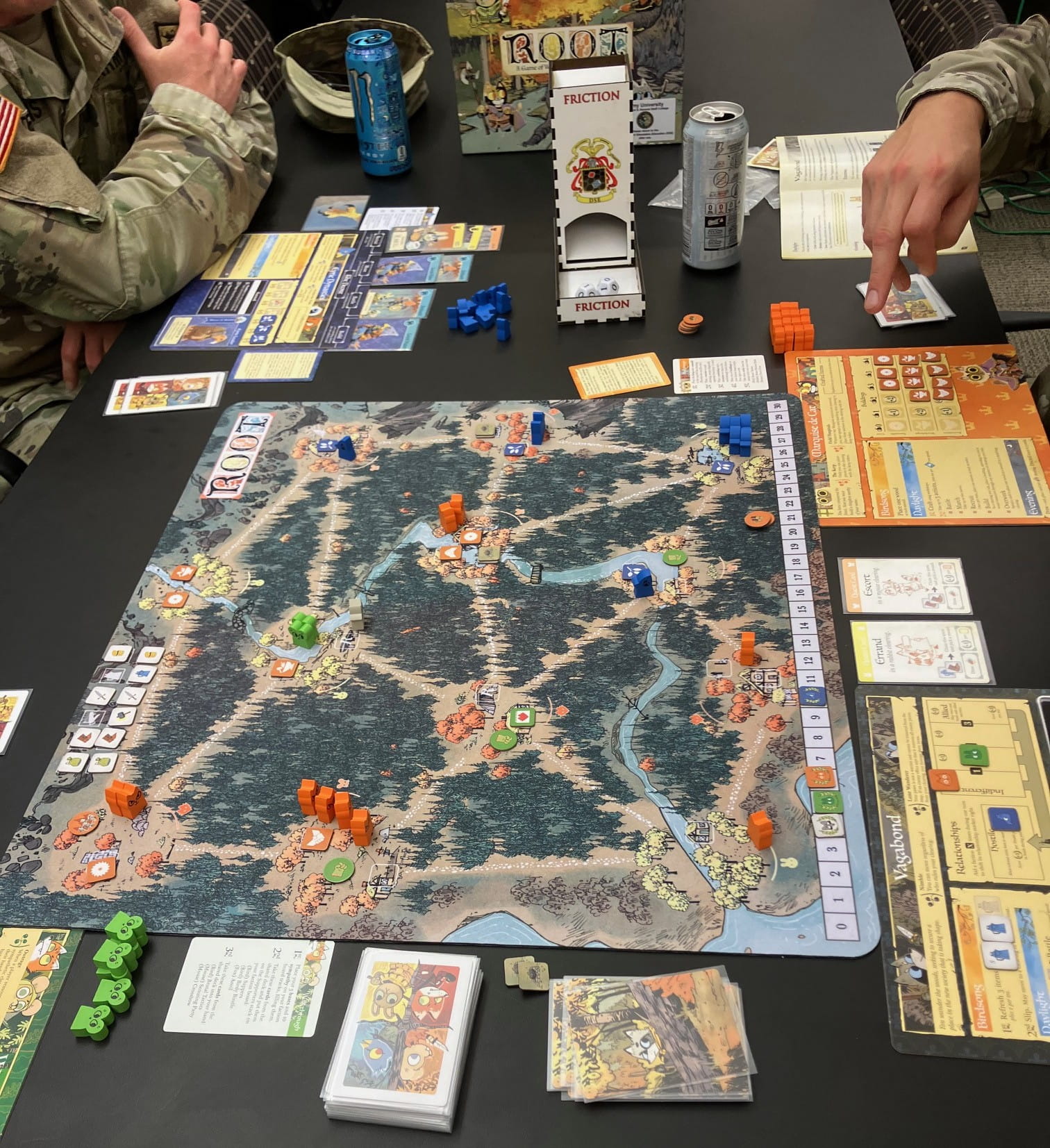

Lance, as he has done so many times as the German player, drives on Moscow in Holdfast (top) while I try to bottle up the Germans
on the other board playing the Soviets. Other teach-and-play games included (middle) the thinly-disguised insurgency game Root, and (bottom) a rousing game of Rebel Fury that would make Mark Herman proud!
The afternoon saw us playtesting in the wargame design course, and I gravitated to an insurgency game being designed by an international student officer. He taught me and my opponent how to play his game, and we provided feedback on game mechanics, along with James Sterrett, who flitted from table to table providing sage advice. I was so engrossed in the process that I forgot to get any pictures before the games were taken down!
That night, James Sterrett kindly invited Lance and I to his house for pizza and a unexpectedly competitive teach-and-play session of Race to the Rhine, with me as the British 21st Army Group (Monty), Lance as the American 1st Army Group (Bradley), and James as the American 3rd Army (Patton). The focus of the game is logistics, and keeping your armies surging to the Rhine. He was really gracious to do this on a work night, and Lance and I really appreciated it as we had not played this game before.

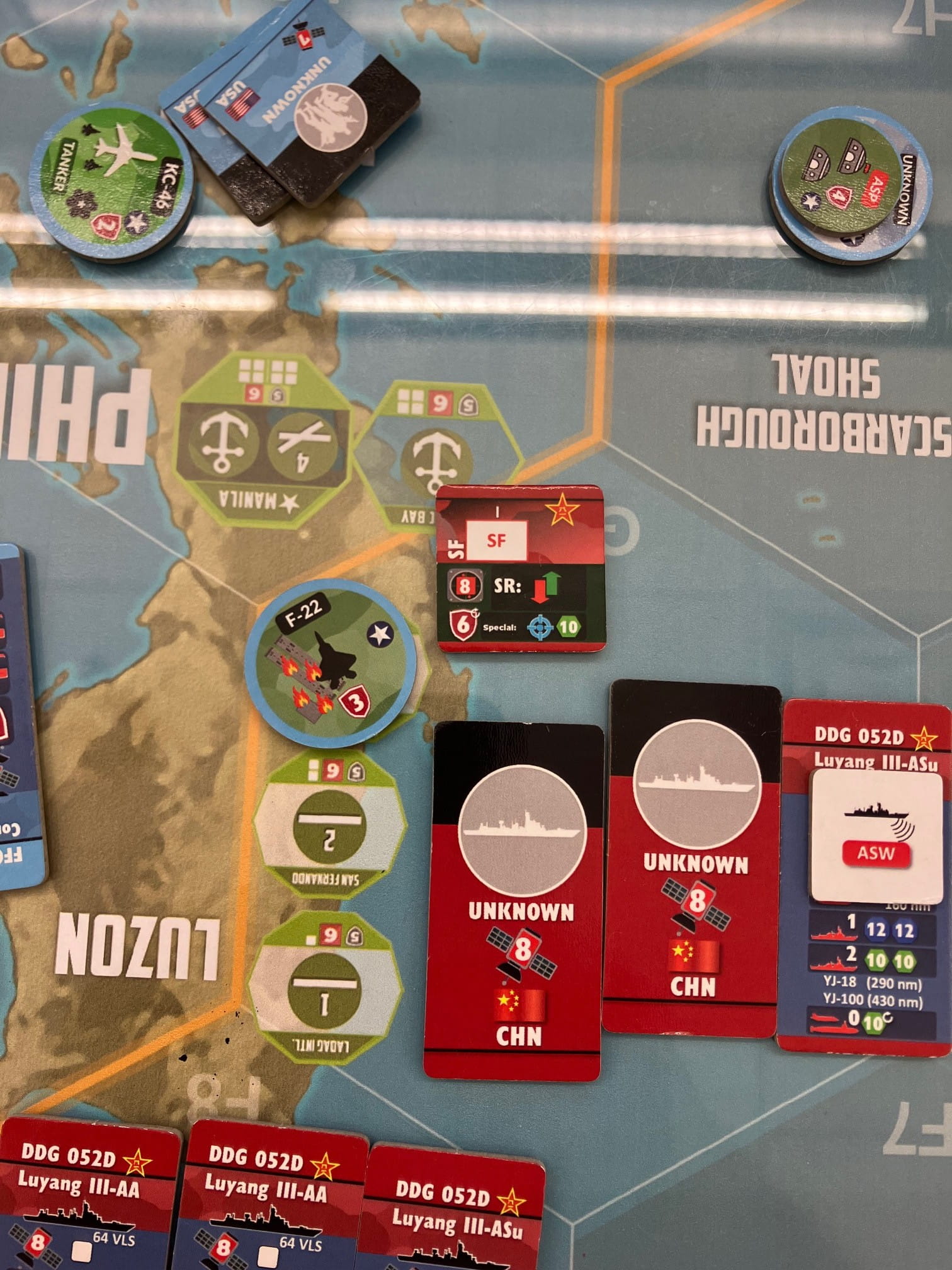
Thursday morning brought us into multi-domain operations, and this week it meant the Operational Wargame System (OWS) created by Tim Barrick at the Marine Corps University. We played a modified Assassins Mace module focusing on multi-domain combat in the region surrounding Taiwan, the Philippines, and the South China Sea. I had briefly played it once before years ago, and seen it played on a large scale at Quantico. This is a more complex game and more of a challenge to teach it to unfamiliar students who don’t have time to absorb the rules out of class. I was paired up with another student as Team China, facing off against a multi-national (U.S., Japan, and Philippines) Allied team. This definitely was a learning game to figure out the sequence of play and what dice are rolled to resolve each action, and the students caught on quickly.
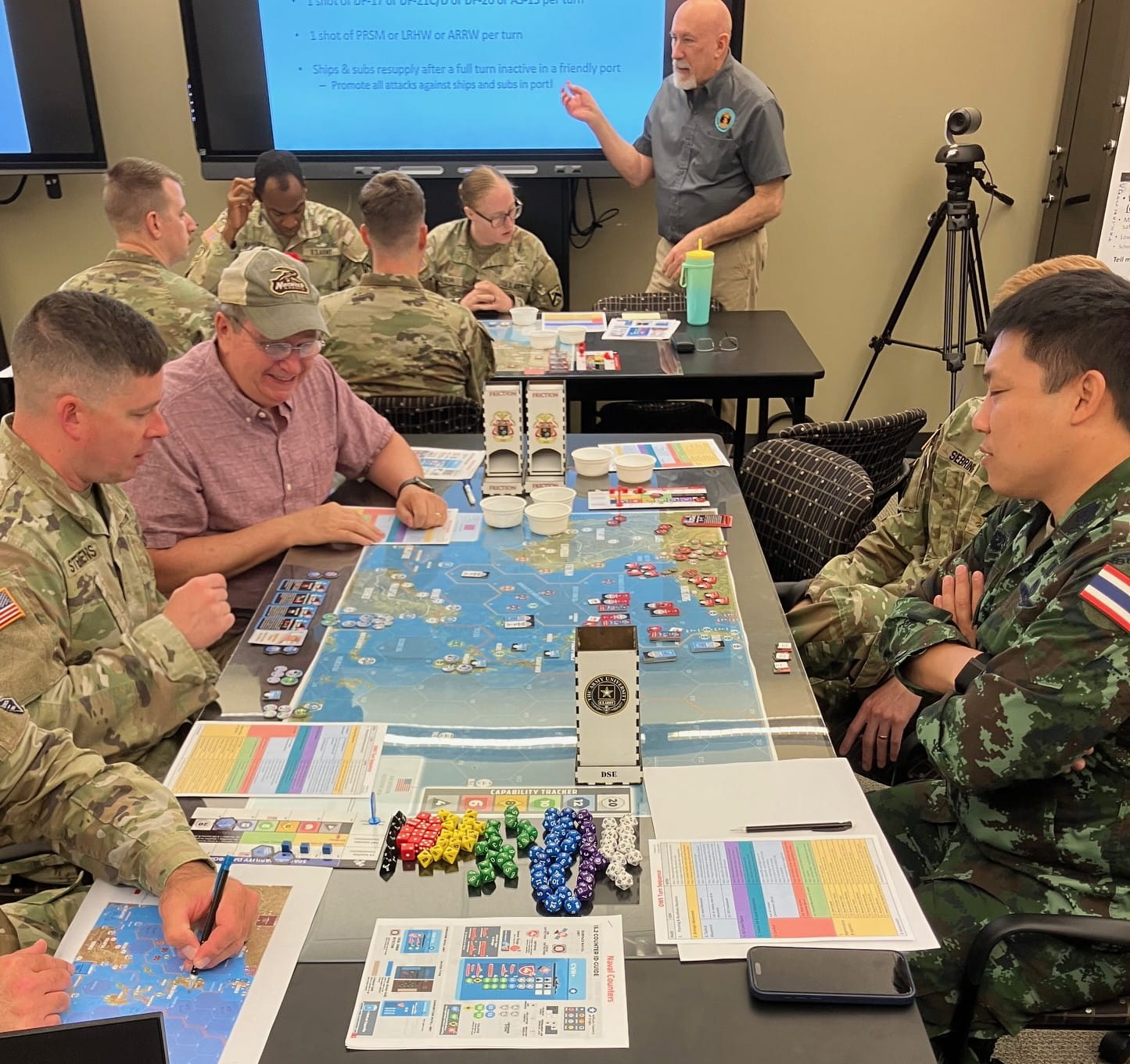

My friend Lance and his team try and figure out the game (top) while my team (bottom) hides our subs while searching for the U.S. aircraft carrier.

All-in-all, experiencing wargaming with seasoned professionals has enticed Lance and I to return to Leavenworth at some point (we still need to take that last class!). I want to thank James, Mike, and Mark for their hospitality for taking on a couple of retired Army grognards and teaching us some new tricks. I wish them and their students luck, as the students that go through their classes and others like them are potentially our future commercial wargamers as well. Follow IDAC activities on X via Mark Greenwald.


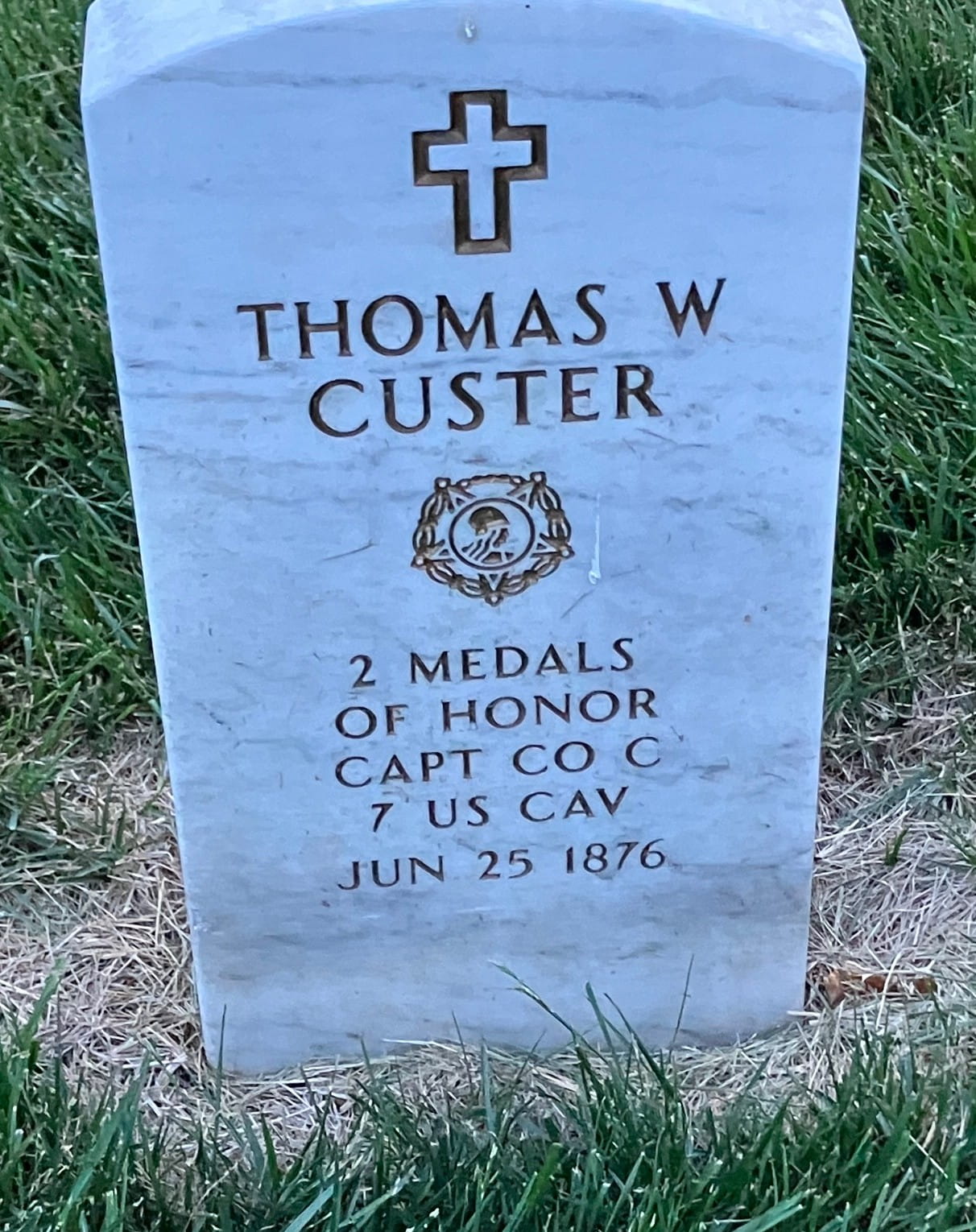
Some other random pics of just a few of the many interesting things we did at Leavenworth: (L) the tower at the WWI Museum;
(C) I got to sit at McArthur’s postwar desk (no, that’s not his computer);
(R) yes, he’s a long way from Little Big Horn in the Leavenworth cemetery.
You can chat about this article in the Professional Wargaming section of our discussion forums
Thank you for visiting the Regiment of Strategy Gaming and riding with The Armchair Dragoons.
Rather than list a bunch of social media links, the easiest thing to do is to check out our LinkTree, which connects you to all of our various locales around the web.
You can also support The Armchair Dragoons through our Patreon, and find us at a variety of conventions and other events.
Feel free to talk back to us either in our discussion forum, or in the comments below.