
 by
by Keith Tracton, 4 June 2026
I received a promo copy of TS’s Holland 1944-1945, part of their WB 95 system. This game covers the northern half – the “other half” – of the Battle of the Bulge in December of 1944 in Holland. The action is in the seam between the more northern British sector and the American sector immediately to its south covering the great city of Maastricht and the Meuse river crossings there. The Germans threw several panzer divisions at that seam, intending a crossing of the Meuse river.

click images to enlarge
The physical components are top notch: rounded counters that pop out of the sprues; good quality scenario and setup cards in full color, and a map depicting the area around Maastricht at the time.
Full disclosure: this is two tales, one of the journey to translate the rules and charts and tables; and a short after action showing how fast-playing and fun this game is.
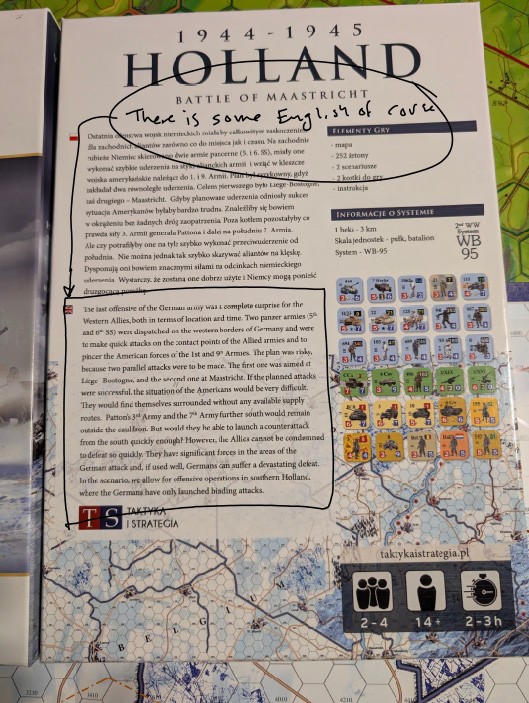
It is worth noting that Taktyka i Strategia (TS) has gone to great lengths to ensure accessibility for English-speaking players. They provide an English version of the rulebook, a translated description of the Maastricht campaign on the back of the box to inform buyers, and English text on the scenario cards, particularly regarding Victory Points.

I dove right into the printed rulebook to see what I could see and – WHAM! – it was, of course, in Polish. OK, I knew that going in, and having located an English translation from the publisher, proceeded to try and get the game concepts down and see how far i could get. The translation was less than perfect, which is more than forgivable as it was designed in Poland for Poles to enjoy but there is a large market for games which can be accessed in multiple languages, including English. Which is me.
So here I am faced with a translation that I am dying to do a more polished edit of (I am just that way) but – of course – I don’t speak Polish and so making sure I am refining the text of the concepts of the game properly into English is problematic, as I have no way of making sure they are correct except the internet which can be problematic as well. More on that later.
To my mind, translation to English (or any language) is a bit of a chicken-and-the-egg syndrome for wargame designers and publishers, as far as I am concerned. For English: you have to find someone in your native country who speaks your language and can translate to English; then you publish that English translation; and someone who speaks that language natively (in this case English, like me) will look at that and want to make it more colloquial and consistent in terminology. And of course the trick is that how do you find someone who speaks English natively but who doesn’t speak Polish, and have them contact the person on your side who speaks both Polish and English in order to refine the English to something that’s easier to comprehend. Then there’s the issue of labels on the charts and tables which need to be translated as well but in most rules translations are not. (There’s no translation of them in the English version of the rules.) It’s nice to know that there is a combat results table but knowing what the headings are is kind of important when there’s column shifts involved.
All this is to say that there are a myriad of issues that I see being addressed but I just needed things to be accessible enough so I could play the game. Yes I could ask the internet, but this was an exercise in how to do it as many solitaire players must: on my own. It turned out to be an interesting exercise.
As I have seen other reviewers and bloggers who address games in other languages, yes, the process of accessing the non-English aspects of the game did involve AI. I used the Google Lens button on an Android phone and pointed the camera in the phone at the page or table or paragraph I needed. Google Lens recognizes you may want to translate the text and, once you have confirmed you want that, displays the translations right on the image.

The result does look a bit like a kidnapper cutting and pasting different size text to a ransom demand note, but it does work, not perfectly, but functionally.


This proved MOST helpful for the tables. Below is the translated Terrain Effects Chart:

Now I was off and running!
Game setup is graphic and easy. It was a little messy (again, I am just that way, always working fast!) but it took maybe 20 minutes to place all the counters on the Allied and German setup charts for the scenario I selected (Watch on the Roer!). And another 15 minutes to deploy them to the map (and I took some photos too).


Below, the Germans are set up and I have highlighted the 3 ½ Panzer Divisions set to crash through to Maastricht. The Germans want to cross the river from positions forward of the Seigfried line; the Allies want to kick them back as far behind the Seigfried line as possible.


The battle unfolds tomorrow!
You can chat about this game in the Modern World section of our discussion forums
Thank you for visiting the Regiment of Strategy Gaming and riding with The Armchair Dragoons.
Rather than list a bunch of social media links, the easiest thing to do is to check out our LinkTree, which connects you to all of our various locales around the web.
You can also support The Armchair Dragoons through our Patreon, and find us at a variety of conventions and other events.
Feel free to talk back to us either in our discussion forum, or in the comments below.


