
 by
by RockyMountainNavy, 20 April 2026
Italy ’43: Fifth Army’s Advance to the Gustav Line designed by Mark Simonitch and published by GMT Games in 2025 is a bit of an oddity to me. As another entrant in the Mark Simonitch’s 1940s series of games from GMT Games, Italy ’43 uses “series standard” rules for ZOC Bonds1, Determined Defense2, Extended Movement, and a Combat Results Table (CRT). All of which makes Italy ’43 appear to be “just another Simonitch ZOC Bond wargame.” In reality, however, Italy ’43 is a very different ZOC Bond wargame, both a little less and a little more than I expected.
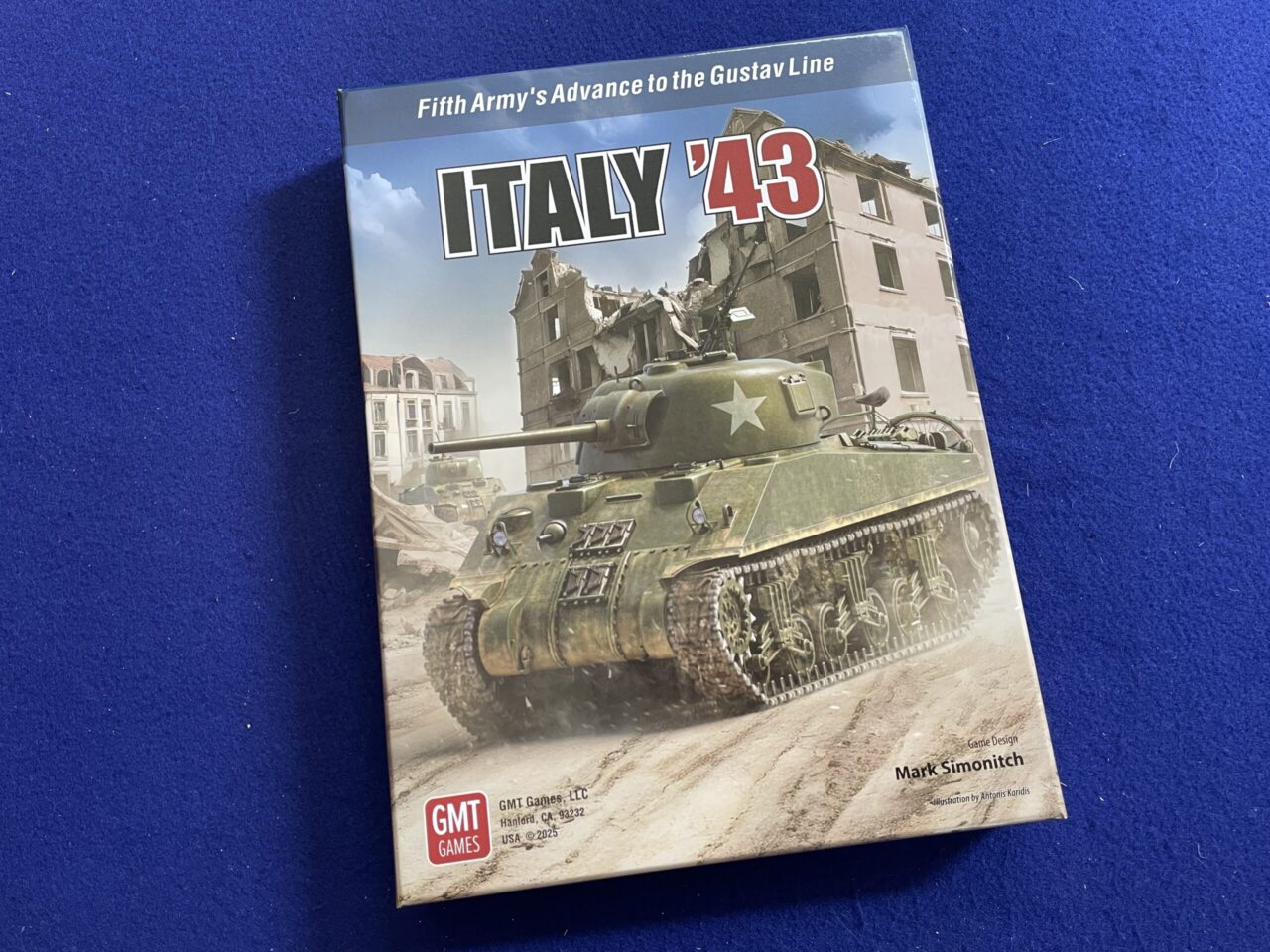
“Abandon all hope, ye who enter here”
That is the subtitle of the first paragraph of the Play Notes in Italy ’43. As the paragraph continues, “Be prepared for a grueling campaign of little movement and low odds attacks” (Play Notes, p. 24). To be honest, that game description does little to make me excited to play.
Yet, I pressed on. It was perhaps a short paragraph in Tug of War: The Battle for Italy: 1943-45 by Dominick Graham and Shelford Bidwell (St. Martin’s Press, 1986) that got me wondering a bit more about the campaign:
Seen in distant historical perspective the fighting in the last three months of 1943 [Italy ’43 plays Oct 1 – Dec 31] seems no more than an entr’acte between the excitements of the landing in September [see Salerno ’43] and the sequence of long-drawn-out and bloody battles to breach the Gustav Line in 1944, but that is not how they appeared to those who took part. Veterans of the Western Front declared that – though the scale of events was far smaller and battles did not last as long, between the intensity of the fighting, mud, and the severity of the winter – Italy was almost as unpleasant as Flanders or Picardy. (Graham & Bidwell, pp. 113-114)
Little Italy in a box
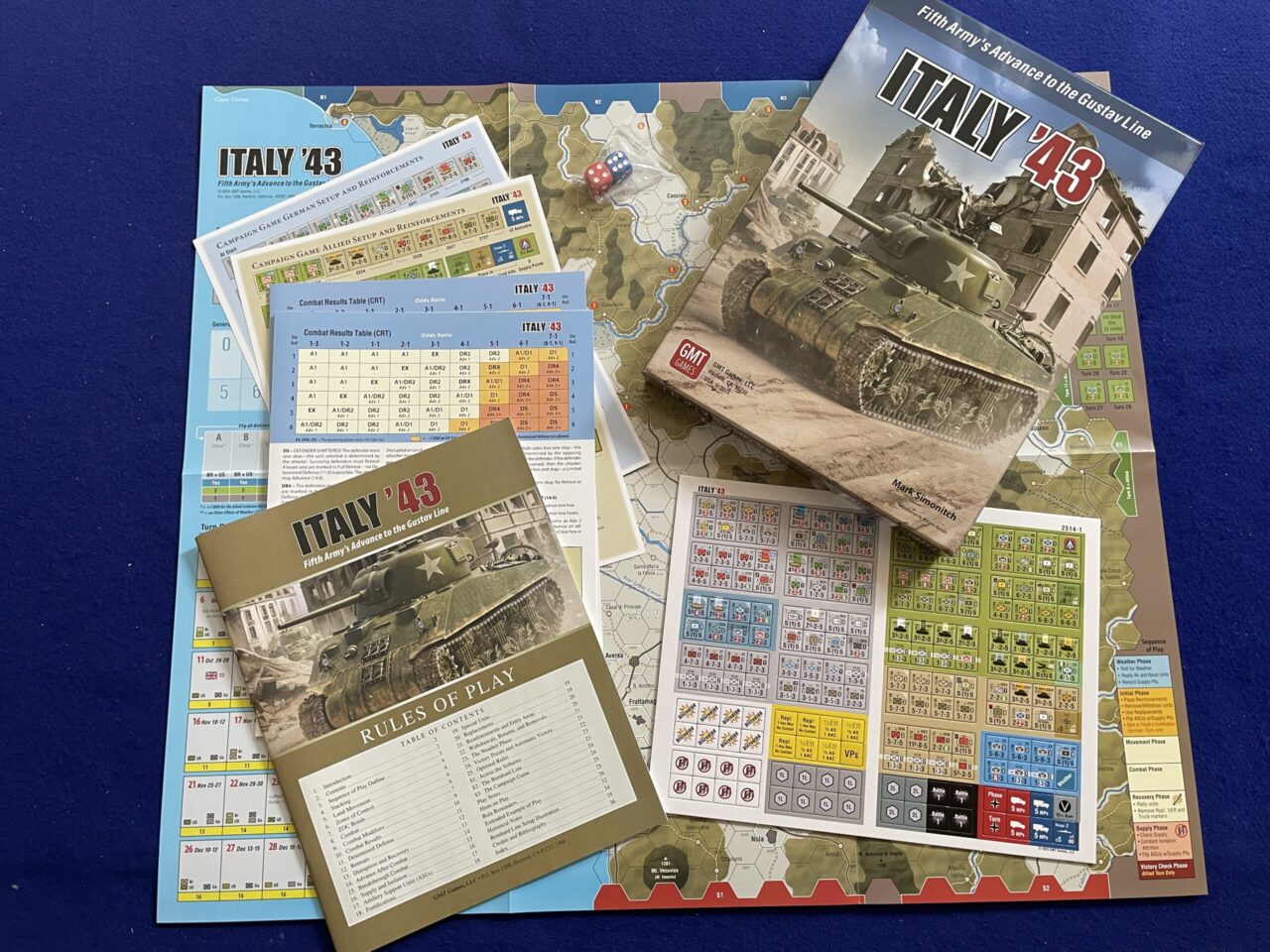
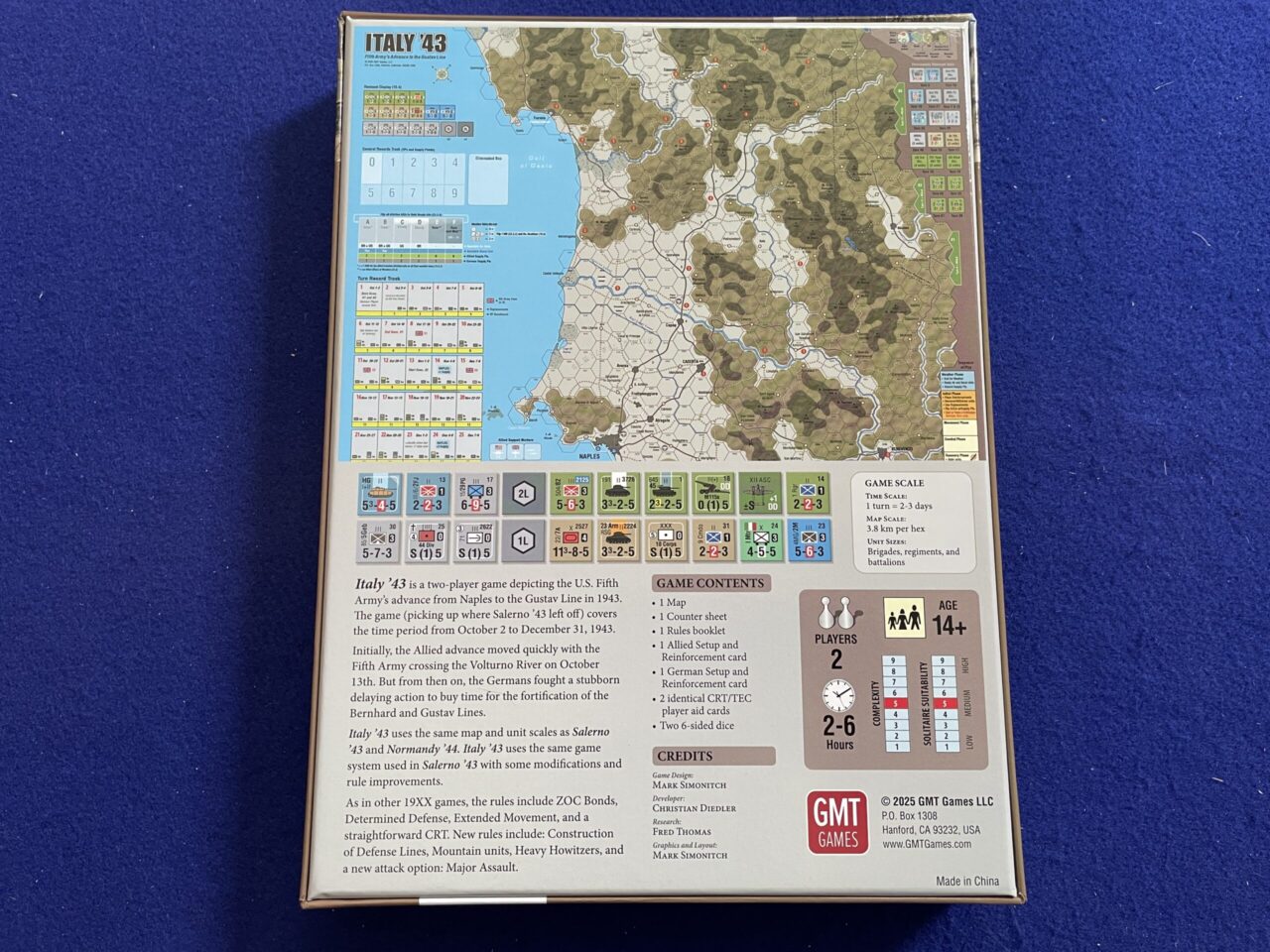
Italy ’43 ships in a standard GMT Games 1.5” deep game box. That is a little less than I expected as seemingly most ‘4X wargames recently are getting the “deluxe” box treatment with bigger boxes. When I pulled the contents of Italy ’43 from the box, I was struck by, well, how little is actually in there. I seriously wonder why this was not a magazine game or packaged as a folio. Then again, that is not the GMT Games way.

The contents of Italy ’43 are little more than:
-
- One (1) paper-fold map measuring a mere 25.5” x 22”
- One (1) counter sheet with a mere 192 counters (9/16” each)
- One (1) rulebook of 36 pages in full color (but not glossy)
- One (1) double-sided 8.5” x 11” Allied Setup and Reinforcement Card on slightly heavier cardstock
- One (1) double-sided 8.5” x 11” German Setup and Reinforcement Card on slightly heavier cardstock
- Two (2) identical CRT/TEC player aid cards (11” x 17” folded with four panels)
- Two (2) d6 (red and blue)
- Several baggies for counters
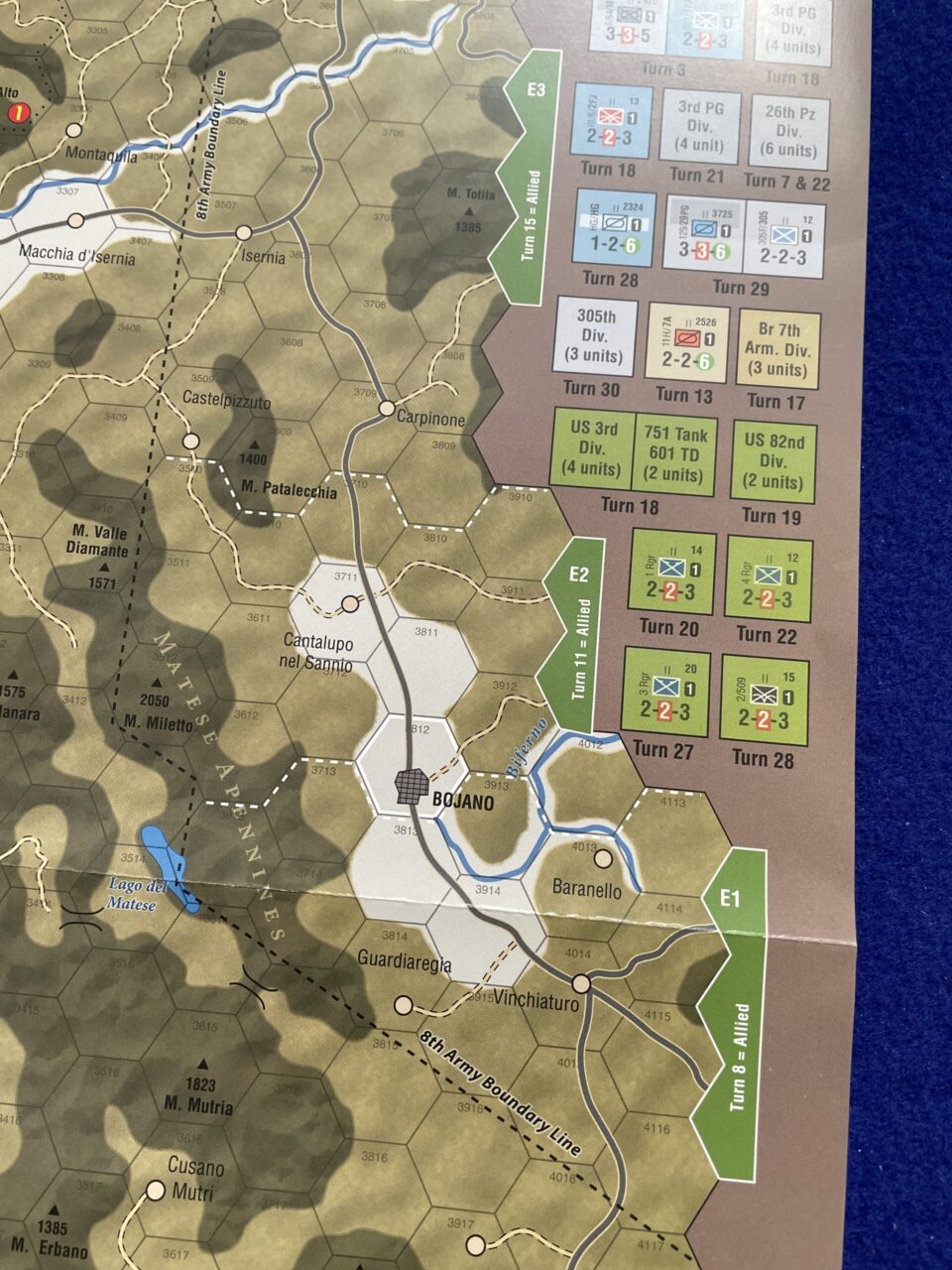
The map for Italy ’43 has both the game map and tracks for use during play. The “battlefield” portion of the map is the central and right (east?) thirds of the map; the “western” third of the map is devoted almost exclusively to game tracks. By the way, a section of the far eastern side of the map is marked, “8th Army Boundary Line.” This area is out of play for the Allied player as the British 8th Army advance is handled by fiat [see 5.8 The 8th Army Boundary Line]—a little rules wrinkle I was not expecting. All told, the map in Italy ’43 has a little less battle space than I expected on a map that is already a little less in size.
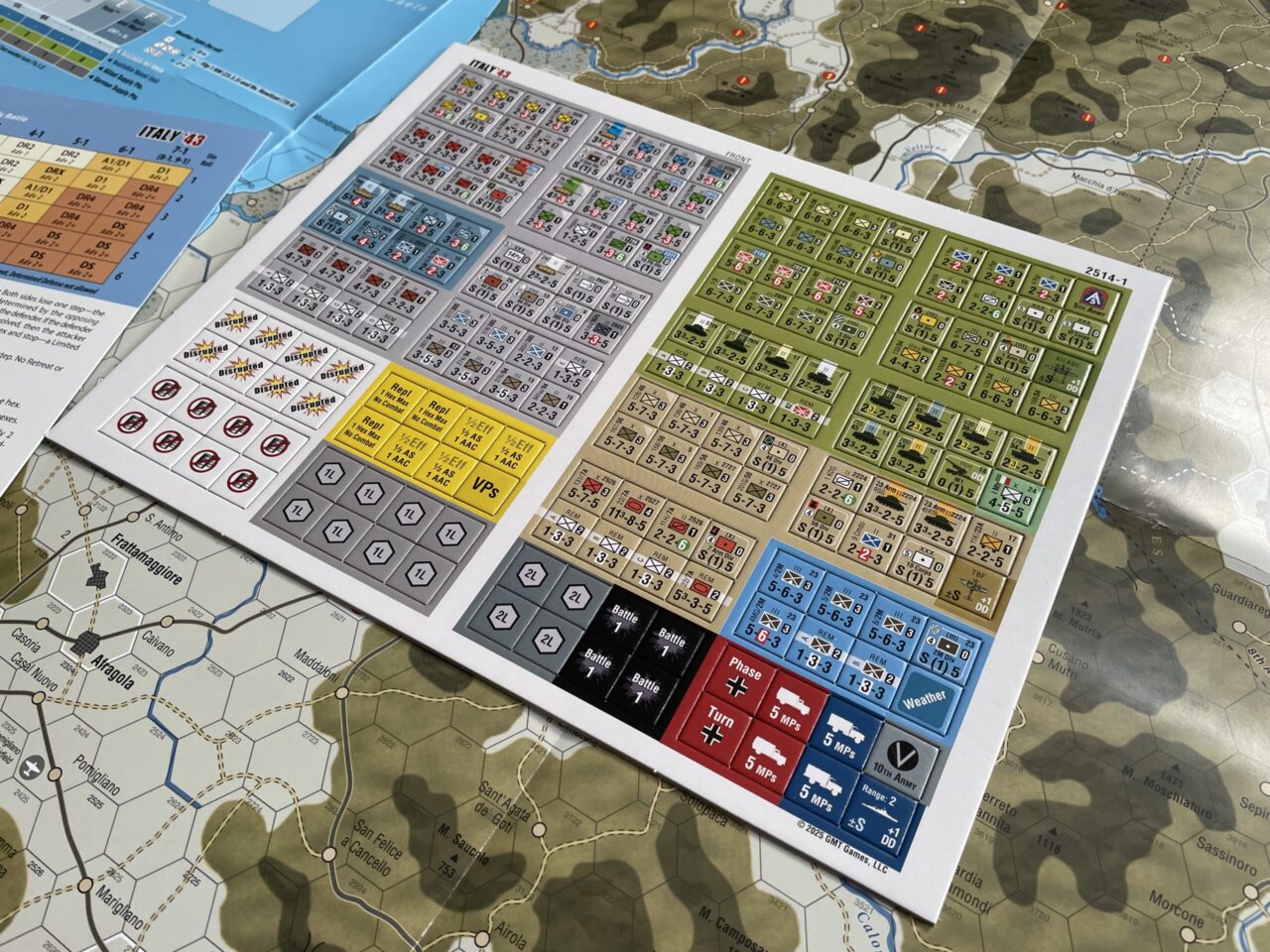
The counters in Italy ’43 portray forces that are a little less than I expected. While the unit counters are scaled to represent Divisions-level formations using Brigades/Regiments/Battalions the German player has a mere 64 unit counters; the Allied player gets slightly more kit with a mere 79 unit counters. Still, this wargame has far fewer counters than I assumed (proving the adage…).
The rulebook for Italy ’43 is 36 pages but that is a bit deceptive. Unlike many GMT Games titles of recent times there is no separate Playbook for Italy ’43. Of the 36 pages in the rulebook, 22.5 double-column pages are used for the rules of play and a single page (two columns) is used for the three (!) scenarios. The remaining pages are devoted to one-page of Play Notes, a half-page for Hints on Play, a six-page Extended Example of Play, three-pages for Historical Notes, and two-pages for end matter and an Index. All told, that makes the rulebook seem a little less than what I expected.

Little more rules
As the GMT Games website for Italy ’43 explains, “Italy ’43 uses the exact same map and unit scale as Salerno ’43 and Normandy ’44. Italy ’43 uses the same game system used in Salerno ’43 with some modifications and rule improvements.” For those familiar with Salerno ’43, the few new rules in Italy ’43 include: construction of defense lines (18.1 Building Fortifications), Mountain Units (19.3), and a new attack options of Major Assault (25.1 Major Assaults). Oh yeah, in an addition that certainly is not little, a new unit type—Heavy Howitzers (19.4)—is introduced to showcase the US Army’s 8-inch howitzers of the 194th and 995th Field Artillery Battalions.

Little odds
Although the Combat Results table (CRT) in Italy ’43 is odds-based and squarely centered on the “mystical” 3:1 odds ratio, the rulebook warns that players should expect most attacks to be at around 1:1 odds. As the Play Notes make clear:
It’s a 1-1
Due to the limit of 20 Defense and 20 Attack Strength Points in each combat almost all Allied attacks are going to be 1-1 attacks with possible shifts to bring the final odds higher. All the German player has to do is put 6 Defense Strength Points in a Hill hex (and there are plenty of Hill hexes) and that doubles to 12. Even if the Allies bring the maximum 20 Attack Strength Points against the hex the CRT odds will only be 1-1. So CRT column shifts are extremely important to getting good odds in an attack. (Rulebook, “Play Notes”, p. 24)
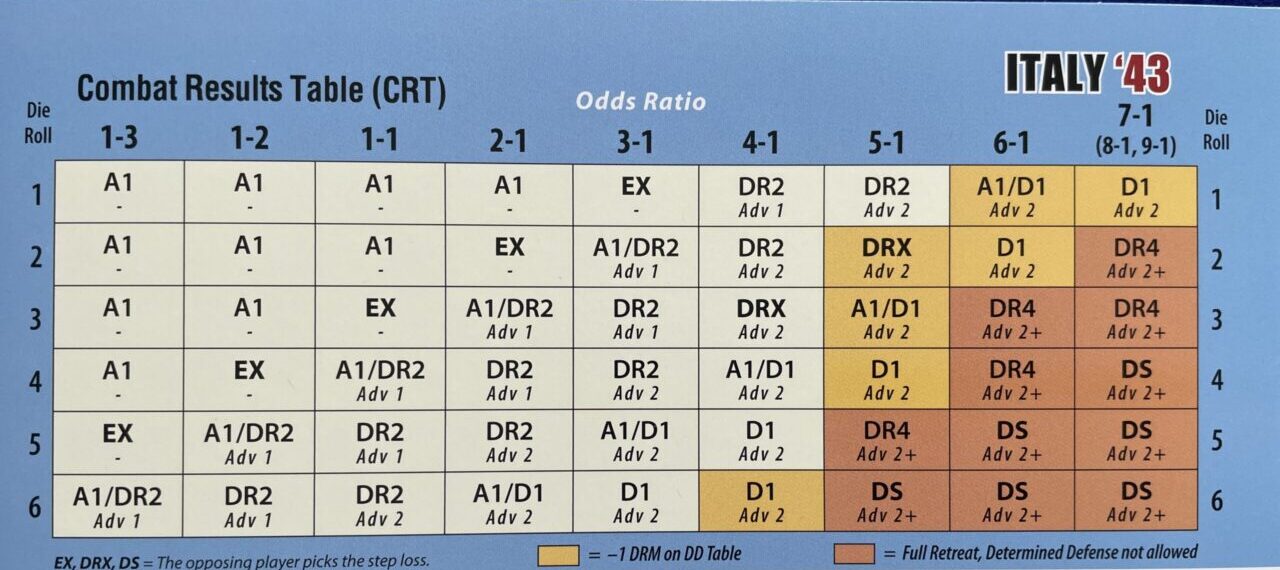
Therein lies the real secret to playing Italy ’43; combat in this game is not just the little matter of comparing attack to defense factors, but a game of little column shifts on the CRT. While there are times that attacking or defending factors are halved, they have little impact as compared to the column shifts. Further, there are only a few little ways for the attacker or defender to make a column shift. Often players will find the shift they have will get cancelled by their opponent. That is more than just a little frustrating.
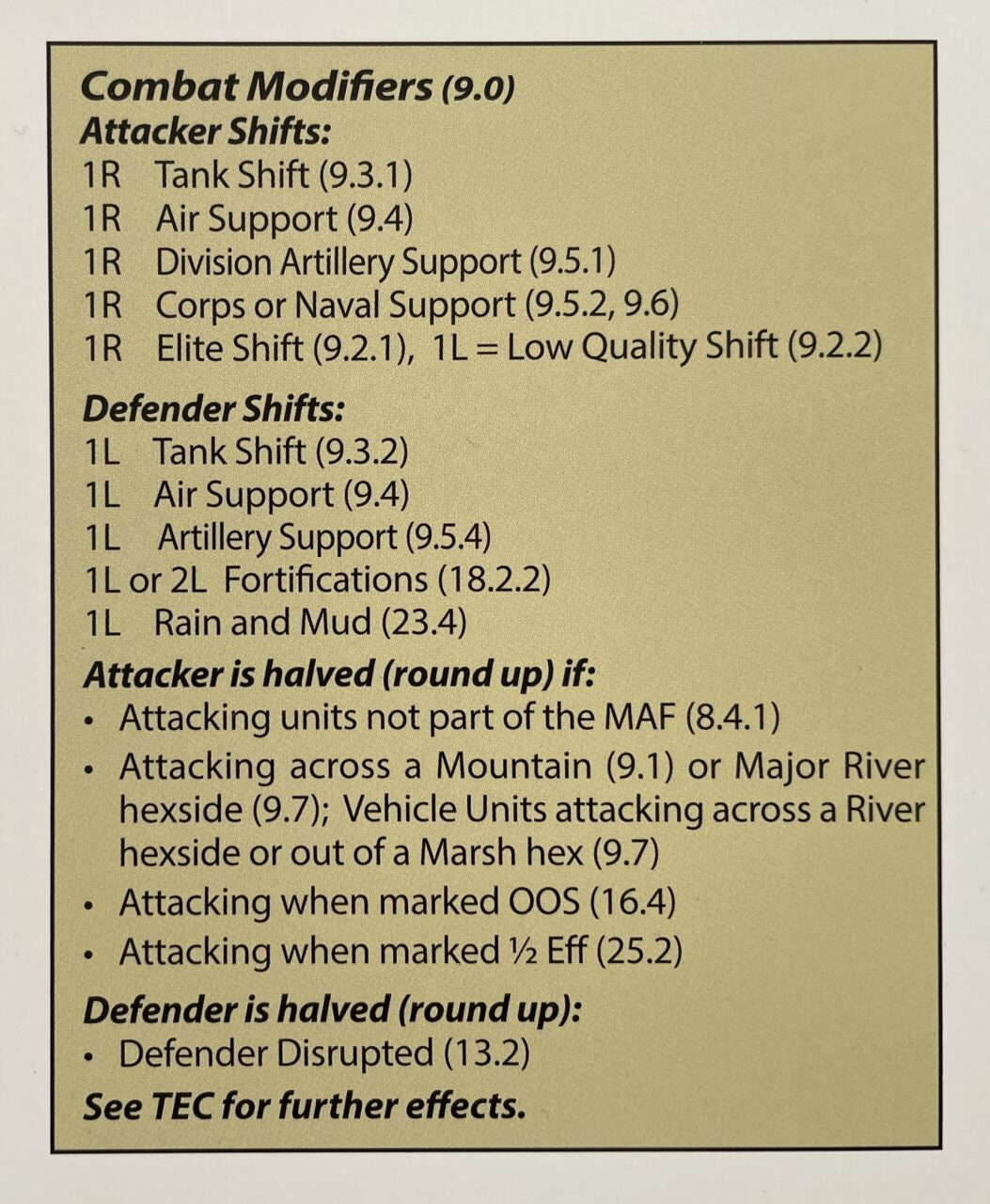
[This raises a few questions in my mind. I noticed in other ‘4X series games the 20 factor limit but did not really think about it. Now I find myself asking, “Why”? Does the factor limit have a basis in reality or is it a game mechanism for balance? Sometimes, it is the little questions that make one ponder the most.]
Yet, a little more
While Italy ’43 is a relatively little game compared to some of the ‘4X series, this wargame with a smaller footprint delivers huge challenges. Victory in Italy ’43 is determined by Victory Points (VP) and VP are gained (or not) mostly through the control of VP hexes or for elimination of certain Critical Units (see 21.1.2 VPs for Critical Units). This makes Italy ’43 a little bit of an area control game. The rules for Benchmark Numbers (24.2.1) also forces the Allied player to keep pressing; fall too far behind expectations and the German player automatically wins. As a Design Note for the Victory Conditions in the Campaign Game (S3.2) notes, “To win, the Allied player will need to take at least one hex of the Gustav Line. Historically, the Allies controlled only 17 VPs by the end of 1943, so this game considers the historical outcome a German victory.”
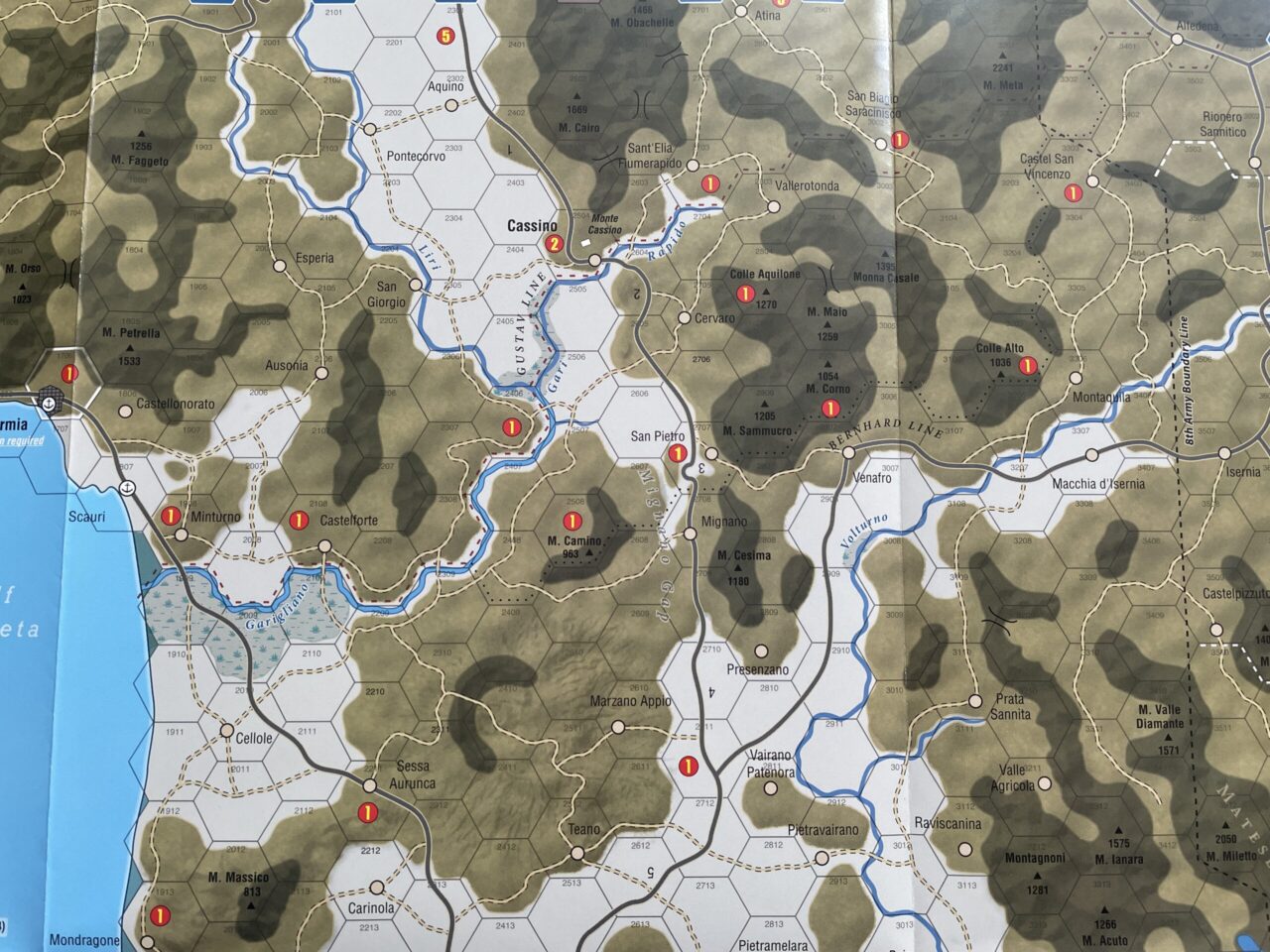
The real challenge in Italy ’43 is taking those VP hexes. Though the map area seems small as the attacker you never seem to have enough units to get that breakthrough. As the attacker one must accept—and plan for—a slow, plodding-yet-steady, attritional fight. As the defender you need to keep a wary eye on the terrain and how to add those valuable defending column shifts, especially if the attacker has not organized their force to maximize their attacking column shifts. This (refreshing?) need to consider you force beyond a simple attacker-defender comparison paradigm is a little more than I expected—but welcome.
To a point.
Italy ’43 does a great job of recreating, as it promised up front, “a grueling campaign of little movement and low odds attacks.” In my play of Scenario S1: Across the Volturno which starts on Turn 1 (Oct 1-2) and ends after Turn 7 (Oct 13-14)—and demands the Allied player score at least 7 VP to win—I found my own play not that different from the historical record as related in Tug of War:
On the Volturno front General Clark’s hopes of a rapid advance and a crossing of the rive on the run over a broad front were dashed by October 9 [Turn 5]. To force the passage of a large river is a difficult enough operation when the attacker has every advantage, but on the lower reaches of the Volturno where the 10th Corps had to cross, the river was one hundred yards wide and six feet deep, and flowed at four to fives miles an hour [see 5.5 Effects of Rivers on Movement, esp. sub-bullet 3 for crossing Major Rivers], and the approaches, soon converted to deep mud by the passage of vehicles, were sown with mines. (Graham & Bidwell, p. 116)
Even as I completed Scenario S1 and continued onto Scenario S2: The Bernhard Line (Nov 1-2/Turn 13 to Dec 30-31/Turn 32) my play still had little rhymes with history:
On the Volturno, it was not until October 24 [Turn 10] that the advance could be resumed along the whole front because Fifth Army had not the means to press the enemy closely. Then exhausted infantry had to forget about rivers for the moment and think about mountains [see 5.5 Mountain Hexsides and Movement]. At last, in November it came up against the Bernhard Line [see 18.0 Fortifications]. (Graham & Bidwell, p. 117)
The Campaign Game of Italy ’43 is 32 Turns long. In a design where the historical outcome is a German Victory I guess I should be a little excited that scoring more than 17 VP is better than history; but with 38 VP on the board it feels…a little unsatisfactory.
[Interestingly, the “playing time” assessment for Italy ’43 is 2-6 hours according to the box back. Salerno ’43 is likewise rated at 2-6 hours, and Normandy ’44 is rated at 7 hours. Given the “little game” approach in Italy ’43 I would expect it to play in a lesser amount of time, but even if one plays a complete turn in 10 minutes that is still 70 minutes for Scenario S1, 200 minutes for Scenario S2, and 320 minutes—over five hours—for the Campaign Game. Aside from Scenario S1 the play time seems…a little long to me.]
To be honest, Italy ’43 does a little too good of a job replicating history. Like the historical campaign the turns tend to plod along with “feel good” moments few and very far between. While I play wargames in great part to learn about battles and campaigns, I still want to enjoy playing it at least a little bit (and yes, defeat can be enjoyable as long as one is still learning). Italy ’43, however, gives me little excitement.
Although I may find the play of Italy ’43 to be a little bit unexciting, I nonetheless must admire the game design. In particular, in Italy ’43 Simonitch refines the combat resolution model in to get away from the classic straight-up 3:1 combat odds table and challenges players to reconsider their way of war by using column shifts. In that respect Italy ’43 is, admittedly, a little more than I expected.
So, if you are a fan of Simonitch’s ‘4X series of wargames, or as I call then “‘4X ZoC Bond wargames,” and are looking for a smaller (less expensive?) title to cut your teeth on, then Italy ’43 might be a good candidate for you. Be warned, however, that like the historical battles it portrays this is not a game of sweeping, lightening assaults but campaign of little advances over time.
You can chat about this game in the Modern World section of our discussion forums
Thank you for visiting the Regiment of Strategy Gaming and riding with The Armchair Dragoons.
Rather than list a bunch of social media links, the easiest thing to do is to check out our LinkTree, which connects you to all of our various locales around the web.
You can also support The Armchair Dragoons through our Patreon, and find us at a variety of conventions and other events.
Feel free to talk back to us either in our discussion forum, or in the comments below.
Footnotes
- ZOC Bond: See 7.1 How to Form a ZOC Bond – “Any Combat Unit without the white outline around their counter that is in Good Order (13.1.1) can form a ZOC Bond. When two such units (or stacks) are two hexes apart (with one vacant intervening hex) they create a bond between them that no enemy unit may enter or cross.”
- Determined Defense: See 11.1 [Determined Defense] In General – “The defender may attempt to cancel the Retreat portion of a CRT result by using the Determined Defense Table provided at least one step survived the combat and the Combat Result allows it. A successful result on this table cancels the Retreat, the Disruption, and the Advance After Combat.”


Thanks for the review. I’m a fan of Simonitch games, one of my favourite designers, and have played all Western Front’s (and the North Africa’s) titles (sorry, not a fan of WW2 Eastern Front battles at all). I was not sure about jumping into this specific title, but after reading your post I think I will give it a try.
To be fair, both this and Salerno and the (I think?) upcoming third game which links them all together, should have been one game. GMT either gives you great value or doles them in a miserly fashion. North Africa 41 is the same.
I don’t think GMT thought to purposely sparse the games out for profit. I think it’s more a factor of starting with the landing, and somewhere in that process, getting the interest of expanding the campaign coverage, mixed with the time and resource capacity of the designer. We may one day see a combined package. That said, Rock’s take in the game is what I expected my take to be given my passing knowledge of the campaign, so seems like I was right. And I am a fan of the designer. That said, I still strongly believe that the Ardennes 44 version and scale of the this system is the best.
A well-written review. I have not purchased or played any games in this series yet. The size of this one tempts me. Now, the challenge…read this review as a drinking game. Take a drink every time you read the word “little” and see if you can get through the entire review!