
 by
by Paul LaFontaine, 5 July 2026
We joined the Armchair Dragoons Wargames Headquarters at the Origins Game Convention with the Battle Decisions Kriegsspiel system. In this AAR we’ll look at how the system performed, its value as part of the in-person experience and future ideas for using in-person Kriegsspiel. We’re writing this assuming the reader has knowledge of how Kriegsspiel works and that the audience are umpires interested in how in-person game play works. We ran four scenarios and had 31 players join over the course of the sessions.
most images can click to enlarge
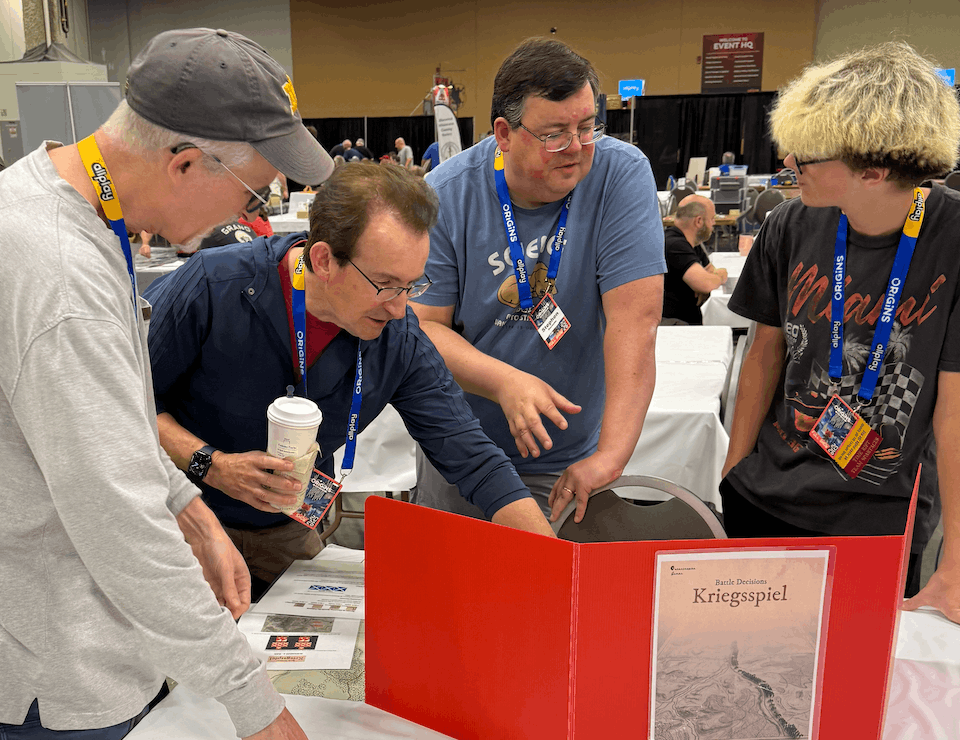
Our goals this year were to run four sessions implementing improvements from lessons we learned out of the previous live sessions at Origins the year prior and at sessions run at Georgetown University. The Battle Decisions system is tailored for in-person play. The combat system resolves rapidly and unit strengths are simplified. Umpire Steve (on left) had joined me last year and was able to help this year so we had continuity in the umpire team.

This is another of a series of Kriegsspiel AARs from our Wargame HQ at the Origins Game Fair. You can find the original article here.
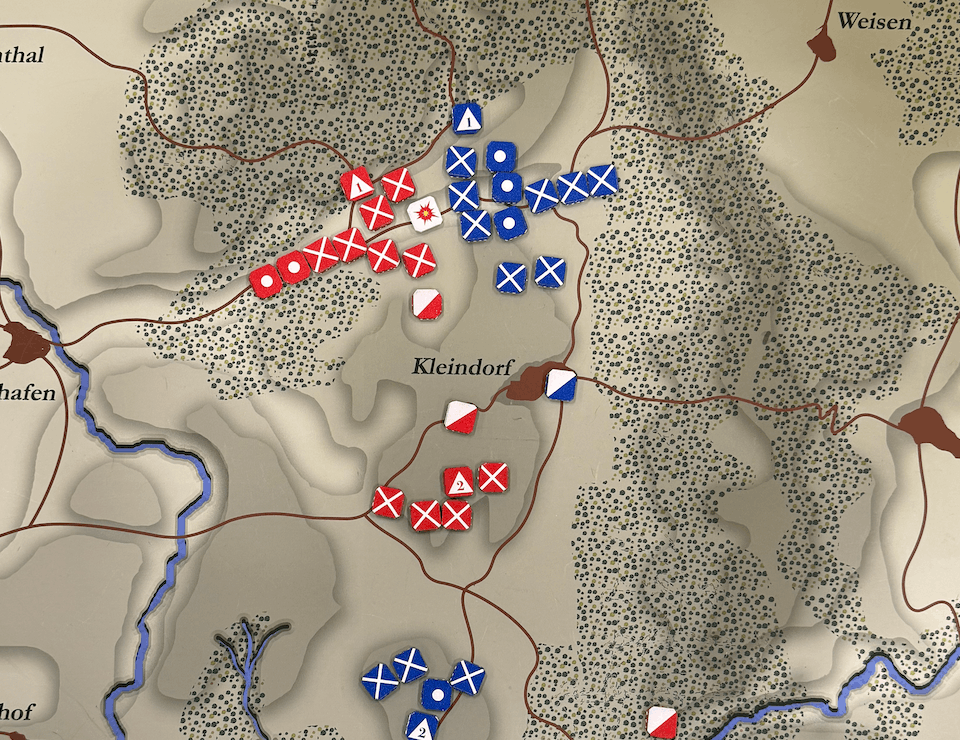
The Battle Decisions Kriegsspiel uses a common map that presents the player with the problems and historical force ratios the commanders faced. The players have to determine how to defeat a larger force, or use terrain, in a way that is consistent with the historical battle. The scenario does not replicate all the detail of the terrain and forces present. In fact, the players do not know the battle they are playing until the end of play and the presentation of the After-Action Review (AAR). This keeps players from using knowledge of the battle to mimic historical solutions.
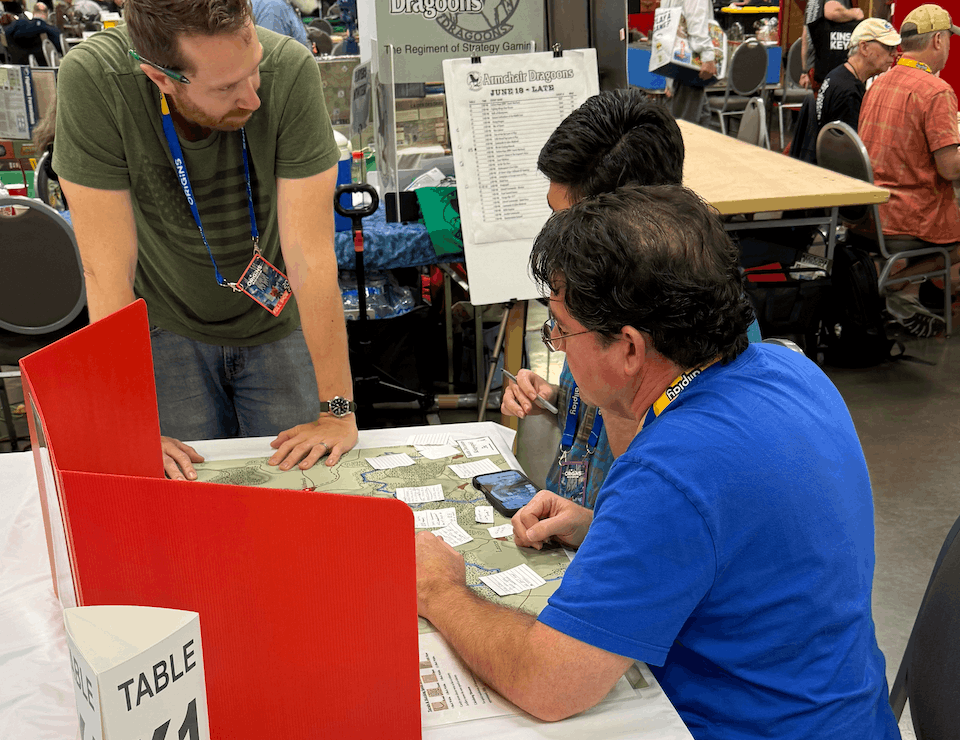
This year included players giving the umpire verbal orders while writing messages to each other on 3 x 5 cards. Previously players wrote orders and messages. Verbal orders made collection and resolution faster while allowing the players more time to compose messages to each other. This worked well in a 7-minute turn. When we moved more quickly and compressed the turn time below 7 minutes, the players did not have sufficient time to compose messages and they reported that the sequence felt “off”.
What was happening was when we were asking for orders and dispatches, they were giving orders then trying to complete the writing of dispatches, handing them off when we returned with reports of the action. This felt out of sequence. Consciously allowing two minutes for players to compose messages and decide on order rectified this problem. When we asked for orders and dispatches, they were able to give the verbal order and hand off the completed dispatch. The two-minute period added in settled the total turn time at around a 7 minute average.
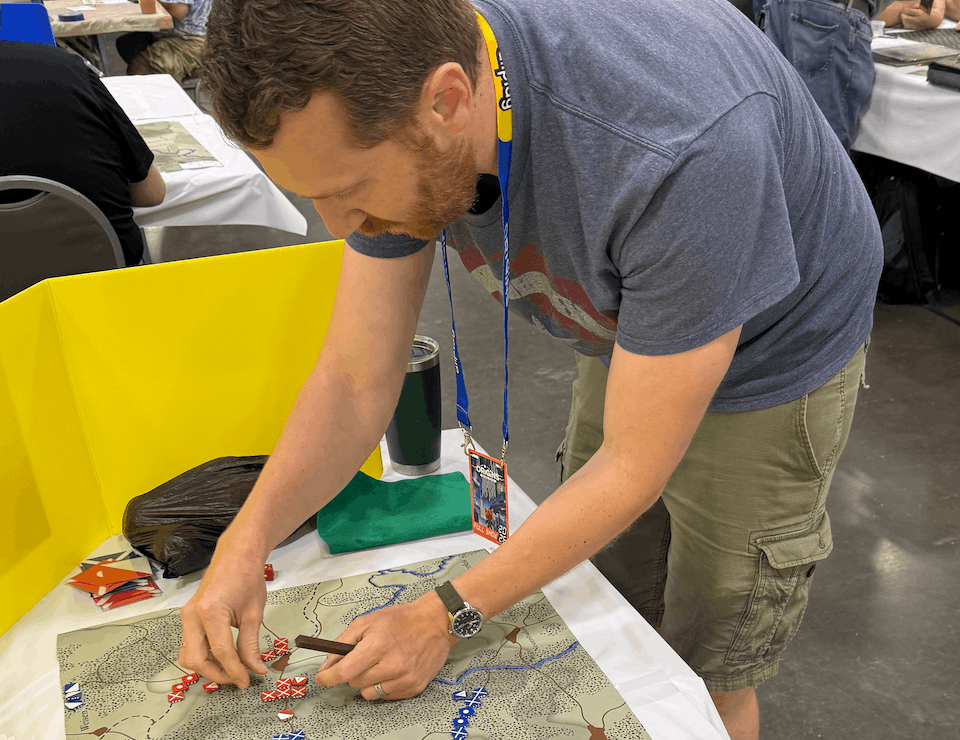
Umpires moving from player table to umpire map one at a time. In past games we moved in a circular pattern between players which forced the umpire to process all the player orders at the same time. This resulted in having to “hold” too much data as the umpire moved from table to table. To do this, we tried solutions like kneeboards carried by the umpire and single page maps for notes, which increased complexity and introduced errors.
By changing the flow to taking a single player order and then moving that player’s units on the umpire board before getting orders from the next player, the umpire map remained the source of truth and errors were far less evident. The umpire table was best situated at the center with a divider around it allowing for privacy and a short walk to all tables.
We eliminated the player position of Commander in Chief (CiC). In past iterations we had a CiC who could position himself at different tables and this created more communications. It tended to override player ability to make decisions as they would wait for the CiC to return with news from the other table and instructions. By separating each command into two wings and having them be independent, each player table had full control over their forces throughout the game. Players reported enjoying this much more than the previous year’s “roving CiC” model.
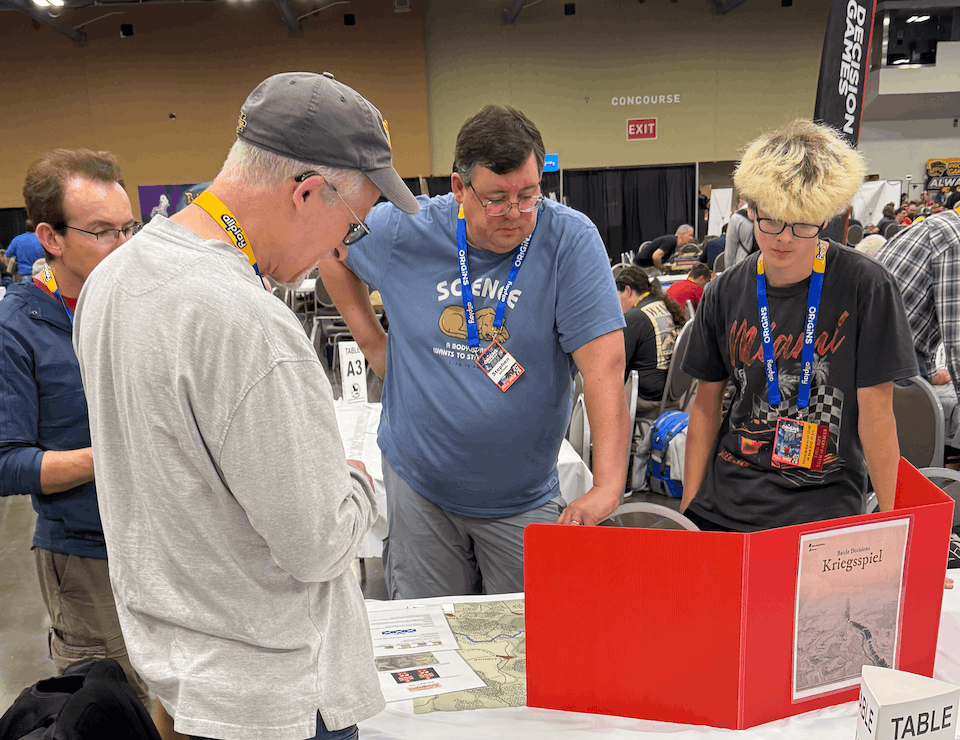
Fast combat resolution was a success. The shortest game was 8 turns due to the majority of units coming into contact early and fighting their way to exhaustion as quickly as they could. In the sessions where there was maneuver before contact, the game ended at 10 turns. The utility of a system with scenarios that end in a predictable 8 – 10 turn range gives the umpire assurance that he can steer the experience. Seven-minute turns give a 56 – 70-minute play time. With a 30-minute orientation and planning session beforehand, and a 30-minute AAR after play, that gives the umpire the confidence he can deliver a two-hour experience that is entertaining and complete.
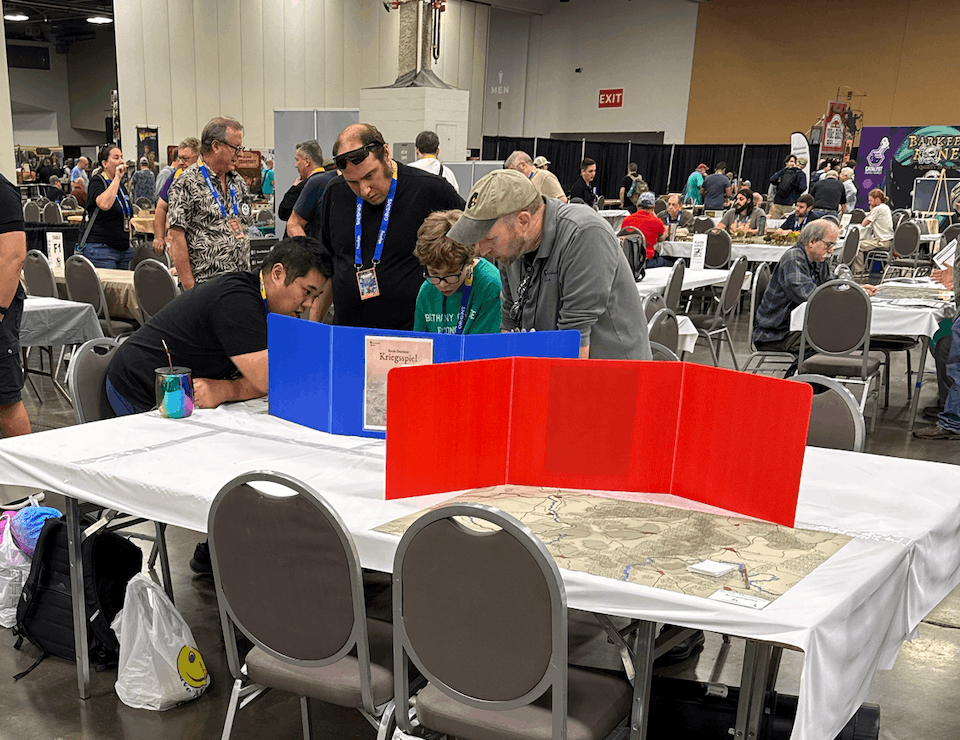
Umpires were each responsible for 2 player tables. Originally, we had a resolution umpire who took orders and moved the units, and a communications umpire who moved dispatches. We found a superior solution was for each umpire to take two player tables each and handle both orders and dispatches. Both umpires would come together and resolve on the umpire board, which created a conversation and “co-resolution” such that both umpires knew what was happening across the board. This was much more fun for both umpires.
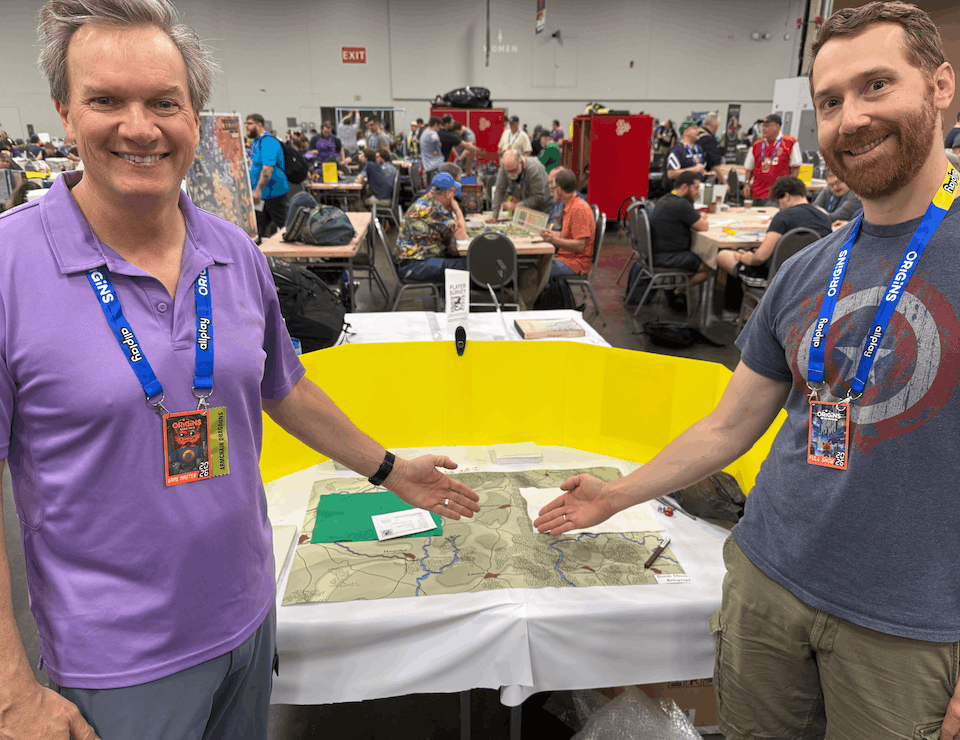
The best player numbers are between 4 and 8. With two umpires, this entertains 6 – 10 people. Having each player station trying to discern enemy action and also trying to understand what friendly forces were doing makes for a nice level of tension. When one player controls an entire force it dramatically reduces the number of moving parts. With four players each table has one player. Additional players add individuals to tables. Two people per table made for spirited conversation, a division of responsibility and plenty of gameplay tension.
We made simple, large, laminated pieces for the AAR. This worked very well. It gave players something to place on the map and move around, which all seemed to do easily. The description of decisions and movements were animated by the placing of large, easily seen, pieces.

Looking ahead, there are several takeaways.
The two-hour format nests very effectively inside a larger event. In this case, the larger convention set of events with the Armchair Dragoons was the context. Battle Decisions games are good for conventions as they play in an afternoon or evening. An alternative format would be a combined battlefield visit and play of the battle. A group could do a terrain walk of a battlefield, play a scenario of that battle, then tour the battlefield as part of their AAR. We will test this in September with a group we are taking to Shiloh.
The game being used is Battle Decisions: Kriegsspiel from Catastrophe Games.
Larger groups can be accommodated by an additional umpire and two additional tables, splitting each force into three or four parts. This could take the capacity up to 16 players and 4 umpires. Though this would take some testing for balance, the Battle Decisions system could resolve fast enough to handle these additional tables.
In-person Kriegsspiel allows for social interaction. Online the experience of other people is abstracted behind avatars and screen names. At Origins, I recognized people who had played last year and greeted them with a handshake. This cannot be replicated online. For the niche of the in-person experience inside the niche of Kriegsspiel as a game format, we think we have a stable system for future in-person events.
We’ll see you out there.
If you’d like to join one of Kriegsspiels you can pop into this part of our forum for more
and you can also find out about the International Krieggspiel Society here
Thank you for visiting the Regiment of Strategy Gaming and riding with The Armchair Dragoons.
Rather than list a bunch of social media links, the easiest thing to do is to check out our LinkTree, which connects you to all of our various locales around the web.
You can also support The Armchair Dragoons through our Patreon, and find us at a variety of conventions and other events.
Feel free to talk back to us either in our discussion forum, or in the comments below.


Paul,
As a player the past two years (and also with Dr. Sterrett prior), I’d like to pass along my thoughts:
I particularly enjoy the opportunity to do a kriegsspiel that is stricter on communication — written orders, dual-level command, time lag as the battle spreads — for what it additionally presents with respect to OODA loops. That said, this year’s system was *excellent* for quality play in a condensed timeframe. As you note, this fits well into a 3-hour con block with something approaching two hours of engaged time. That’s a great experience to be able to run.
The umpire process seemed to work well from the player end. We were heads-down looking at updates and discussing next steps to realize that you were having to stage your way through table updates, so a thumbs-up for that if it’s keeping your workload in check.
The laminated large force markers for the AAR were a great addition. Much better than just pointing at the map and losing the thread of who knew what. I could see a couple of additional shapes being useful – a rectangle (twice-long half-height) to mark a line or column, an arrow for miscellaneous purposes.
I’d be interested in hearing about the Shiloh event if it’s open attendance.
Stephen
Stephen,
Thanks for the comment. I like the idea of more shapes for the AAR and I’ll take that on board. There is one way to reintroduce dual command that we’re experimenting with. The written orders can suffer penmanship issues in the time environment of a live game! Appreciate your continued participation and look forward to next year.
Cheers
Paul