
 by
by Bill Simoni, 27 July 2026
Hubris, designed by Morgane Gouyon-Rety and published by GMT puts you into the role of controlling a post-Alexander, post-Successors kingdom. As the Macedonians, Seleucids, or Ptolemaics, can you dominate the world while also keeping your kingdom secure from within?
The Physical Game and Its Concepts
The game isn’t just grand in scope, it comes chock full of quality components, including a mounted map, almost 200 cards, and 25 blocks with stickers to represent leaders when they are on the map. You also get 160 pages of rules, scenarios, and commentary across 4 booklets.

click images to enlarge
The booklets are:
- Rules of Play – 52 pages (rules encompass 37 pages; scenarios are the remainder)
- Solitaire Rules – 12 pages
- Learning to Play – 28 pages
- Companion Book – 68 pages
The Companion Book hammers home the point that Gouyon-Rety has made Hubris a love letter to this period of history. You could do much, much worse than to sit down and read through this booklet for a fascinating dive into the overall history, background on all the leaders and events that appear in the game, designer notes, pronunciation guide (which also translates the people and place names into English), a key to help find the locations on the map, and an extensive bibliography.

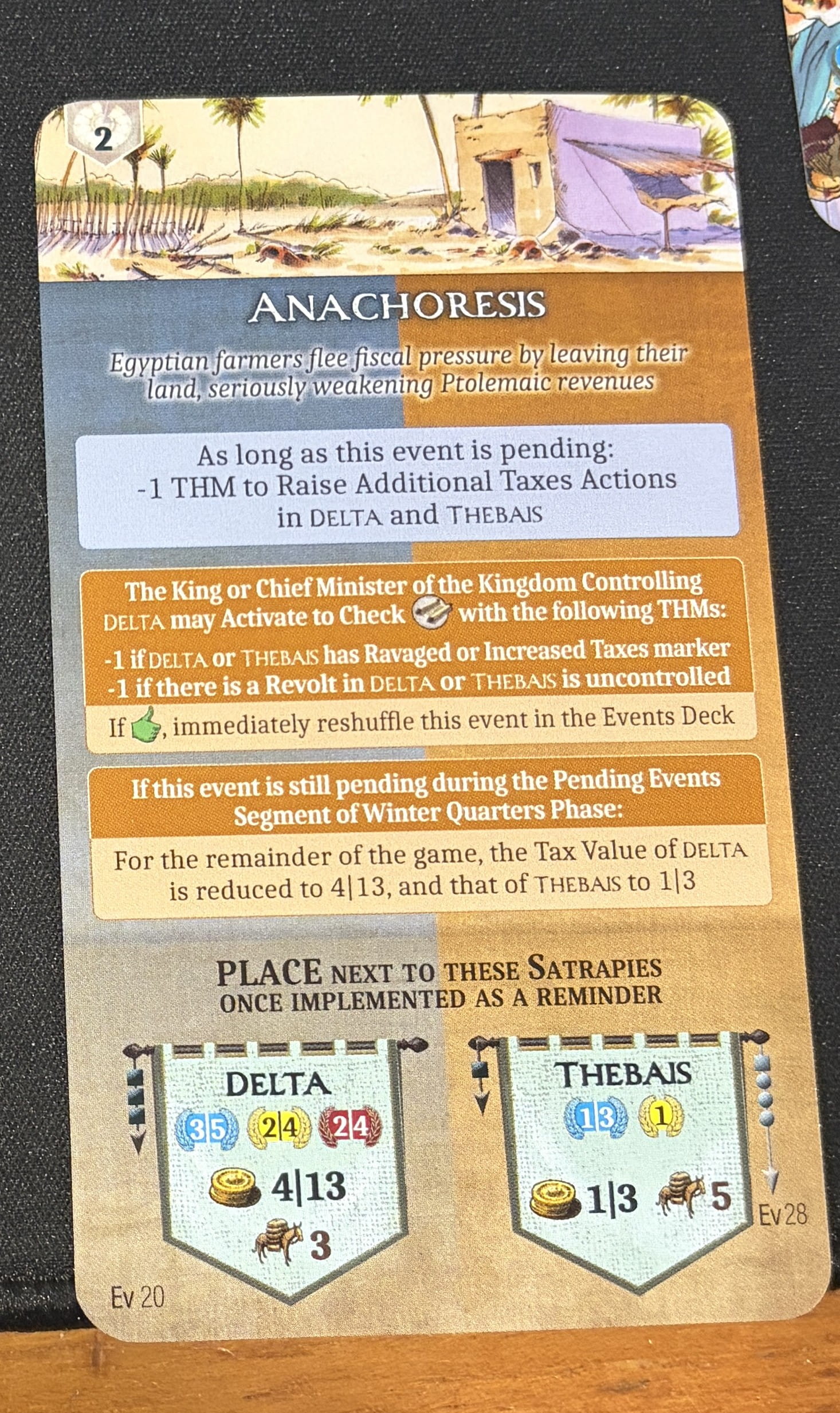
Each turn of the game represents 5 years. The historical scenario can cover 3, 7, or 11 turns. Every turn there are 6 recurring events and a Winter Quarters card, which controls when the turn ends – at least 4 recurring events must happen before Winter Quarters ends the turn; drawing it early results in shuffling it back into the deck. Each turn event cards are added that help recreate historical events. Any event cards that don’t get drawn this turn stay in the deck until eventually drawn in a future turn. Most of these events leave the game when triggered, but there are some exceptions; the Ptolemaic player will learn to hate the Anachoresis card, which keeps getting shuffled back into the deck until you fail at mitigating the peasants tanking your revenues.
Each player has a court, populated by a king, chief minister, and from one to several friends…scheming, conniving “friends”; collectively these are your leaders. As cards are drawn, players will have the opportunity to use leaders to take actions, but each leader generally can take a maximum of 2 actions each turn, unless they have the lazy attribute, which limits them to one. Leaders can only take actions in areas they are competent in – military (battles and sieges are rated separately), diplomacy, or administration. Some are rated in every category; some are one-trick ponies. Need to engage in some key negotiations to bring a tribe or city into an alliance and your only leader is solely focused on military matters – too bad for you!
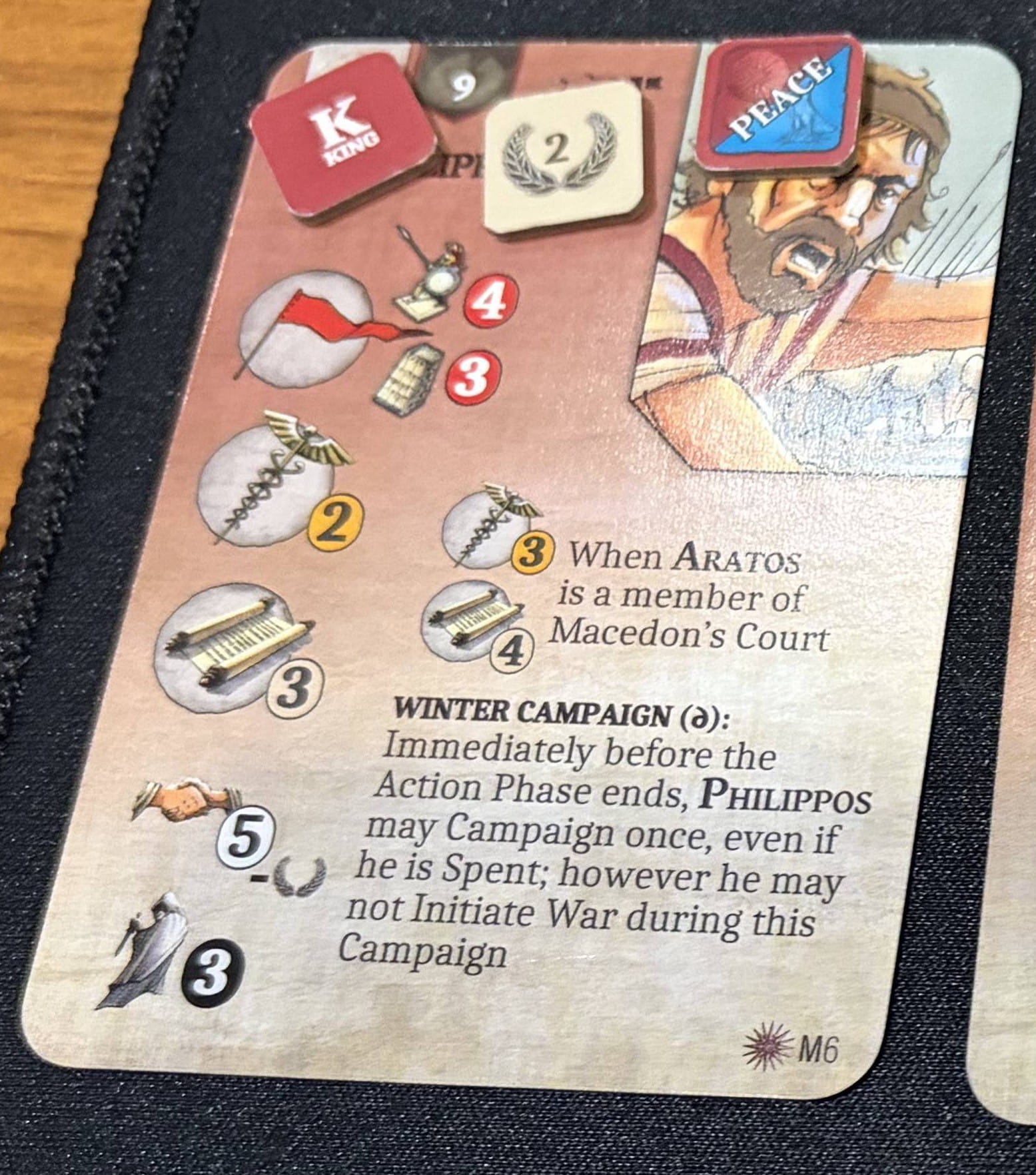
VPs are scored primarily by area control of territories on the board (satrapies). Each satrapy has one to many places within it. Control means having an alliance or garrison in a strict majority of places (i.e. 50% +1) in a satrapy. Your king can also earn renown during the game, which translates 1:1 to VPs. However, when your king dies, you lose that renown (boo!) Fortunately, half of that renown gets transferred to your dynastic VPs (yay!) Automatic victory occurs at 30 VP (judged at the end of a turn) or by highest when the game ends. There is a handy chart that shows what the historical VPs for each power would be at every turn, so my game group judged the winner based on who outperformed history.
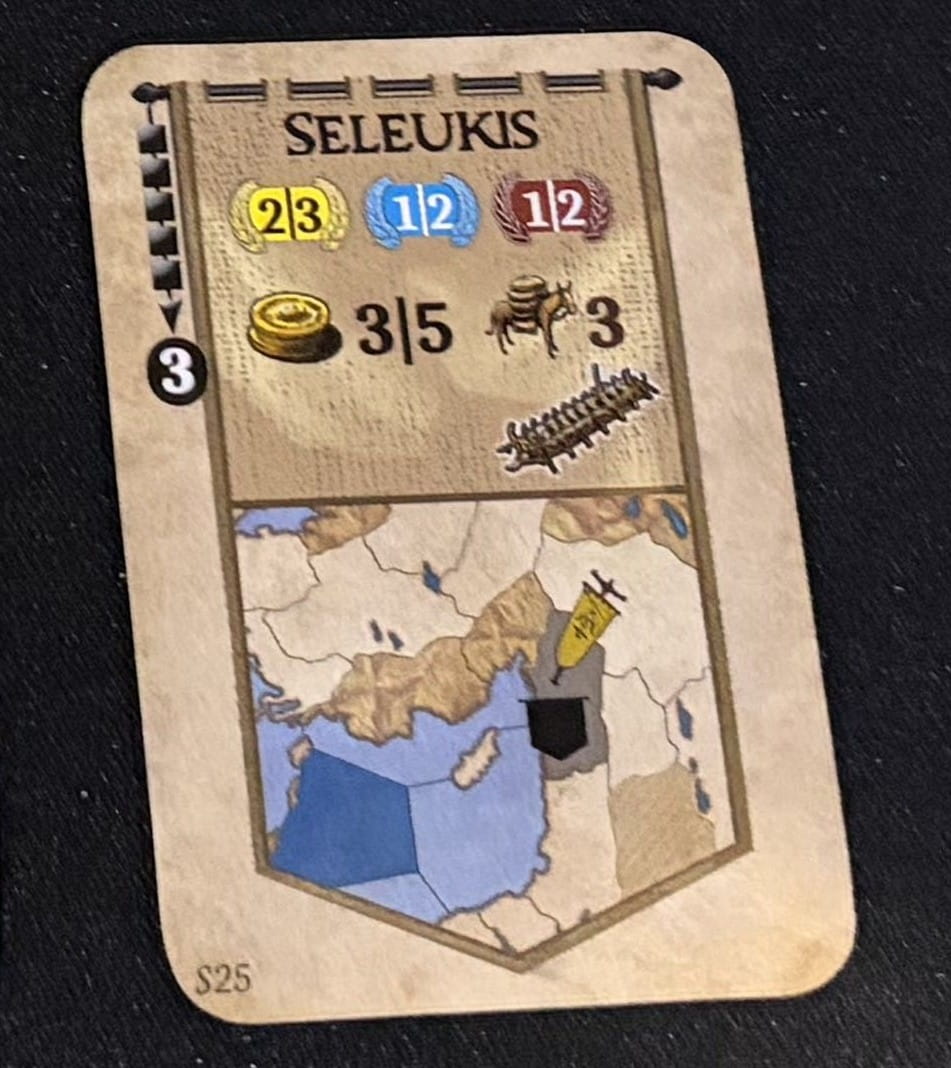
One last important piece of background – each satrapy can be in one of five states of control:
- uncontrolled (no power has a strict majority of alliances or garrisons)
- 100% controlled
- 100% controlled, but more than half of that is with alliances
- Partially controlled with a strict majority
- Partially controlled with a strict majority, but more than half of the controlled areas are with alliances
Control dictates which power gets victory points; many satrapies, but not all, offer fewer points for partial control. Not all powers get the same number of VPs for each satrapy. Control also dictates how much revenue the satrapy produces each turn; again, partial control will sometimes afford less revenue than total control. Control with a majority of alliances cuts revenue in half for the satrapy. But, luckily for you, the one time the game isn’t actively trying to hurt you is with rounding – 1/2 rounds up for revenue (and VPs).
Gameplay
After the deck is built for each turn, players count up their revenue for each satrapy they control, adjusting for any that have been ravaged, or your total cut in half if you are at war with another player or Rome. Rome is a non-player power that is controlled by its own deck and priorities as triggered by event cards. They start the game distracted by Carthage and will soon enter the 2nd Punic War. In fact, both my plays involved Rome losing the war and being removed from the game completely. Neither time did they ever impact the game at all.

Then players bid for the services of the handful of mercenary armies that are on the board. You have to be present in one of their home territories to participate. There aren’t many forces in the game, so gaining control of these mercenaries may be important for you to execute your goals for the turn. You are only buying their services for the current turn; some may be drawn off by the Punic War as well.
Next comes the action phase – cards get drawn from the deck. If the card is an event, it gets executed. This may trigger something with Rome, events of the 2nd Punic War, or, most likely, change the game state to the detriment of one or more players. Remember – the game is out to get you! If the card is a recurring event, it gets executed…do you remember – the game is out to get you!

For example, the above card can lead for one to three checks to have “friends” of the court remove other friends, the chief minister, or even the king from the game. An opposed roll against the Intrigue ability (lower is better) may result in a drastic shake-up of your kingdom’s leaders.
Then the card dictates the order in which each player (and Rome, if they are still in the game) can take one action:
- Battle (land, naval, or overseas campaign)
- Send envoys to gain an alliance (i.e. taking control of the place)
- Lobby to gain influence in the Roman Senate
- Incite Rome to war against one of the other players
- Raise taxes on one or two satrapies – this may result in overzealous tax collectors ravaging the satrapy or even causing a revolt
- Build a naval squadron
- Evergetism – spend money (lots of it) on the public (think monuments or bread & circuses) for a chance to earn a dynastic VP
Use your actions wisely – you can expect to only get between four and six each turn. Rome’s actions are taken from special activation cards.
Winter Quarters is a cleanup phase. All your wars come to an end, unless a player wants them to continue. If so, both kingdoms can expect war exhaustion (all together now – the game hates you!) However, if you let peace take hold, you cannot declare war on that kingdom until one (or both) of the kings die.
What I Love
Gouyon-Rety has made the theme shine through. I feel as though I’m observing the Late Hellenistic world first-hand…might makes right, intrigues at court, generals who rebel, leaders who die suddenly (was it natural or a coup?) – etc. The specifics are going to be different of course, but the game feels authentic.
All joking aside about the game hating you, those nasty events and effects feel true to the era. Not having them would be giving too much control to the kings. They were often swept along by events rather than dictating them – same for you. Enjoy the ride!
What I Don’t Like
My plays put this at roughly two hours per turn for a three-player game. My solo play (three-handed, not using the solitaire rules) was just as slow, even though I played it only two days after my group session – I wanted to make darn sure I was getting the rules correct as I prepared for this review. That runtime puts the 7- and 11-turn scenarios out of reach most of the time. I suspect that duration would decrease if it were played often. However, while my group does play games multiple times, we’re lucky if there isn’t a year or two in between sessions, so I don’t think our pace would speed up much in the future.
Hand-in-hand with that, it’s a long time to spend playing a game that has so much chaos baked into it. Perhaps with frequent plays, we’d learn the cards and know what to expect (there isn’t a ton of mitigation that can be done.) That way, we wouldn’t spend precious activations gaining control of a satrapy just to have a card and a die roll immediately snatch it away. It fits thematically, but it can also be quite annoying.
Related to this is the feeling that there is too much overhead, contributing to the playing time being high. It often felt like we had long stretches in between making active choices in the game. Counting revenue is one of those pieces of overhead. Your options are to examine the board closely to ensure the counts are accurate or use the optional cards provided. These satrapy cards can be given to the player to track what they control. Unfortunately, you either need to keep them in four separate piles representing the states of possible control or else be relegated to examining the board closely.

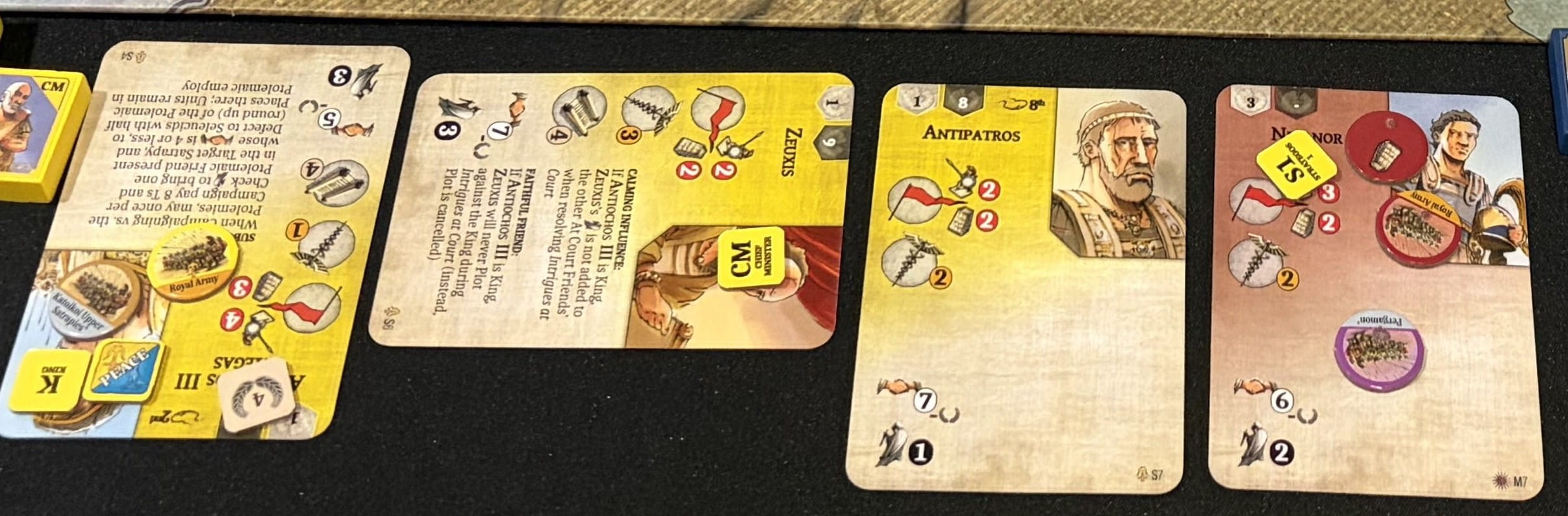
The leader cards can be fiddly as well. You track your leader activations by rotating the card 90 or 180 degrees to show them partially or fully used. However, the game already takes up a sizable footprint, so leaving space for sideways cards can be challenging. The cards frequently have chits on them that need to be maintained – we had several hit the floor during the rotation process. Also, the cards have a lot of text on them that needs to be readable, so the cards were getting picked up so they could be read right-side up. We did solve this issue though by pulling out some wooden discs. Each card was given the correct amount and taken off when an activation was used. I whole-heartedly recommend making this adjustment to ease play.
Final Thoughts
I can see this game having faithful and fervent adherents. Unfortunately, I’ll probably not be one of them, although I don’t think this is a bad game – it’s just not for me. Except for the Companion Book – it almost feels like that was written directly to me and my interests. I can only imagine the time and effort needed to build this masterpiece.
If I’m going to play a game that lasts this long (and I do all the time), I want more control. My sweet spot for a game that includes all these types of chaotic elements would be 2-3 hours max.1 That’s not Hubris nor should it be. This game is proud of what it does and it does it well. It would be the height of hubris for me to suggest this leopard change its spots.
You can chat about this game in the Pre-Gunpowder section of our discussion forums
Thank you for visiting the Regiment of Strategy Gaming and riding with The Armchair Dragoons.
Rather than list a bunch of social media links, the easiest thing to do is to check out our LinkTree, which connects you to all of our various locales around the web.
You can also support The Armchair Dragoons through our Patreon, and find us at a variety of conventions and other events.
Feel free to talk back to us either in our discussion forum, or in the comments below.
Footnotes
- like a shortish scenario of Ancient Civilizations of the Middle East


I am glad to see the review of the game and I am saddened that the title may not see more play for the author of the review.
In my experience, it is possible to decrease the playing time of a single turn down to one hour (and sometimes less, if there are not that many event cards in the deck) – the requirement is in familiarity with the rules and the game (analysis paralysis is a thing, too). Nothing new here, I suppose.
I certainly agree that Hubris is not a game about having a control. There are ways to game the system but it does require some time and repeated plays.
Signed, one of the faithful adherents.