
 by
by RockyMountainNavy, 14 September 2026
Do you Volko?
“Volko Ruhnke is a game designer and retired US national security analyst who is most famously known for designing the card-driven wargames Labyrinth: The War on Terror, 2001 – ? and Wilderness War. He also is the designer of GMT Games’ COIN Series about modern insurgency, including Andean Abyss, Cuba Libre, A Distant Plain, and Fire in the Lake.” – BoardGameGeek, Board Game Designer, Volk Ruhnke, accessed 22 August 2026.
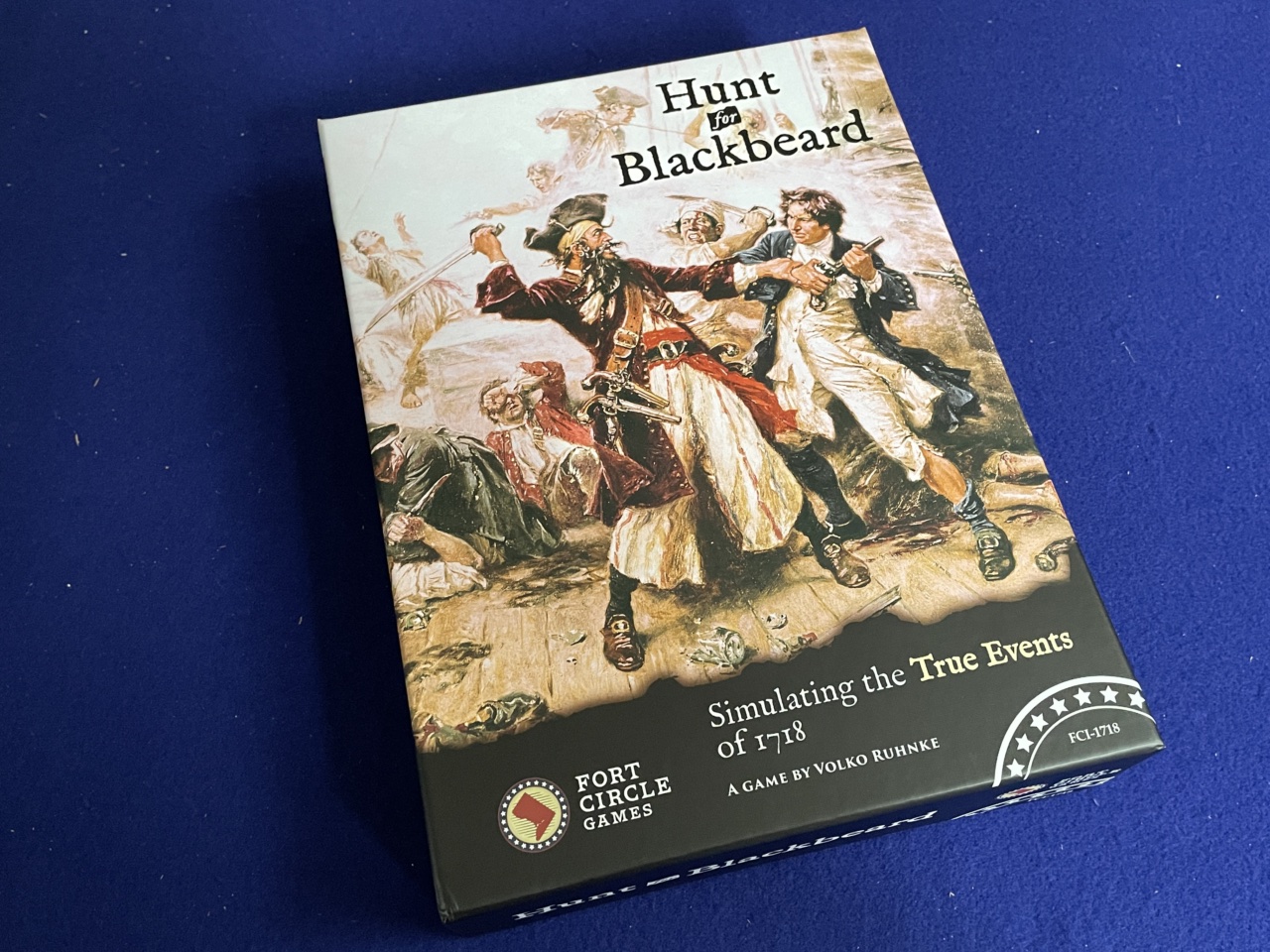
Two of Volko’s more recent games, Hunt for Blackbeard: Simulating the True Events of 1718 (Fort Circle Games, 2026) and Coast Watchers: Allied Field Intelligence in the South Pacific 1942-1943 – Recon Series Volume I (GMT Games, 2026) sailed into my gaming collection over the past few months. Both are not your usual “kinetic” wargames but instead deal foremost with “intelligence” activities; in one case hunting down the pirate Blackbeard before he is too successful (or peacefully retires), and in the other collecting information on Japanese activities and finding Allied spies. The two games share some common design elements but are not games in the same series—think more like game cousins! Most importantly, both games demonstrate that a “wargame” can be something other than simply guns vs. armor.
Hunt for Blackbeard
Hunt for Blackbeard pits navy against pirate in a fast-moving game of detection, deception, and confrontation. As Blackbeard, set your camp and commit acts of piracy or retire to a pirate’s life. The hunters are coming—do you evade or prepare defenses? As the Hunters, press your informants, arm your expedition, and hurry to the search. But be ready, as your quarry is apt to bite! (Back of the box)
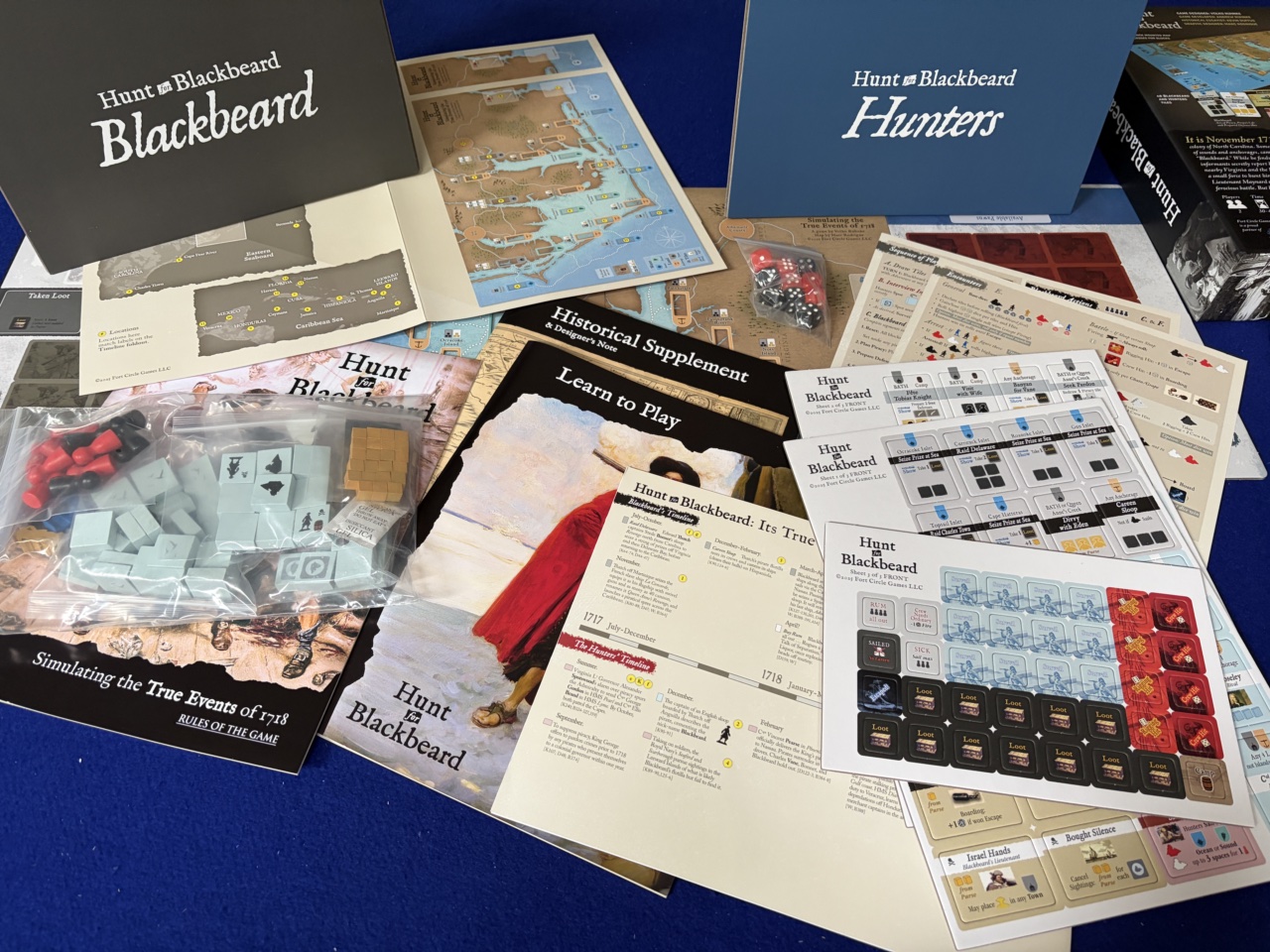
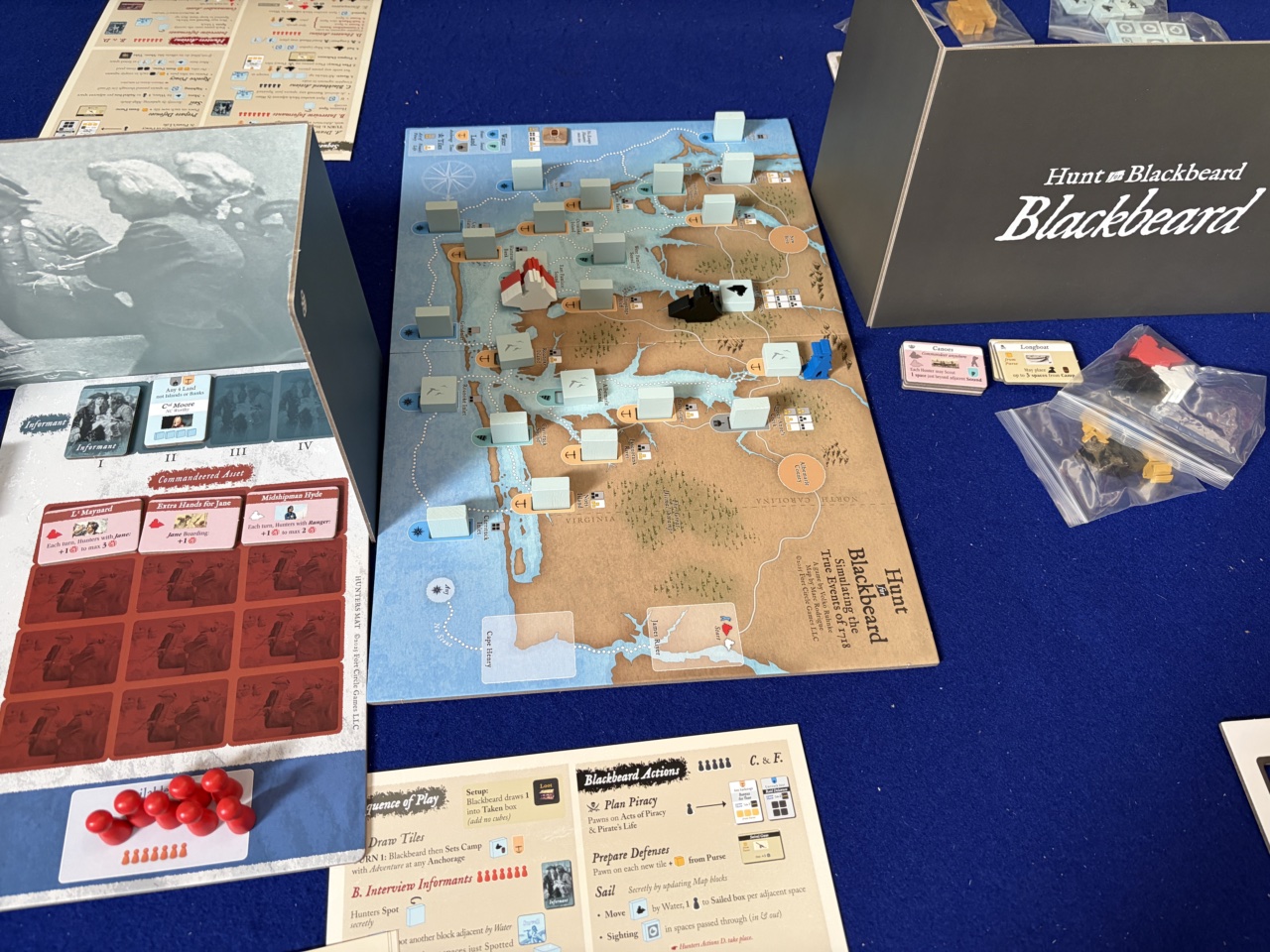
Hunt for Blackbeard is a 2-player game that is playable in 30-45 minutes. The physical components for Hunt for Blackbeard—Fort Circle Game Nr. 4—are lavish and easily the best yet published by Fort Circle Games. From the double-thick board with recesses for blocks to the wooden ships, persons, pawns and cubes; to the tiles, player mats, and screens, they all scream QUALITY. The game board, admittedly, is a bit smaller than I expected measuring only 11”x17”; even so with player mats and play aids a 3’x3’ card table is probably the smallest area reasonably needed for play.
Conceptually, Hunt for Blackbeard is simple to play:
Each turn, you draw random tiles that offer Informants to the Hunters and Piracy opportunities to Blackbeard. After the Hunters secretly Interview their Informants, Blackbeard, and then the Hunters, will use action pawns to move and prepare to face each other. Blackbeard also uses pawns to plan, in advance, what Piracy he will resolve at turn’s end. The Hunters, once in North Carolina, can also use their pawns to Scout for nearby pirates. Whenever any Hunters and pirates end up in the same space, you play out an Encounter—either an attempt at Arrest on shore or Battle between Sloops in the water. (Learn to Play, p. 2)
Coast Watchers
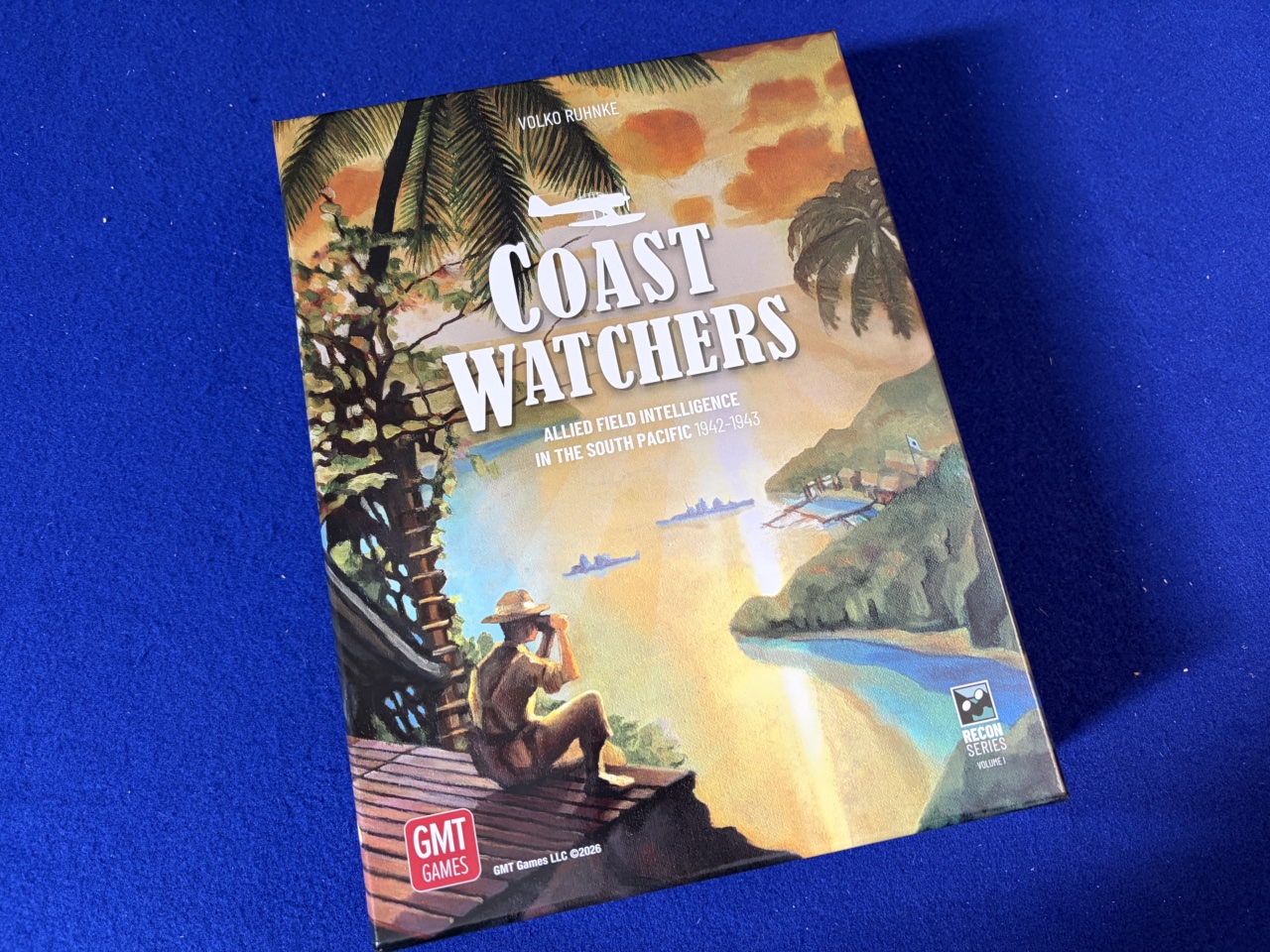
Coast Watchers is a wargame that explores the activities of the Australian coastwatcher program in New Guinea and the Solomon Islands in 1942 into 1943. As the publisher’s ad copy explains:
Coast Watchers takes you into WWII intelligence action across the South Pacific. As the Allies, run your network of operatives on enemy-held islands to report key information and thwart Japanese plans. As the Japanese, hunt down spies and deceive the enemy to achieve military surprise. (Coast Watchers back of the box)
The game design of Coast Watchers is conceptually not that much different than Hunt for Blackbeard, but instead of a game of Japanese spy “Hunters” vs. Allied coastwatching “Pirates” one has a situation where coastwatchers must collect intelligence on Japanese activities to report to headquarters—information the Japanese player seeks to protect. The coastwatchers may also engage in rescues of stranded Allied crew and need resupply.
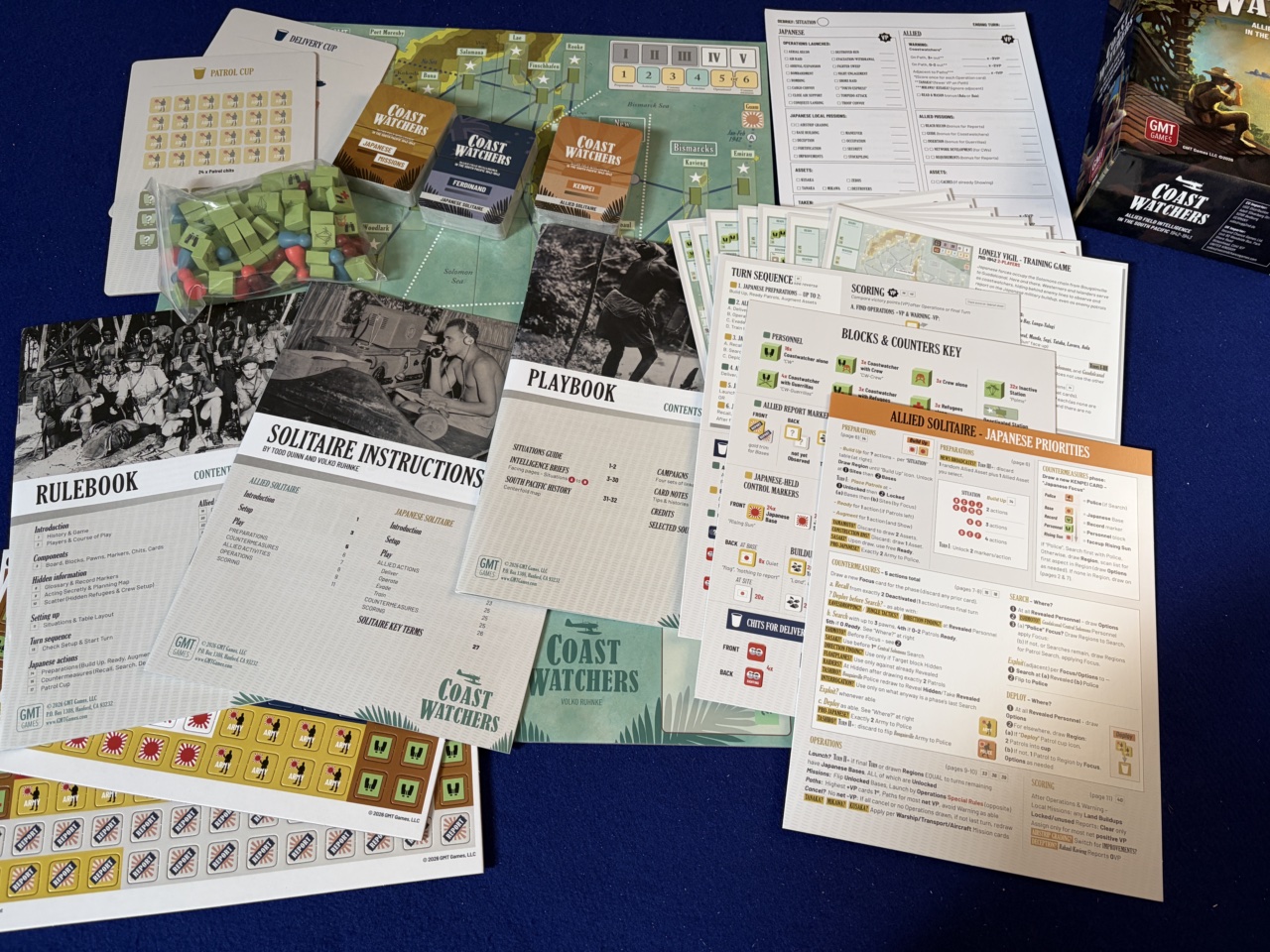
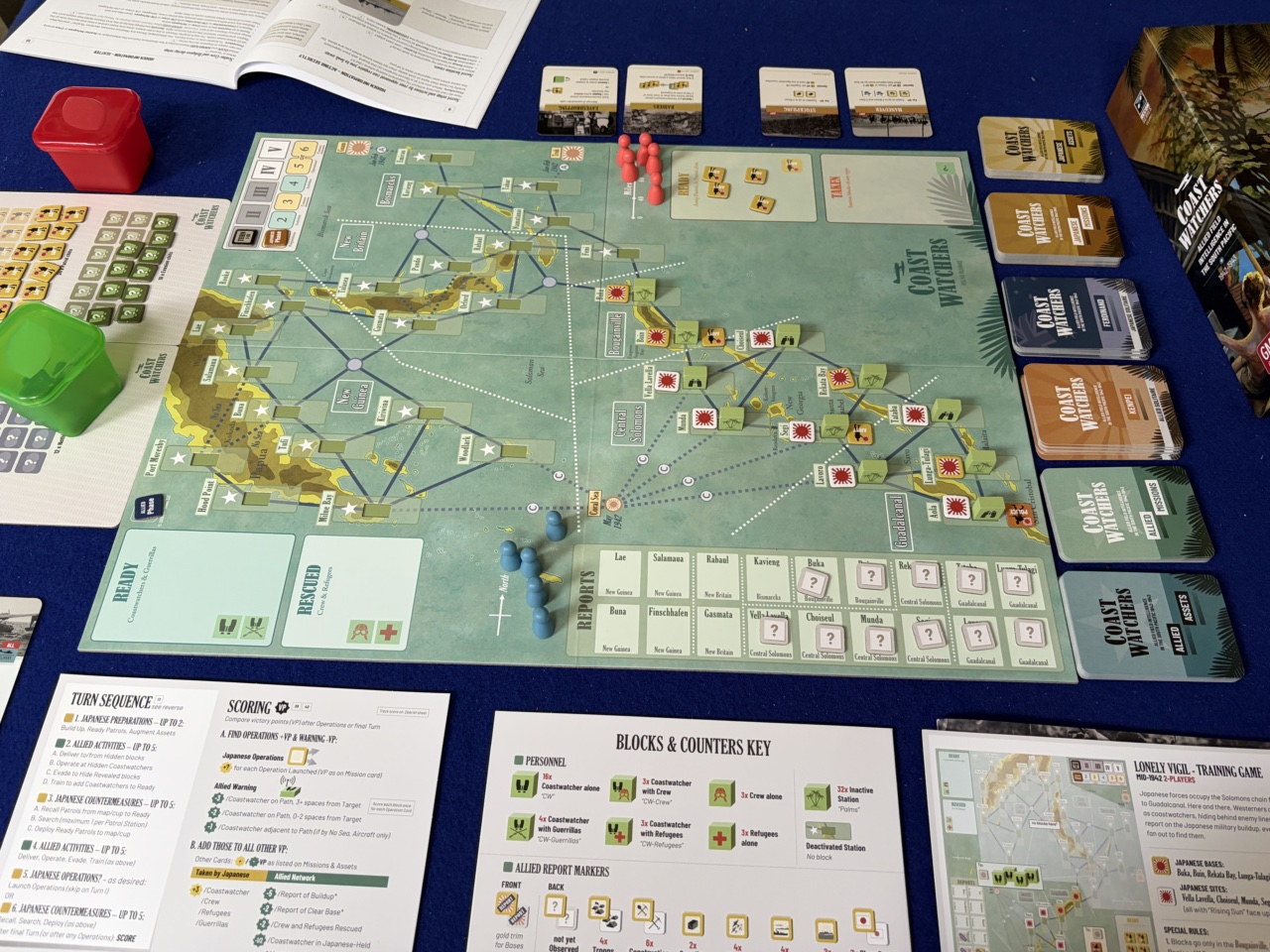
THE GAME: Coast Watchers takes you into this struggle between Allied intelligence teams and Japanese hunters. Standup blocks hide coastwatching stations, guerrillas, refugees, and stranded Allied crew. Gameboard recesses hold the blocks snug. Facedown counters hide the buildup of Japanese forces, which the coastwatchers seek to observe and report to headquarters. Other counters show where Japanese patrols are searching for coastwatchers or go into and get drawn from a cup to run Japanese searches and Allied delivery missions.
According to GMT Games, a typical game of Coast Watchers plays between 1-4 hours. In keeping with the high production standards from GMT Games, Coast Watchers is a very nice looking game (and at $102 retail it should be!). The mapboard in Coast Watchers at 22”x17” is double the size of Hunt for Blackbeard but still retains recesses for blocks. Like Hunt for Blackbeard, the Coast Watchers also uses wooden blocks and pawns, but tiles are replaced with playing cards. Unlike Hunt for Blackbeard, however, Coast Watchers does not use player screens to hide any sort of player mat. This means that a slightly larger play area is needed for Coast Watchers, yet still perhaps no smaller than 3’x4’. One of the most important distinctions between Hunt for Blackbeard and Coast Watchers—beyond the added layer of complexity from the Allied need to collect information, occasionally rescue crew, and get resupply— is that Coast Watchers can be played solitaire on either the Allied or Japanese side.
Watching the coast war or hunting Blackbeard game
At the same time I started learning to play these two games, there was a polite (to date) back-n-forth between Rwizi Rweizooba Ainomugisha at Wargaming Weekly and Kev at Bigboardgaming (in order see “Weekly Wargaming 80”, Kev’s first response, “Weekly Wargaming 81”, Kev’s second response) over the definition of a wargame.
Y’all know my stance on the ‘bigger tent’ approach to conflict games, historical conflict games, and real wargames. If you don’t its very simple. A wargame involves kinetic action between two or more parties in the game…If there is no kinetic action, then it can be a war/military/social/historical or philosophical strategy themed game. But it aint a wargame.
Kev, Bigboardgaming, 11 Aug 2026
Now, both Hunt for Blackbeard and Coast Watchers are labeled “wargames” by some hobby gamers. As I learned and played each I kept the question of, “Is this a wargame” in the back of my mind to see what thoughts it provoked.
(Hunters : Pirates) as (Japan : Coastwatchers)
While Hunt for Blackbeard and Coast Watchers both come from the same designer—Volko Ruhnke—and both share some commonality in game mechanisms (such as hidden information using blocks) both games are quite different.
Hunt for Blackbeard is, from the start, a more simple and straight-forward game in terms of rules complexity and play time. Yet, what outwardly looks like a simple Hunters vs. Pirates game has an interesting twist in that the Blackbeard player can win in one of two ways; first by being a successful pirate that is not caught or, secondly, by peacefully retiring before getting killed or arrested. That second, secret alternative objective adds a layer of strategic play that builds not only game tension but ensures great replayability. Hunt for Blackbeard has two rulebooks; a somewhat standard rulebook (20 pages) and a second Learn to Play booklet (28 pages). Although longer, the Learn to Play is the place to start learning how to play Hunt for Blackbeard as is it lavishly illustrated with step-by-step learning through play. There is a 24 page Historical Supplement & Designer’s Notes that, once again, shows the attention Fort Circle Games gives to the historical groundings of their games.
As already mentioned, Coast Watchers is the more complex of the two game designs. The added complexity of Coast Watchers—both in overall scope and scale—is in part why the game take longer to play. Coast Watchers also offers the solitaire play option that Hunt for Blackbeard does not. As one likely expects from a GMT Game product, Coast Watchers comes with plenty of written materials to aid in learning the game. The 43-page Rulebook is written using a more topical approach not that dissimilar to the “Interrogative Rules” style used in Atlantic Chase (Jerry White, GMT Games, 2021, 2023).
The Solitaire Instructions is a separate 27 page book written in a broadly similar manner. Finally, there is a 63 page Playbook which includes the 15 scenarios (“situations”) and campaigns. The Playbook is also where notes on the history and individual cards can be found. Interestingly, there is no single extended example of play in Coast Watchers though the Rulebook has many illustrated examples of individual rules. Perhaps this style of rulebook is good enough that an extended example of play is not needed? It seems to work for me….
Playing both Hunt for Blackbeard and Coast Watchers emphasized to me just how interesting boardgames that get labeled as wargames can be. Neither of these games are focused on “the kinetic layer” that is essential to Kev’s definition of a wargame, but nor does either totally ignore combat. Instead, both Hunt for Blackbeard and Coast Watchers focus the player’s attention on the “intelligence game.” In Hunt to Blackbeard the “intelligence game” is the search for the hidden Blackbeard, and Blackbeard’s efforts to avoid capture. In Coast Watchers the “intelligence game” is a bit more literal; as in the Japanese player tries to protect his plans from discovery by Coastwatchers while also searching for spies (both classic counterintelligence activities).
If I was forced to use sort Hunt for Blackbeard or Coast Watchers using BoardGameGeeks Subdomain categories, I feel that Coast Watchers would be a “Wargame” as I can comfortably call it a “conflict simulation.” Hunt for Blackbeard is a bit thornier a question though ultimately I think—using BGG’s definitions—that it is a “Thematic Game” as there is a clear “emphasis on narrative” created through play.
Hunt the Coast for Blackbeard Watchers
When choosing which game to play—Hunt for Blackbeard or Coast Watchers—my advice is to find the one that best appeals to you as both are fine games; the only poor decision would be to not try at least one.
Hunt for Blackbeard is not a solo game and as such requires two players. The Learn to Play warns that teaching the game may be a bit challenging to teach as both players execute game actions in different ways, not unlike how different players in Root (Cole Wehrle, Leder Games, 2018) each play their own “version” of the game. To be honest, I personally am not as worried as I thought the learn to play was very easy—an indication to me that teaching it likely will also be straight forward. On the major plus side of the “should I play” equation, Hunt for Blackbeard is shorter to play, and in some ways likely to be more thematically appealing (“exciting”) to new players as it offers the opportunity to not only play a pirate, but inevitably to talk like one too.
Coast Watchers is, admittedly, a game with a more niche audience. As it can be played solo, however, even that niche audience is likely to be able to play as a team of one is all that is required. Although a more complex design, the rulebook for Coast Watchers is actually quite intuitive which eases the learning (and teaching) process.
Both Hunt for Blackbeard and Coast Watchers have incredible table presence due in no small part to the spare-(almost) no-expense productions from both Fort Circle Games and GMT Games (though, I must admit, the use of tiles in Hunt for Blackbeard against cards in Coast Watchers gives Blackbeard an edge). Hunt for Blackbeard could make a good convention game if there is a well-versed host to teach the game to players and coach them along the early turns. Given the time needed to play Coast Watchers, I am not sure it makes a good convention game but the ability to play solo means it can hit the table outside of an organized game night.
Finis
If you already “Volko” you likely already own (or will soon acquire) both games. If you must pick only one I recommend looking at your gaming style. If you often play with non-wargamers or have shorter game nights/weekends then Hunt for Blackbeard should be at the top of your list. If you are more of a grognard, or a solo wargamer, then Coast Watchers rises to the occasion.
The Armchair Dragoons wish to thank GMT Games for the review copy of Coast Watchers and congratulate Fort Circle Games on fulfilling the Hunt for Blackbeard Kickstarter campaign.
Thank you for visiting the Regiment of Strategy Gaming and riding with The Armchair Dragoons.
Rather than list a bunch of social media links, the easiest thing to do is to check out our LinkTree, which connects you to all of our various locales around the web.
You can also support The Armchair Dragoons through our Patreon, and find us at a variety of conventions and other events.
Feel free to talk back to us either in our discussion forum, or in the comments below.


