
 by
by Brant Guillory, 24 December 2025
How open is your gaming table, really? And how active are you about bringing players to your table?
The Backstory
When discussing wargamers with several attendees at the GAMA Expo in 2024 and 2025, there was a recurring theme from the non-wargamers: “you guys are so unfriendly.” For someone trying to evangelize wargaming, that’s one of the worst things you can hear from a fellow game event attendee; at the Expo – an industry-focused event full of the folks who own and operate game stores, companies, and events for a living – that’s doubly-damning, as these are the people most likely to fight through unfriendliness to make a connection with a fellow gamer.
So I dug in with the questions: Why do we seem so unfriendly? Are we rude? Are we insulting? Do we just avoid everyone else and keep to ourselves? Do we tell people to buzz off? Are we mean about it?
there was a recurring theme from the non-wargamers: “you guys are so unfriendly.”
Ultimately, the “unfriendliness” seemed to be defined largely by 2 things.
First, there’s rarely any acknowledgement of people stopping to observe what’s going on, much less an invitation to engage with the table.
Second, when that engagement does happen, it’s almost always one-way – initiated and sustained by the outsider seeking information about what’s on the table.
So on one hand, at least we’re not putting barbed wire and bouncers around our tables to keep people away, but on the other hand, there seems to be a minimal effort to engage & explain, and draw in potential interest from those not in the game.
However, it’s rare that anyone in the wargaming world is actively standing around the table telling passers-by to buzz off and go away, which is often the default assumption of “gatekeeping” that many folks jump to whenever the term is brought up. To balance that out, it’s equally rare that we’ve got wargamers working the aisles at a game convention, or hanging around a game store, trying to hustle new players into a game and pulling out chairs for new players to have a seat.
With these discussions as a background, and 20-odd years of personal observations of wargaming at a number of conventions where wargaming is not the only game in town 1 plus a 10-1/2-hour drive home from GAMA Expo2 I developed a taxonomy of wargamers as seen by non-wargamers, and vetted it with a handful of friends-of-the-Dragoons for feedback.
Building Categories
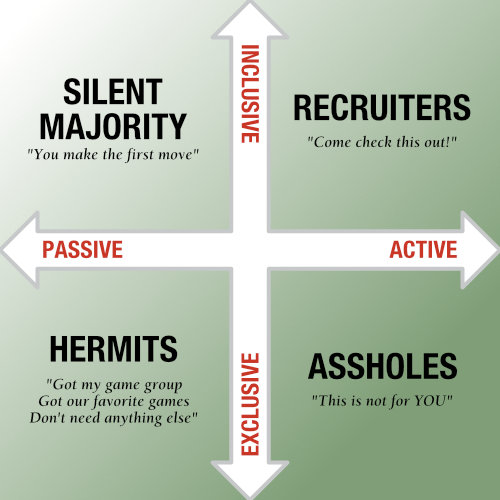
I developed this as two axes: inclusive/exclusive (which gets at the heart of the issue) and active/passive (which seems to be the more contentious part of the discussion).
Inclusivity/exclusivity: are you willing to engage observers and bring new players to your table? And note, this applies to any players – are you engaging with young and old, guys and gals, folks that look like you and folks that wandered in from the midnight showing of Rocky Horror Picture Show.
Active/passive: If they show any interest, are you acknowledging it, as well as inviting and continuing & sustaining a discussion? Do you just nod and go back to ignoring them, putting the onus on them interrupt the game with questions or comments? Or are you inviting / opening the door for their inquiries and discussion?
Now, the second of those can sometimes be controversial among wargamers3 with the reflexively defensive argument of “I’m trying to concentrate on my game!” coupled with the inevitable whataboutisms that (quite correctly) note that many RPG players exhibit similar behaviors.
However, whether or not RPG’ers are curmudgeons is of negligible interest when assessing the behavior of wargamers, and complaints about interruptions to gameplay ring hollow when we’re talking about intentionally playing wargames in public (conventions, game stores, etc) which is where this behavior manifests.
Put another way: no one is anticipating much public engagement with non-wargamers on a Saturday afternoon in your friend’s dining room.
Over the past 20+ years, however, social media has put wargaming in front of vast (potential) new audiences, resulting in a lot of “drive-by” interest in Facebook groups, discussion forums, Twxtter threads, and Youtube comments. Given this entirely new avenue for engaging the public with potential interest in our hobby, it’s amazing how well wargamer behaviors still sort themselves into these 4 categories.
So what do those 4 corners of this grid get us?
The Silent Majority: Inclusive, but passively so. This group will answer questions if you feel comfortable interrupting them, and is unlikely to turn away someone that invites themselves to the table. They’ll play a game with anyone, but they aren’t going to walk around with a bullhorn looking for players. Online, they’ll share photos or reports about their games through more public channels than just wargaming groups/forums, but aren’t going invite readers to chime in with their thoughts.
Recruiters: This group will walk around with a bullhorn in search of new players. They are not only looking for drive-by observers to engage in discussion, but they are out in public ahead of the events promoting wargames and looking for players to come join them. They’re probably one step below those perfume-kiosk guys at the mall, and to any introverts that get too close, they’re equally annoying.
Hermits: They’ve got their game groups and their favorite games and they’ve got no particular interest in discovering anything new – whether that’s new opponents, new games, new publishers, or any other new horizons. They’ve got dice older than the internet and you honestly wonder why they’re at a convention or game store in the first place.
These grogs are most often spotted online, sharing photos of their games, and occasionally answering questions about them, but never commenting on4 anyone else’s photos or game reports. New game/product announcements are usually met with some variation of “meh, I’d rather play (game I’ve been playing for 25 years)”
Most important among this set of categories: the distinctions are as observed by those on the outside.
Assholes: Actively exclusionary, going out of their way to make it clear that what they do isn’t what you do – whether it’s the games they play, the knowledge they bring to the table, or the way they find each other to congregate together. They don’t set up at conventions, because what they do is way too important to be sullied by co-location with non-wargaming rabble, and they’re not afraid to tell you, as derisively as possible.
Online, they’re more than happy to be as dismissive as possible toward photos and reports of games that they perceive as being “less than” the high art of wargaming as practiced by them. They respond to legitimate inquiries from potential new players with in-jokes and sarcasm, and often shamelessly so. Occasionally, they’re zealous enough about their exclusionism that they’ll fabricate or misrepresent the positions/statements of members of the other three groups, though given how easy it is to verify what was actually said, the reasons for this seem to elude comprehension.
Most important among this set of categories: the distinctions are as observed by those on the outside. This isn’t about where you see yourself. It’s about where outside observers put you based on the behavior you display to the rest of the gaming public. Again, go back to the top – this all started with non-wargamers telling us that we’re unfriendly, so what is it that they see in our behavior?
One other key note that needs to be mentioned5 is that the idea of inclusivity/exclusivity is not about trying to redefine idea of wargaming to include Ticket to Ride or Terraforming Mars. Definitions of “what is a wargame?” are many & varied and there are big tent/small tent factions just like there are when discussing the Baseball Hall of Fame. But whether you’ve got a 6-board game of Advanced Squad Leader or you’ve tricked out your Tank of Tank game with minis instead of counters or you’re flipping cards over Paths of Glory, the behaviors described above are still relevant, especially (say it with me) when observed by outsiders.
What’s Next?
Now, is this perfect? No taxonomy ever will be. There are always edge cases, and behavior may be contextual based on both the surrounding audience and the positions of the observers. Someone might be an asshole in one context but a hermit in another. Someone convinced that they are a recruiter might be seen as a part of the silent majority by someone whose efforts at new player involvement are even higher.
Moreover, people will exist at many different points along both axes, with most of them likely clustering toward the center of the graph given that people with extreme positions on anything aren’t common. The behaviors described above do pull to the extremes of each corner, for emphasis; there’s no need to camp out at the extreme margins of each part of the grid to fall into one of those categories. But clustering / grouping people within these overall blocks is, to be honest, anecdotally easy to do.
What’s needed now is a more empirical collection of data around operationalized criteria for each definition to better confirm / deny where the lines are drawn and whether there are some ‘hidden’ populations within these 4 boxes that we’re not observing. For instance, is there a cluster of wargamers that are high on the “inclusivity” scale but close to the middle between active/passive? If so, how might they be characterized?
So we put it to you, fellow Dragoons: what are your experiences with your fellow wargamers, especially in how they interact with the non-wargaming public? Did we get the names of the four groups right? Did we get the four groups right? Where do you see yourself6 and is it dependent on the audience you’re in? What have you observed from your fellow wargamers online? Is it different depending on the platform (BGG, CSW, Facebook, Twxtter, etc)? What observable behaviors might you attribute to the different groups we’ve identified?
Thank you for visiting the Regiment of Strategy Gaming and riding with The Armchair Dragoons.
Rather than list a bunch of social media links, the easiest thing to do is to check out our LinkTree, which connects you to all of our various locales around the web.
You can also support The Armchair Dragoons through our Patreon, and find us at a variety of conventions and other events.
Feel free to talk back to us either in our discussion forum, or in the comments below.
Footnotes
- mostly Origins, but also Buckeye Game Fest, GenCon, MACE, Playthrough, and others
- normally 9 hours without traffic snarls on I-64 in West Virginia
- and anecdotally seems to get worse as the age of the grogs goes up
- or even ‘liking’
- and will be ignored by those who see a chart and can’t be bothered to read the accompanying text
- and be honest if you’re one of the assholes!


One thing I notice about gaming conventions in the UK is that there seems to be a particular interest in “participation” games. For wargamers I see it often mentioned at minis conventions. From what I gather, a participation game is a large game with multiple players per side that supports drop in/drop out players. Bystanders literally walk up, often attracted by awesome table presence factors (incredible terrain, minis, etc.) and then ask about the game. In response they are “invited” to play maybe a turn or an activation. Some stay, some go. Often, however, one of the participation games is singled out as a highlight event of the day for them.
How do wargamers do THAT at a convention? Alas, I think we often do NOT. No, we sit down for our several-hour long block and go head-down.
For myself, I try to remember that when at a convention I am demonstrating a game as much as playing it. I have to remind myself the goal is to PLAY which means the game might not be finished in the time allotted. If, however, at least one person stopped by and I talked to them and got them interested THAT IS A SUCCESS and time well spent.
Good point about the drop-in games, and it’s something that we haven’t quite fully cracked for Origins. The fact that it runs for 4-1/2 days makes it tough to keep a table like that fully staffed at all times, whereas many UK cons last 1-2 days and it’s a little easier.
We might need to spend a little more brainpower on it this Summer in planning for 2027
A game table at a convention has the dynamics of an evening party. You can show up to a gathering on a Friday evening and if the host is gracious, welcomes you, introduces you to a few people in the spirit of “we’re all just having a good time” then it’s a wonderful situation. If you show up to a Friday evening party and no one will even look at you, then obviously it’s less interesting. The center point of your matrix is the host, a person at the gaming table that just makes eye contact and invites a question and who acts an intermediary to at least explain what’s going on.
It can be equally offputting if you just want to walk around the convention and see what’s going an a carnival barker at the table insists on dragging you into the game for a few hours of play. Those tables also feel weird.
Speaking only for the Dragoons area at Origins, as an example, we should all walk around and just check each other on ensuring if that tables host is clear and available. If one person at the table knows they’re the intermediary then they know that their play or their concentration might be interrupted by a question, but that’s OK. They know that ahead of time. It could be a small way that the area improves in its “friendliness.”
A small step like that could be a big tipping point for the group.