
 by
by Peter Robbins, 4 March 2026
The Next War series has been around now for a decade plus. It’s a rock solid system and continues to expand and update itself over the years. You can freely peruse it’s large set of Support Files (all series rules and game-specific rules pdfs) here
I squarely place the full rules of Next War: Taiwan in the Advanced level of board based wargaming, but I’ll temper that judgement based upon the fact that the SOP (Sequence Of Play) is spelled out quite nicely. If you want to keep things a bit simpler, stick with the Standard Rules. Quite honestly, while there are a lot more layers involved in the sequencing of the Advanced Rules, they ultimately add more fluff than may be necessary at this particular scale of wargame, just my personal opinion.They are there for the grognard souls of the planet to roll the dice a few more times yet come up with roughly the same end results all said and done 🙂 doh. It does add a solid layer of realism to the computations (consequently extra flow charts have been made by players to manage it better), and it does so with a clear set of rules steps throughout.
Anyhow, I digress.There is some decision-making agency involved with the full monty that is in the Advanced Game, and we’ll touch lightly in this article on what is included in them.
For me, as with any computer based game I review, a board game needs to present the player with as many options as possible, without getting unruly (pun intended?). You also do not want there to be upteen options while only one or two are ever the real path towards success. That ends up making the player agency a mirage.
Next War 2nd Edition, and this Taiwan offering in particular, is a good baseline for what the 2nd edition allows player agency wise. There are a good amount of decision points in the SOP. The scale is very appropriate for this conflict scenario. The turns are meaningful. Plenty of naval and air involved, a concise amount of land involved, rinse, repeat, fun. This is a tried and true system that continues to be refined and augmented with each release of the series.
The Unboxing
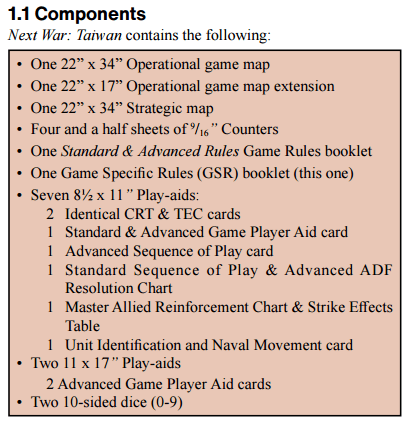
The literal “list” of what is physically provided in the boxed set of Next War: Taiwan, 2nd Edition is above.
Below are a few shots of my initial unboxing, complete with semi-wrinkled table cloth. You never realize how muddled up your tablecloth is until you take direct photos of your games at play. I eventually threw the cloth in my dryer to make it less wrinkled.

click images to enlarge
Everything in the box is visible at once above. The game specific rules were a bit bent, don’t know how that happened, but nothing a little self-maintenance couldn’t even out. Everything else otherwise was in pristine condition upon unboxing.


Again, the GSR was a little warped, but nothing major that couldn’t be flattened out with a heavy book on it for a while. Hey, if that’s all that was a little off, I consider that a solid unboxing.
Mechanics & Gameplay
Standard Game
The Standard Game includes a no frills set of hex and counter wargame phasing with CRT based combat results. It’s a generic (just meaning no majorly inventive mechanics*), but very detailed coverage of combat realities throughout. The standard rules cover ground combat primarily, with air and naval being compressed into single table dice rolls. You’ll see how that pans out in a turn play thru below.
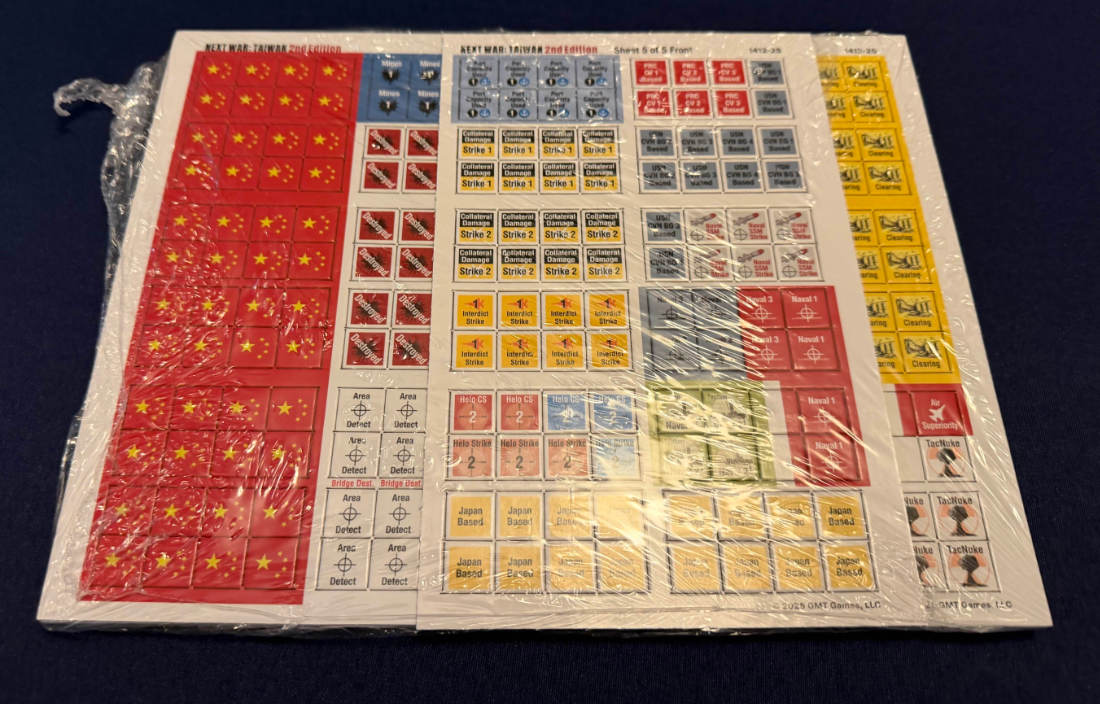
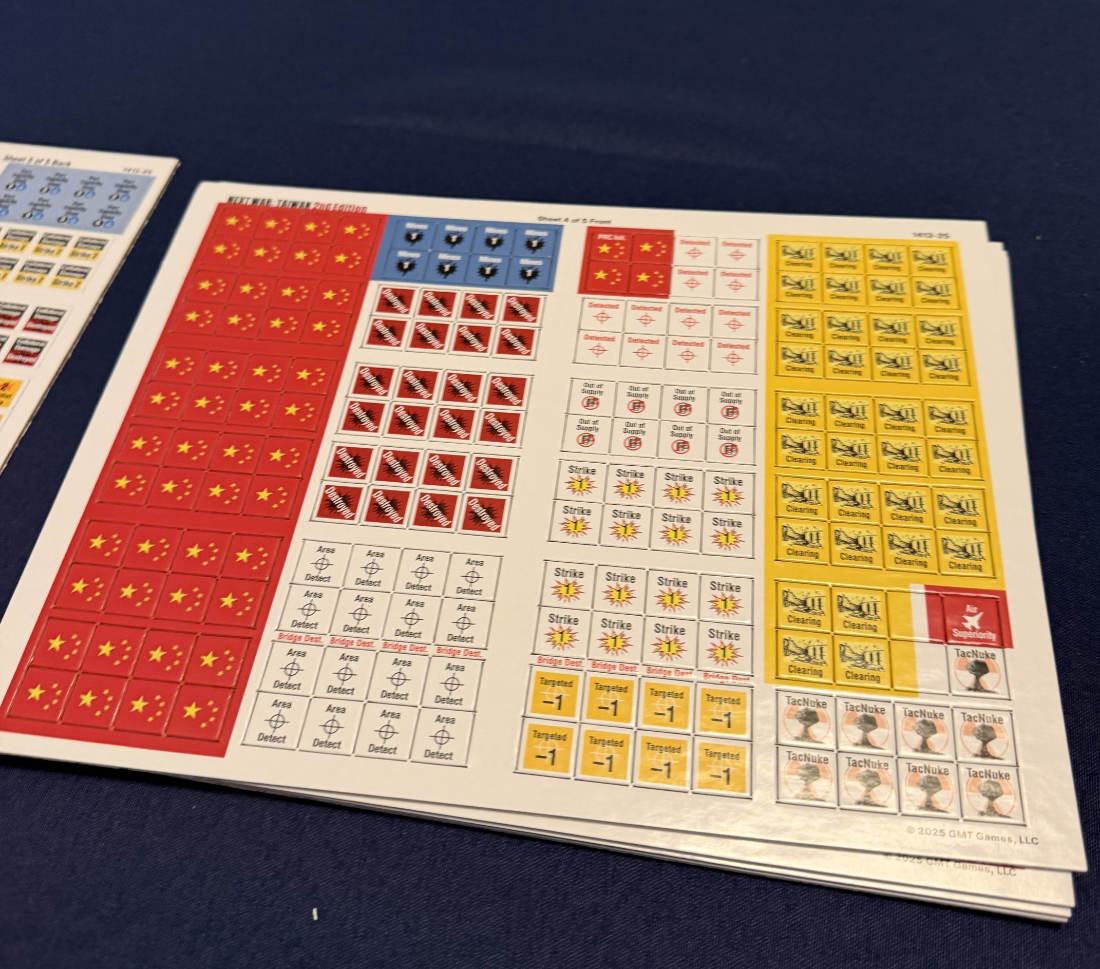
Counters, pre-punching



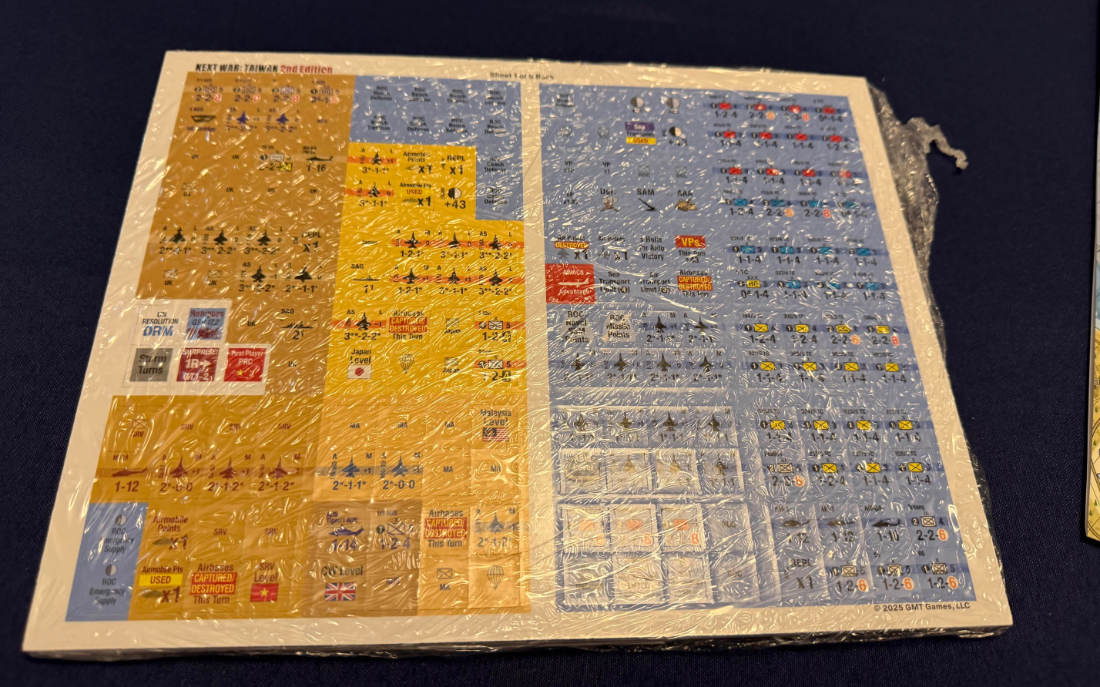


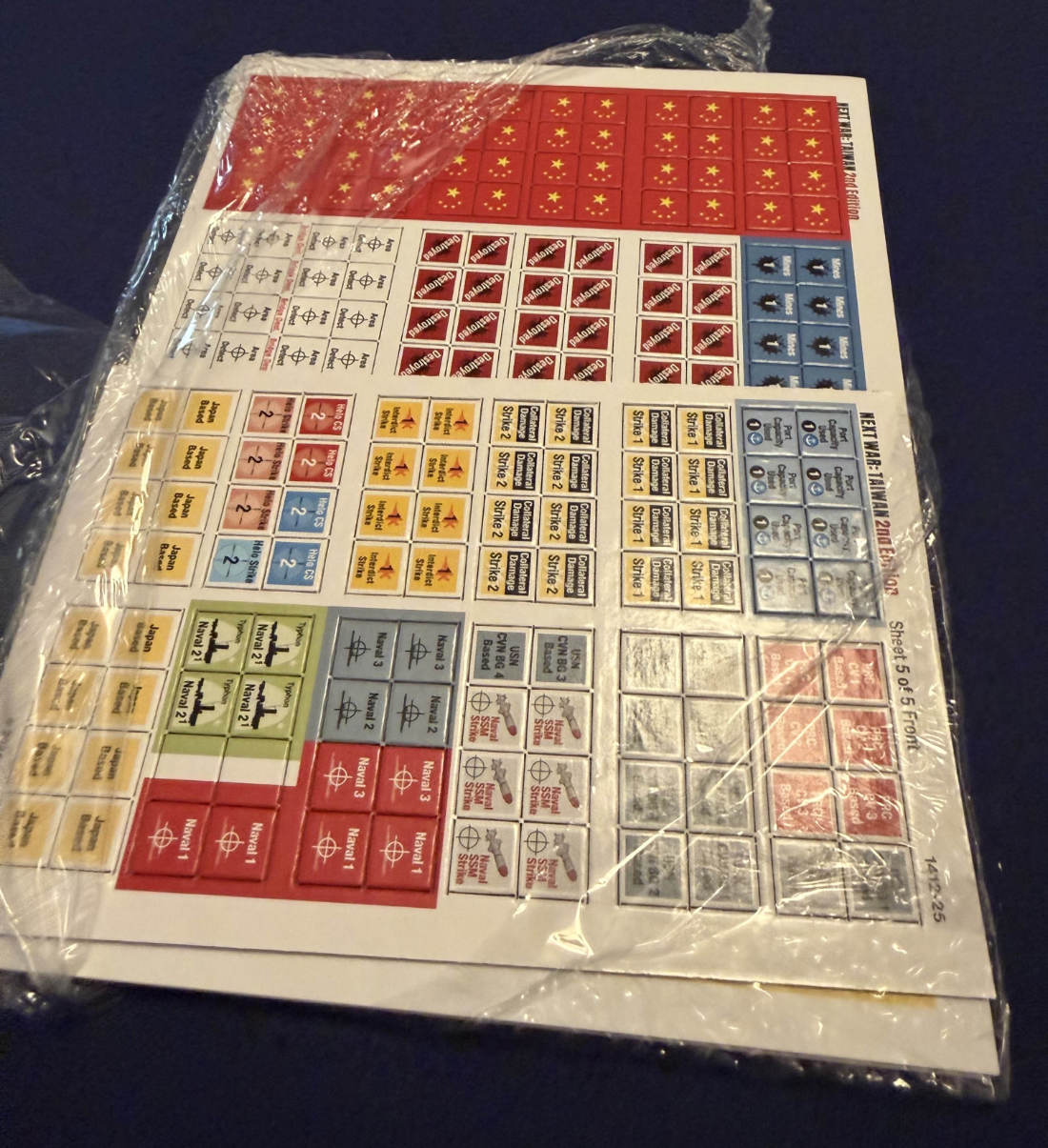


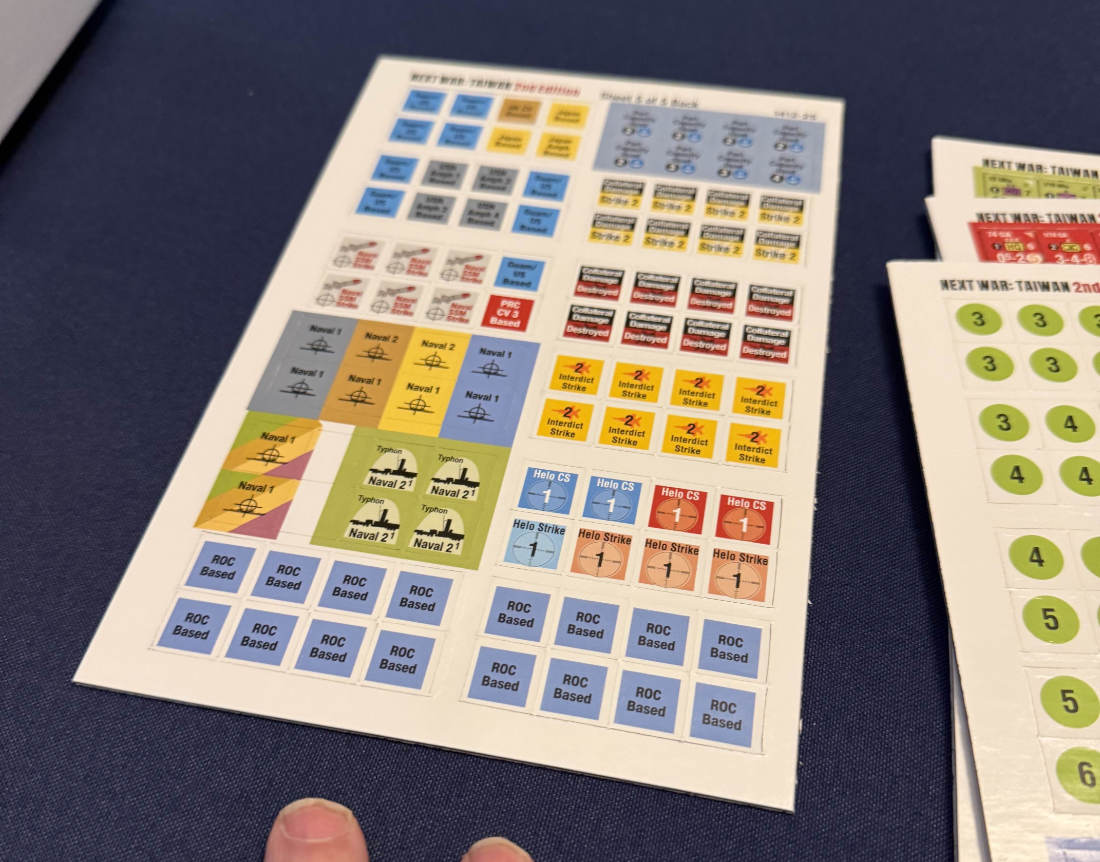


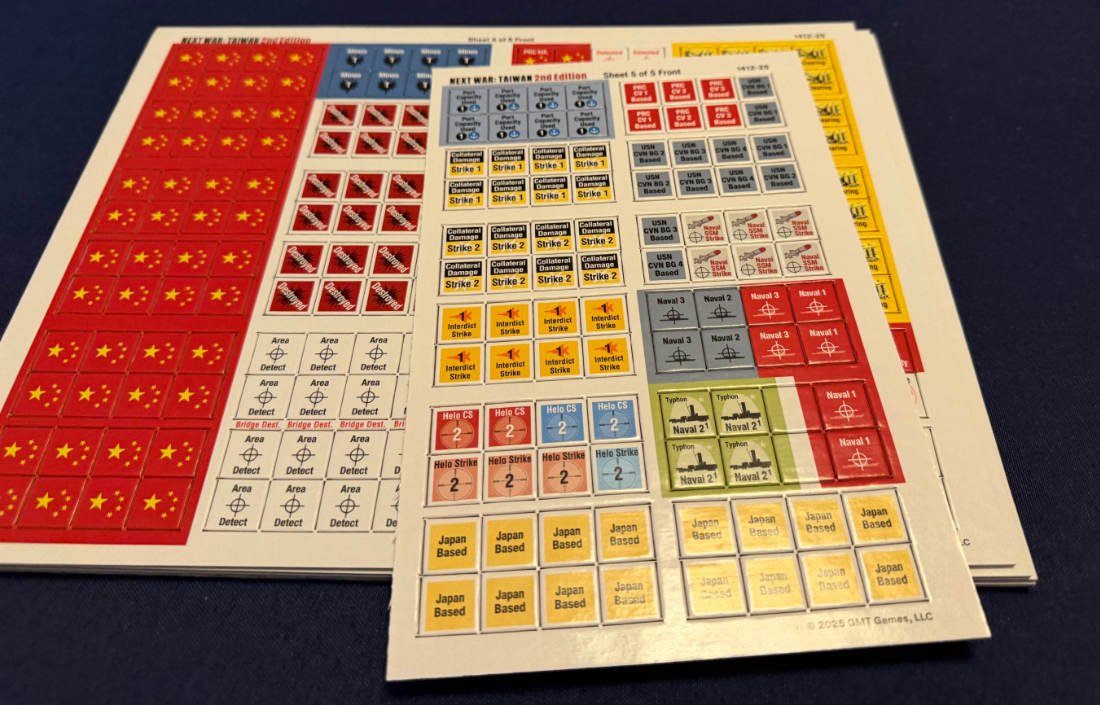


Introductory Scenario – Turn PlayThru
We will be quickly walking through a turn of scenario 18.2.1 Target Kaohsiung.


In extremely general terms your turn as a player consists of:
- Check conditions (weather, air, sea control)
- Move your forces
- Fight battles
- Clean up / reorganize
- Bring in reinforcements
- Score points / check victory
- Advance the turn
But that is just a very basic mental listing; we’ll stick to the Standard SOP card as we move through the motions of a turn one for the scenario so that we don’t skip anything.
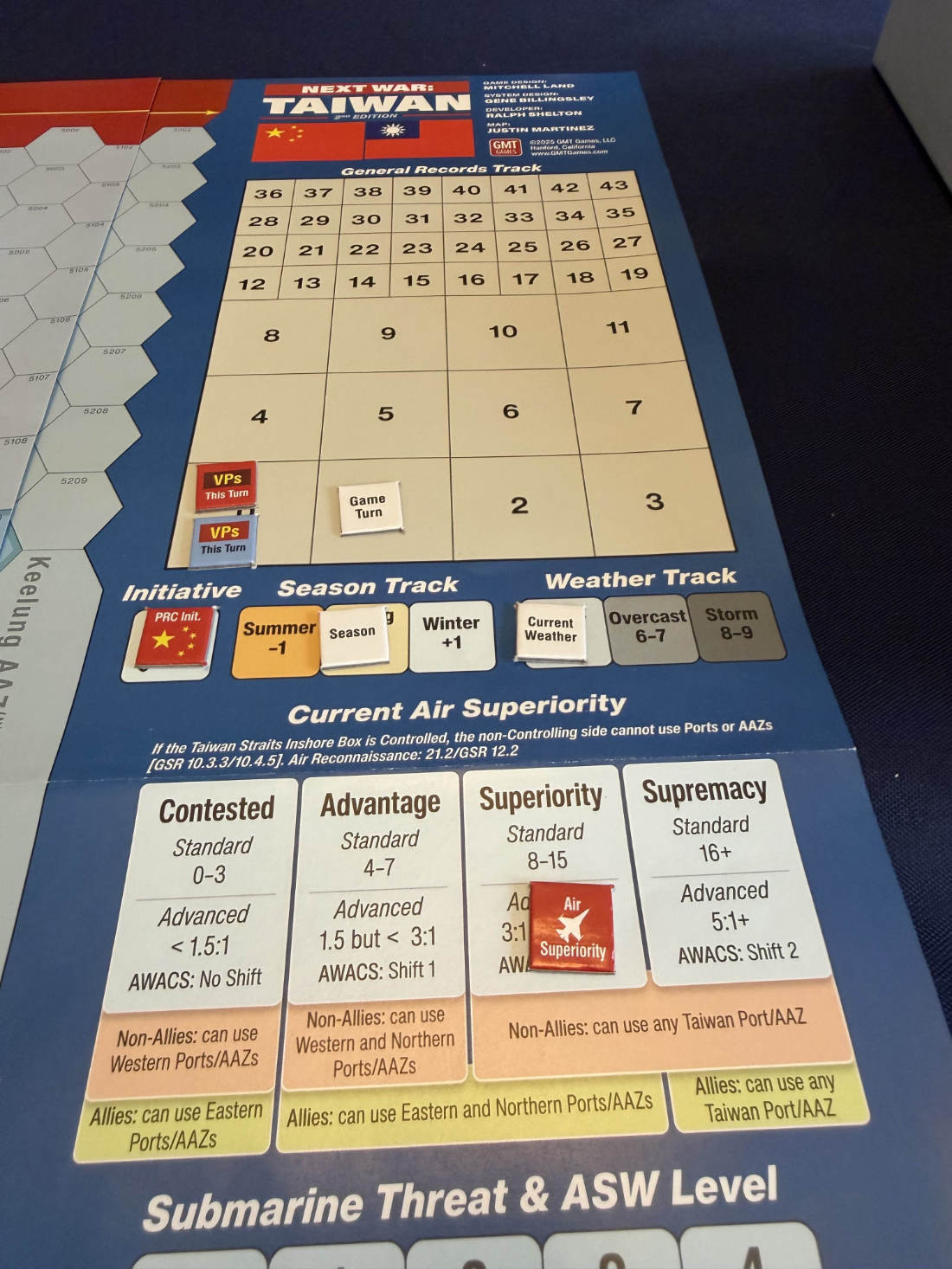
This is the first of the Standard Game scenarios. We start by setting the Weather to Clear per the scenario. Confirming per the GRS (Game Specific Rules) and the scenario description that the PRC have initiative for the first three GT (game turns). I’ve also just set the VP’s This Turn to 0 for both RED and BLUE, and the Game Turn tracker to 1.
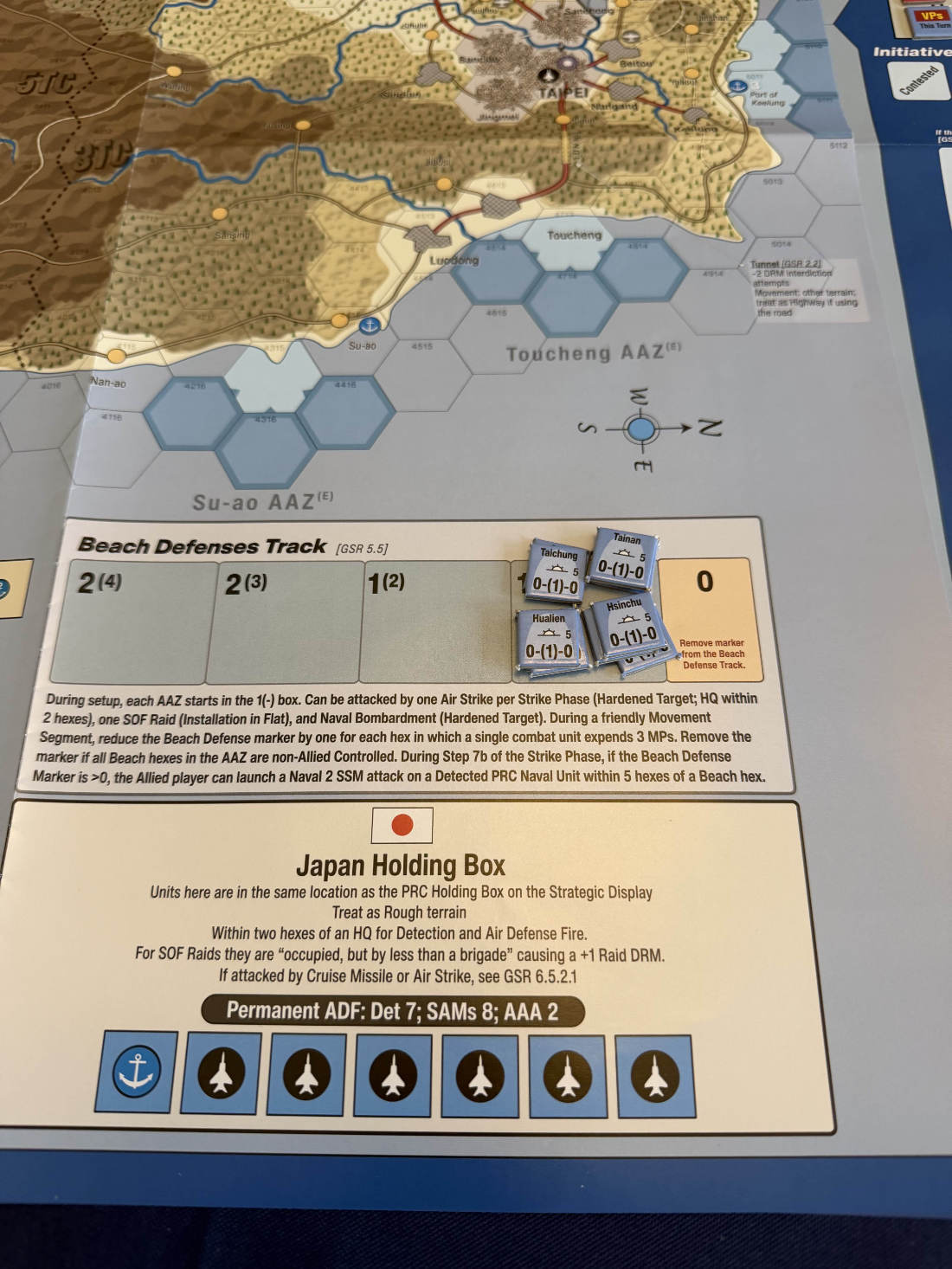
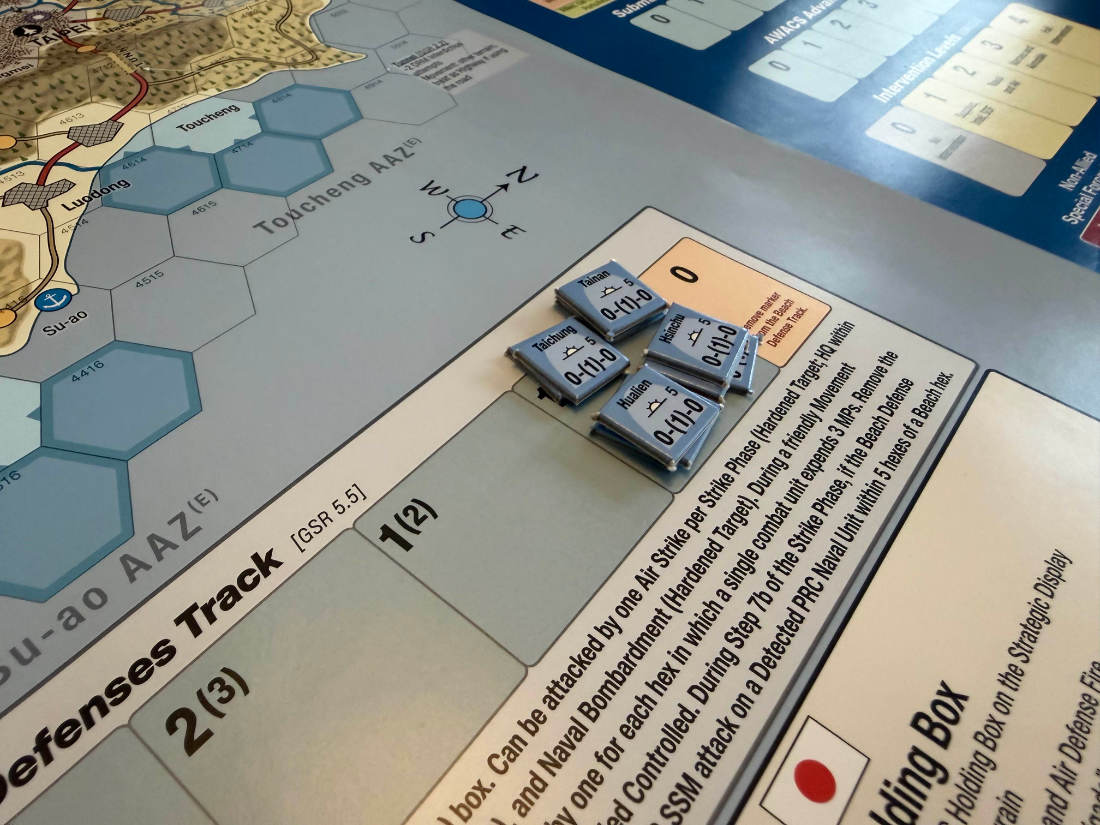
The beach defence markers are also put out, per the Game Specific Rules. The AAZ or amphibious assault zones found on certain areas of the coastline are depicted as dark blue and light blue hex groupings along the edge of Taiwan proper. Each has a certain level of intrinsic defense mechanisms, up to and including anti-ship missiles! Nice touch ROC!
Normally at this point we’d roll for Supply, but that is an Optional rule for the Standard Game, as for intro sake, not going to do it. Wouldn’t be prudent (in Dana Carvey voicing by Georgh Bush Sr.). We move on to Air Points. For air points we roll miserably with a “2”. This gives PRC a significant level of air superiority so we mark the Current Air Superiority on the map to Superiority with a PRC marker.
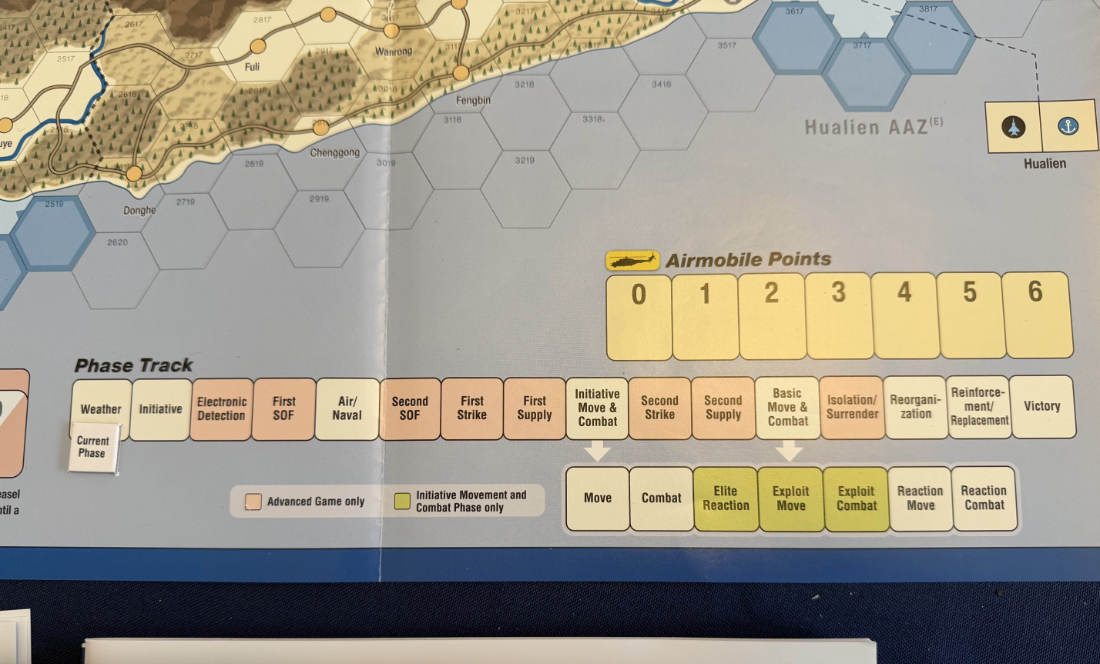
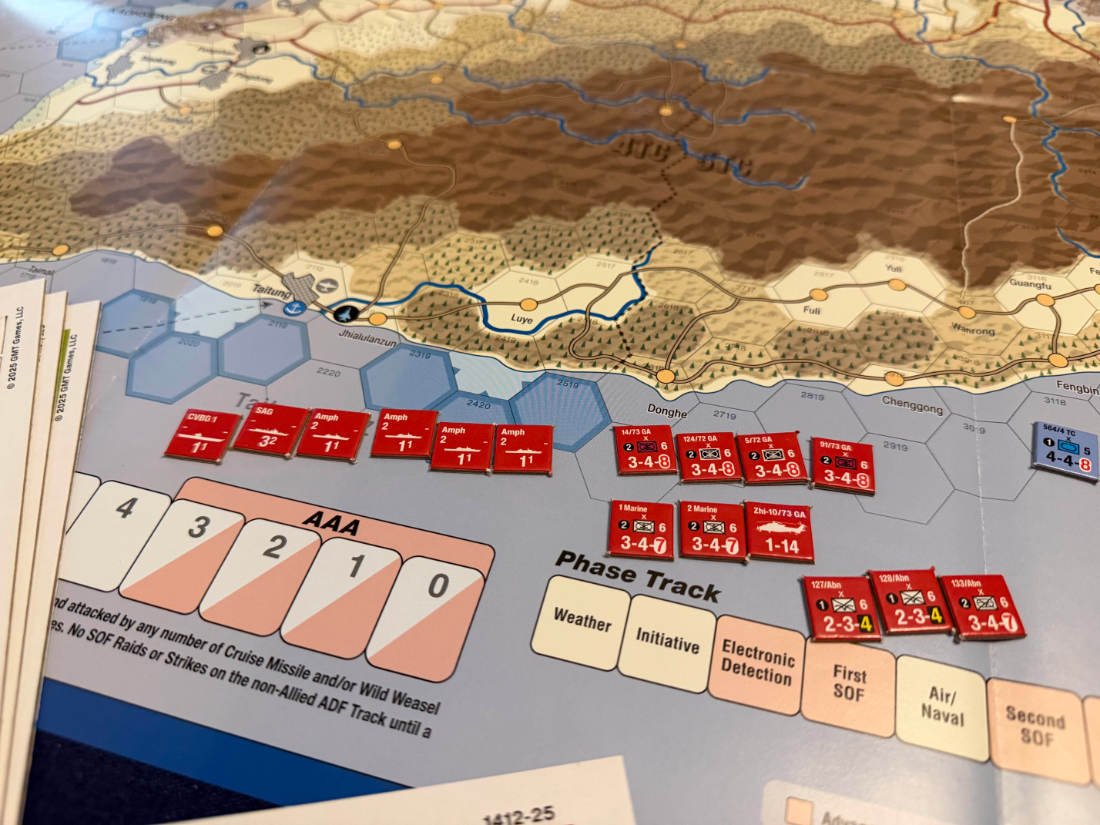
The meat and bread of the game, the Phase Track. Note that when it’s an “Initiative” based turn, which the first THREE turns of this intro scenario are, then PRC have initiative and basically will get two moves and combat phases to the one of the ROC. Though special force units / elites will get to move and we’ll see that here in a second during this sample turn 1.

PRC forces on hold in the Inshore Box for Taiwan. Other forces for the PRC which will be reinforced in later turns will be held in a PRC Holding Box, top left of this box.
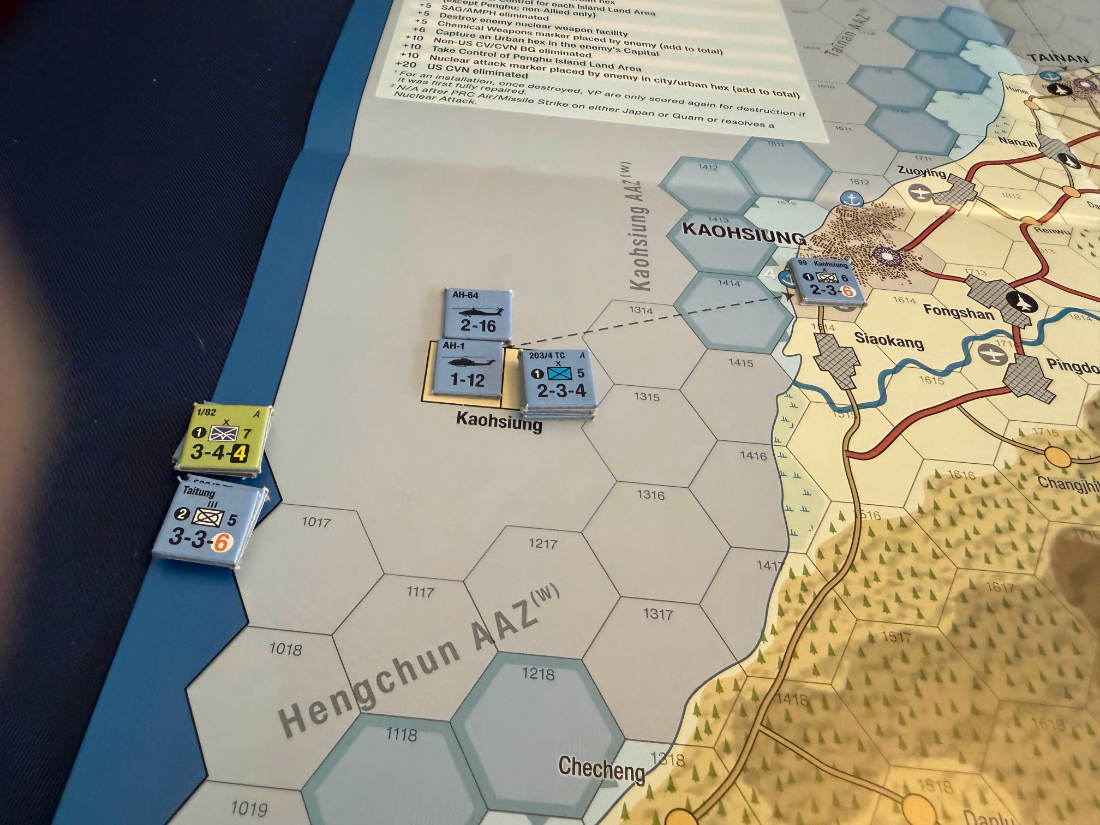
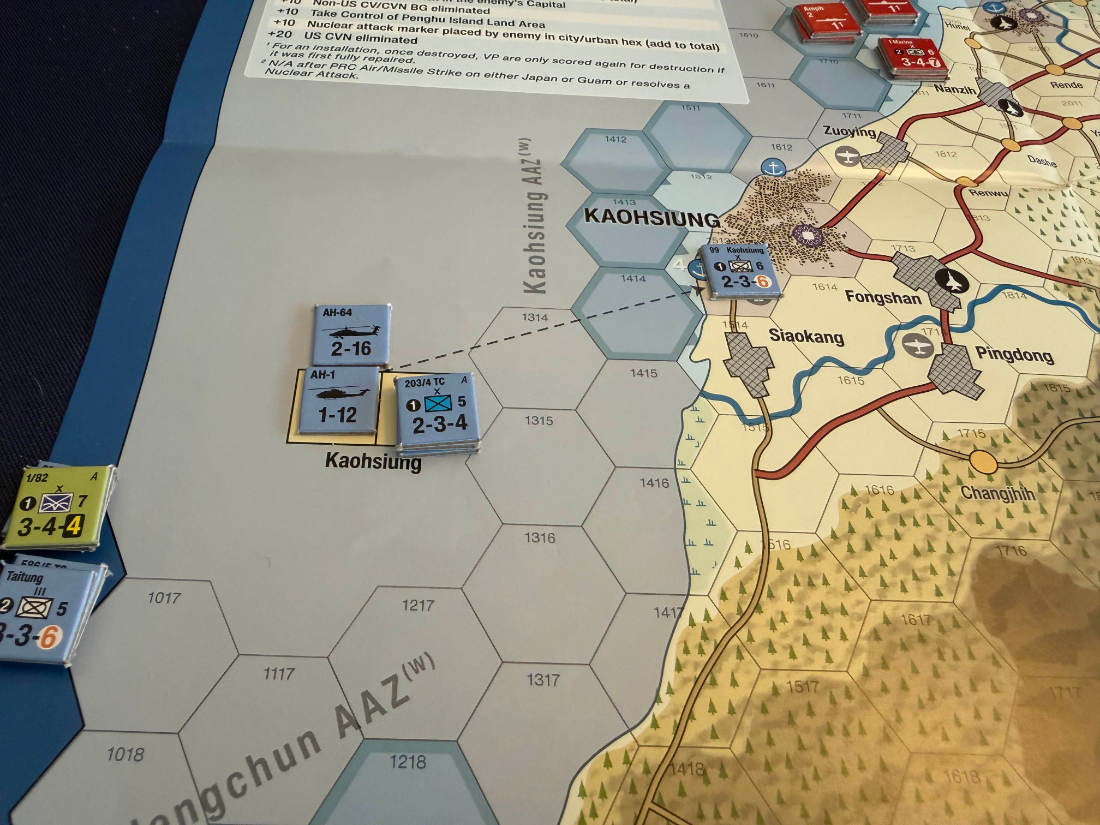
ROC Air and ground forces are in an outlay area representing what is inside of the Kaohsiung hexes. As we move them out we’ll move them out of here and into normal hexes in Taiwan proper.
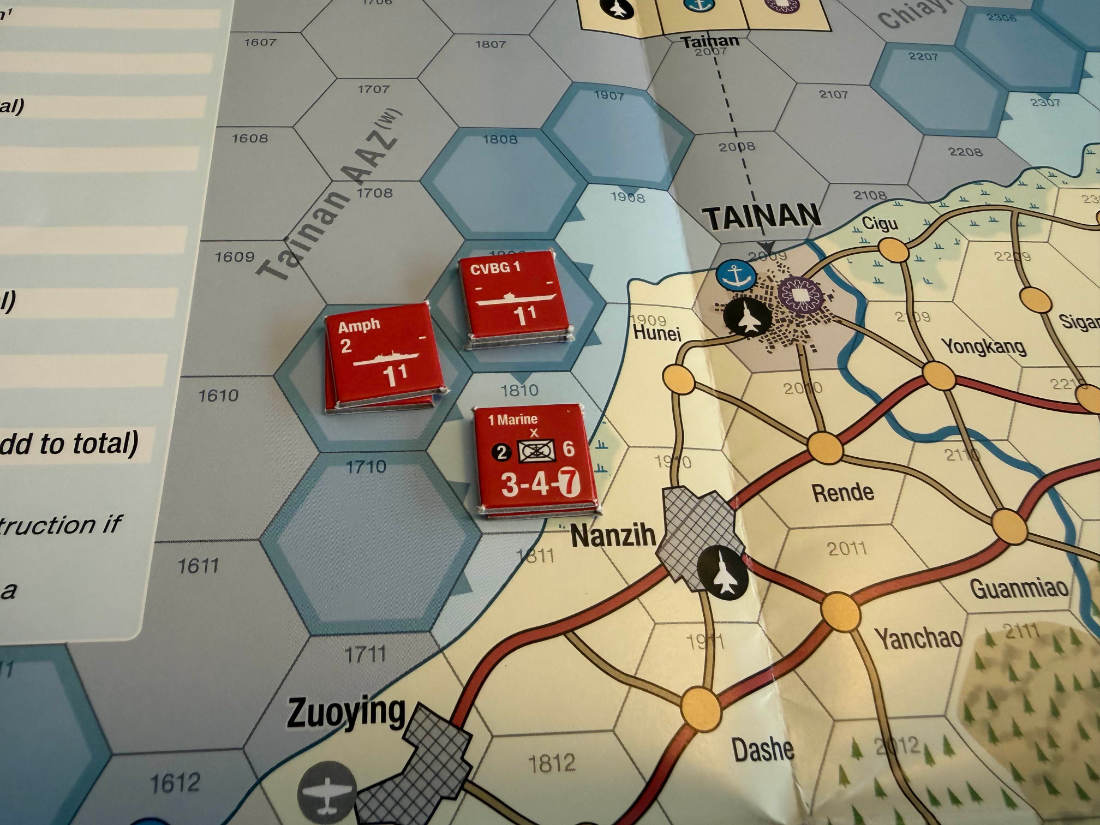
The PRC marines begin their landing during turn 1’s move and combat initiative phase.
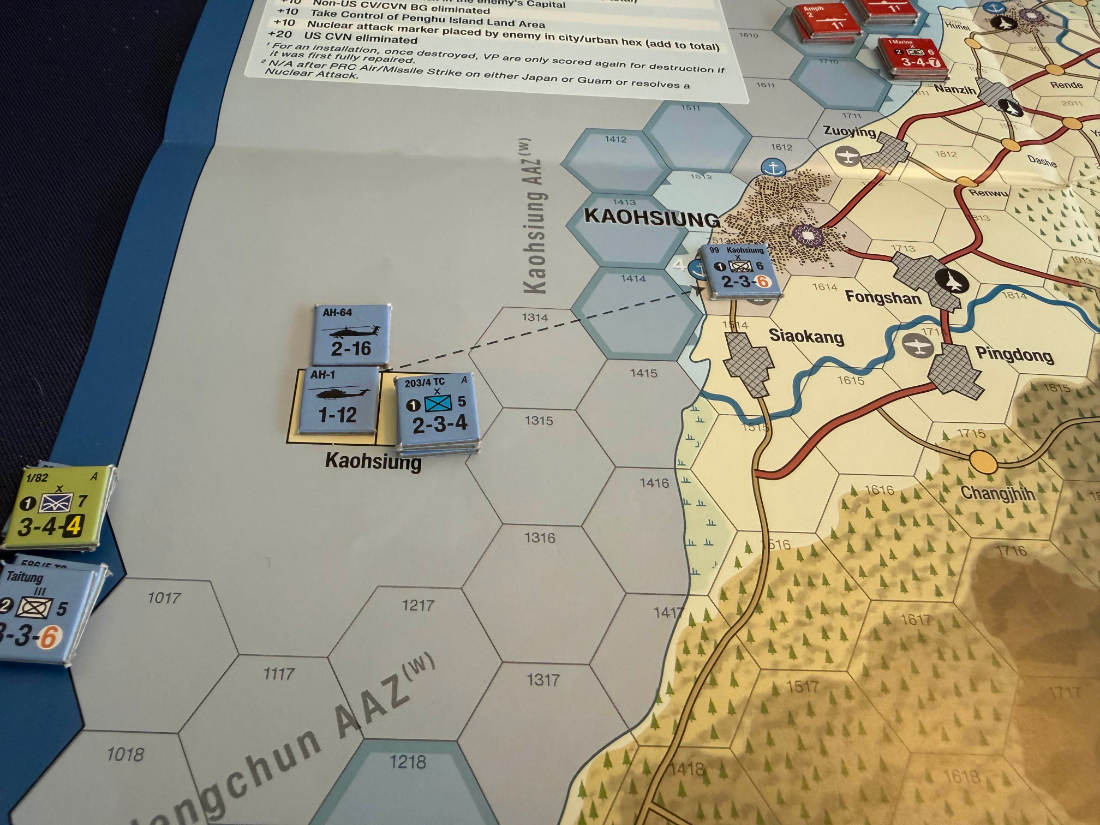
The ROC Special Forces then begin to move during their Elite Reaction Movement Segment.

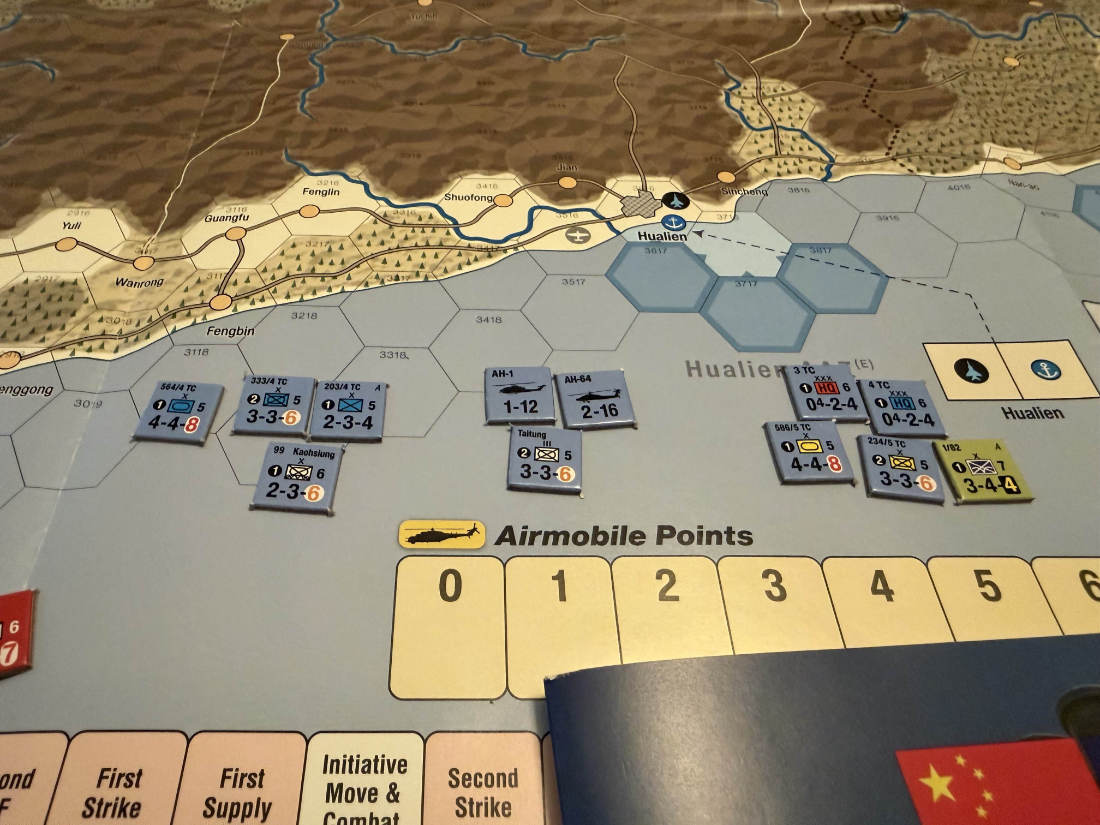
Again, here are the landed PRC marines, they’ve gotten by the low beach defenses I’d simulated being here. Just wanted the game to move along example wise, honestly, likely I’d have pushed more Beach Defense Markers here in a full on game against another human.

Above are the ROC special forces (blue counter with 99 on it) making their way quick like panthers up to take on the PRC beaching marines. They are successful at pushing them back one hex as a result from the CRT.

Now in the normal ROC move and combat phase, which happens AFTER the PRC reaction move and combat, they are able to slide up the highway and support their special forces brethren and push the PRC marines up and over two hexes to hide in Tainan city itself. Now we are very likely to get into some close knife fighting in that city, not a great place to be against hardened marines.
And this is roughly the end of Turn 1 of the introductory scenario. Just a taste of the ebb and flow of a typical standard game turn for this first impression sake.
Advanced Game
I’m not going to dive too far into a full on advanced rules play through; though I do have an open line with Mitchell Land to do an eventual youtube video of a few advanced turn situations. Hoping that will be taped within a few weeks from now.. Mitchell is a great game designer, and friend to the community at large and I look forward to getting to play a little bit of the game with him describing the rules design in-depth as we talk.
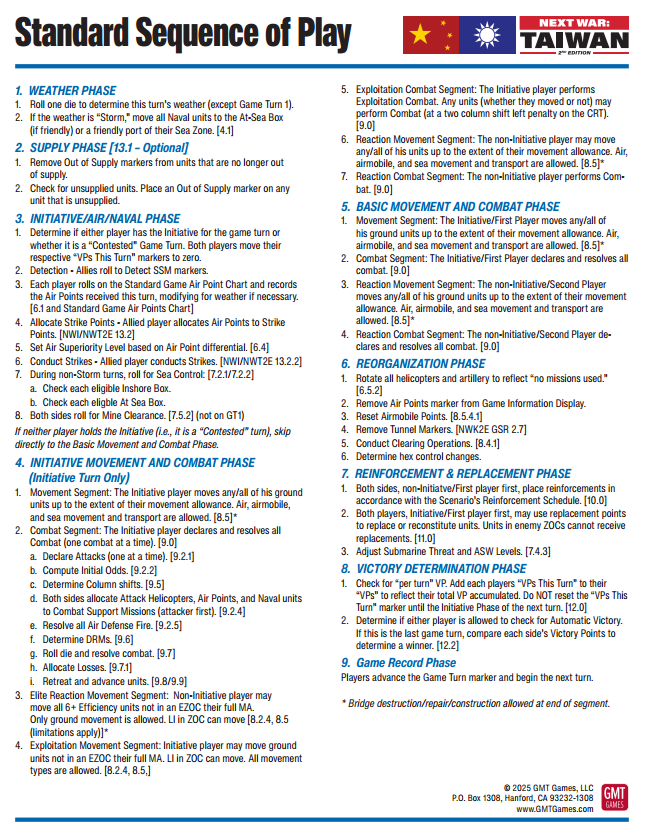
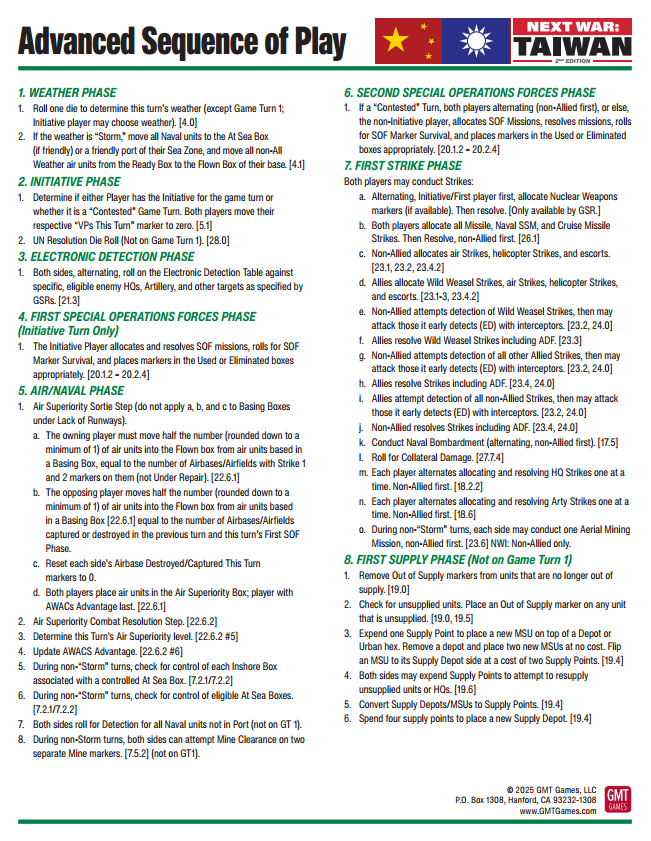
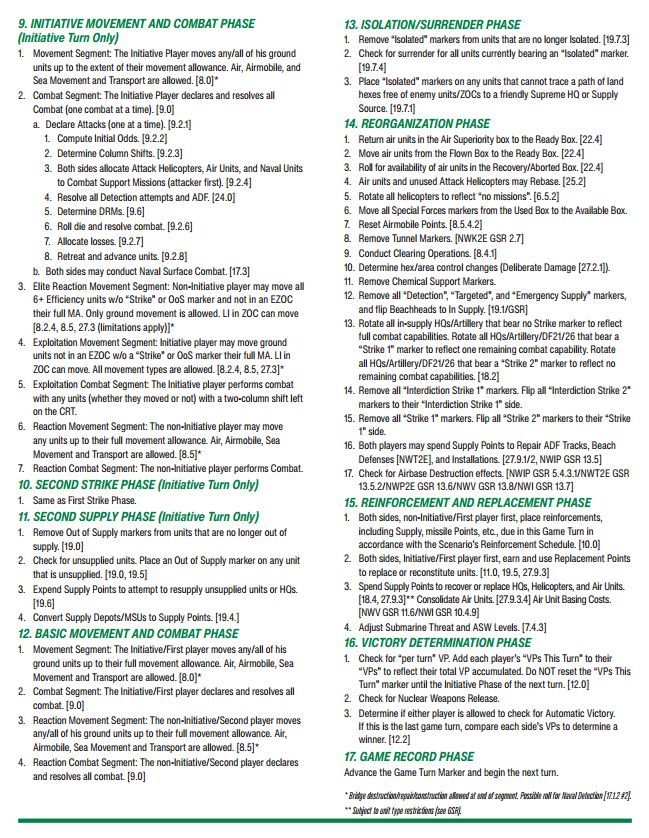
Below is the full-on Advanced SOP to give you a better idea of the depth of the full set of rules. As you can see, it’s quite detailed. I want to avoid saying Complex, as, if you follow the SOP cheat sheets closely, it keys you right into the rules sections to refer to. Time-Consuming, yes, absolutely. Complex? No, as I take that to be befuddling, and so far I’ve not seen much in the way of WTF Moments reviewing the full set of rules.
Strategic Display
The strategic display is only used in the largest of the overall scenarios. I thought at first it was only ever used in the Advanced Game, but I was wrong. The last Standard Game scenario, Red Dragon Rising does say to use the strategic display. What I’m missing a bit is a full example of play where the Strategic Display comes in handy. Its more of an extra set of a few holding boxes, and then also gives you the ability to move between Next War: Taiwan over to Vietnam and or Korea Next Wars as well. Which is an interesting idea, but not seeing much in the way of at least provided scenarios where the strategic display really is needed on the table. A smaller holding box cardboard sheet may have sufficed. Keep in mind, I’ve not played a full on Advanced Scenario yet, so I may just be naive here on its need; at least with the provided scenarios. I could see you coming up with your own scenarios that include the island locations for example.
Conclusion & First Impressions
I really like this game. It’s got a natural ebb and flow feel to it. I like how it differentiates turns when there is clearer initiative vs contested turns; and they feel different in execution. It’s palpable. That is a subtle flow difference that just works ultimately. The best way to describe Next War:Taiwan is that it is detailed, has a nice level of complexity where you want it, but ultimately it’s a traditional phased hex and counter game with slight adjustments based upon modern improvements in mechanics over time. The core still feels classic or traditional in overall method of CRT and table-based rolls execution. Lots baked in here if you want to get to the detail the full on Advanced Game offers. I for one, will be putting in the time to master the Standard Game, and then move eventually on to the Advanced for smaller scenarios at least. I don’t know if as a GM I could personally handle a full sized scenario with the advanced rules, but that’s a me issue, not the games issue. Its got the detail, you just have to be willing to put in the effort looking up the well linked rulings throughout the SOP cheat sheets.
Bravo, on what I think many folks agree is one of the best of the bunch of the series. Next War: Taiwan 2nd Edition is well worth not only the cost, but well worth getting on the table at least a few times in the year with your gaming friends, as well as well worth the investment of time it takes to master the rules. It’s a bit of a chunky game. But in a good way. If you like that type of thing.
Fair Critiques On BGG
A couple BGG reviews stood out among the crowd as a good cross-section of folks’ reaction to this board game. I think they are fair assessments and worth calling out. Even though the first is a low score they hit upon the worth of the standard game rules at its core. I don’t particularly agree with the first assessment on its mushy factor in the advanced rules, but I will say some of it is overkill. I agree on that aspect, but I consider that more of a personal taste than an error in the game design.

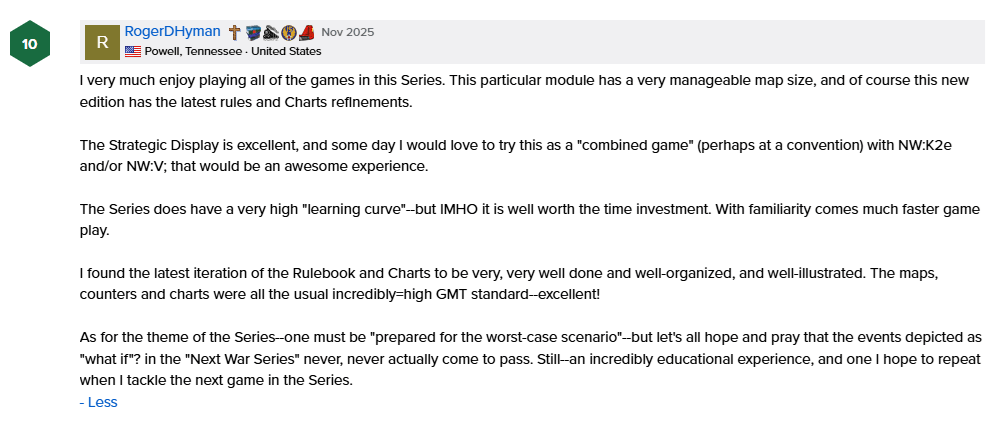
I find myself squarely between these two reviews, or slightly higher. Next War:Taiwan 2nd Edition is a solid game that gives you exactly what you expect; a traditional hex and counter experience with plenty of detail where you may want to add it.
Additional Photos


You can chat about this game in the Modern World section of our discussion forums
Thank you for visiting the Regiment of Strategy Gaming and riding with The Armchair Dragoons.
Rather than list a bunch of social media links, the easiest thing to do is to check out our LinkTree, which connects you to all of our various locales around the web.
You can also support The Armchair Dragoons through our Patreon, and find us at a variety of conventions and other events.
Feel free to talk back to us either in our discussion forum, or in the comments below.


