
 by
by MarcM, 25 May 2026
The question isn’t, “Can you sink your target?”
The question is, “Can you attract enough investors to fund your plans to build a first-generation submarine, hire a crew strong enough to crank it through the water, control it, repair it, navigate it to your target undetected and then destroy the target without sinking yourself?” Oh, and make it home.
click images to enlarge
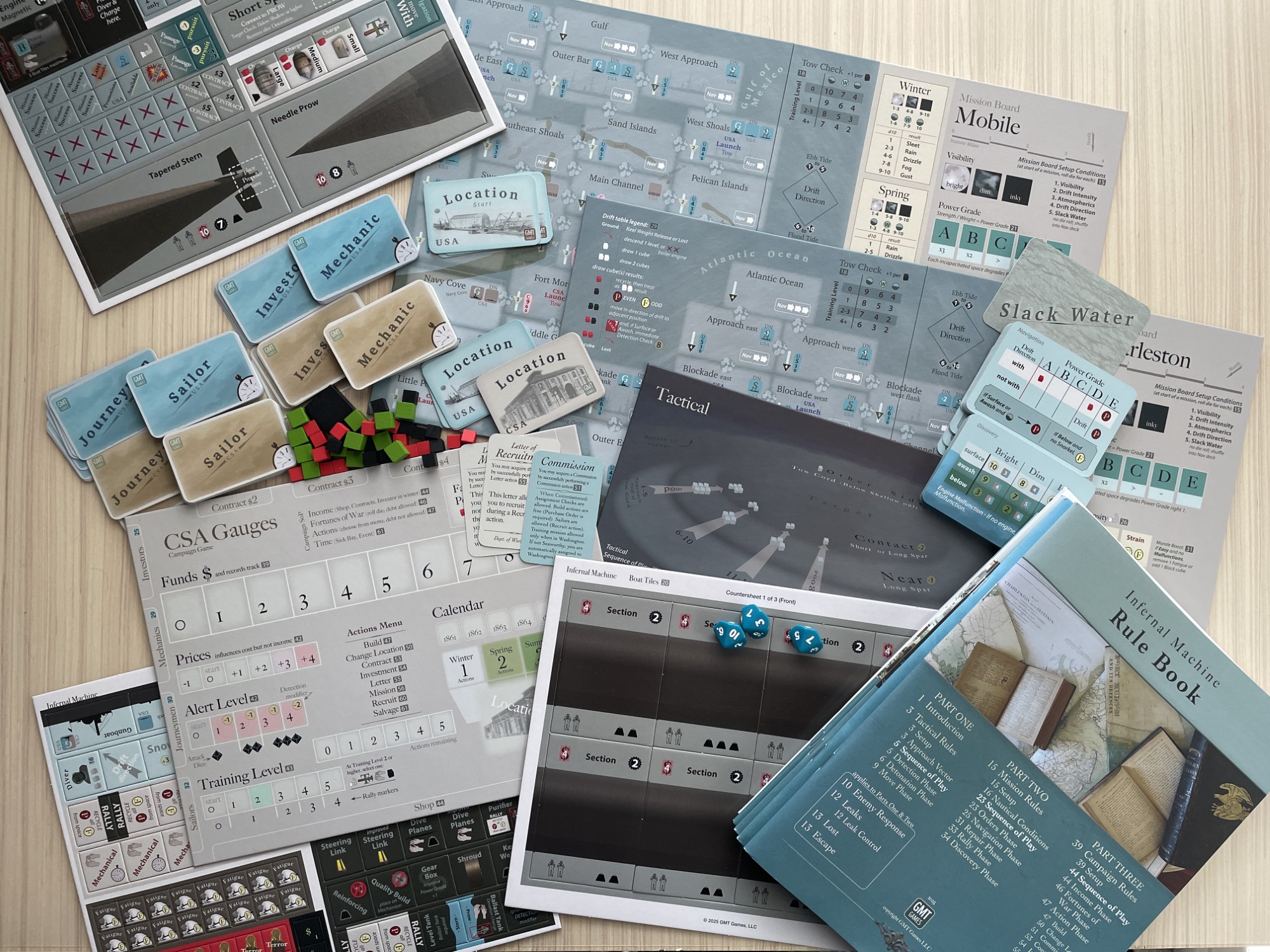
That’s what you need to do to play Infernal Machine from designers Ed Ostermeyer and Jeremy White. Publisher GMT supplied a copy of the new solitaire game, and since I was always fascinated by computer games based on submarine warfare, I was happy to play a board game on the topic. And it’s not often I play a strictly solitaire game, so I was interested to try.
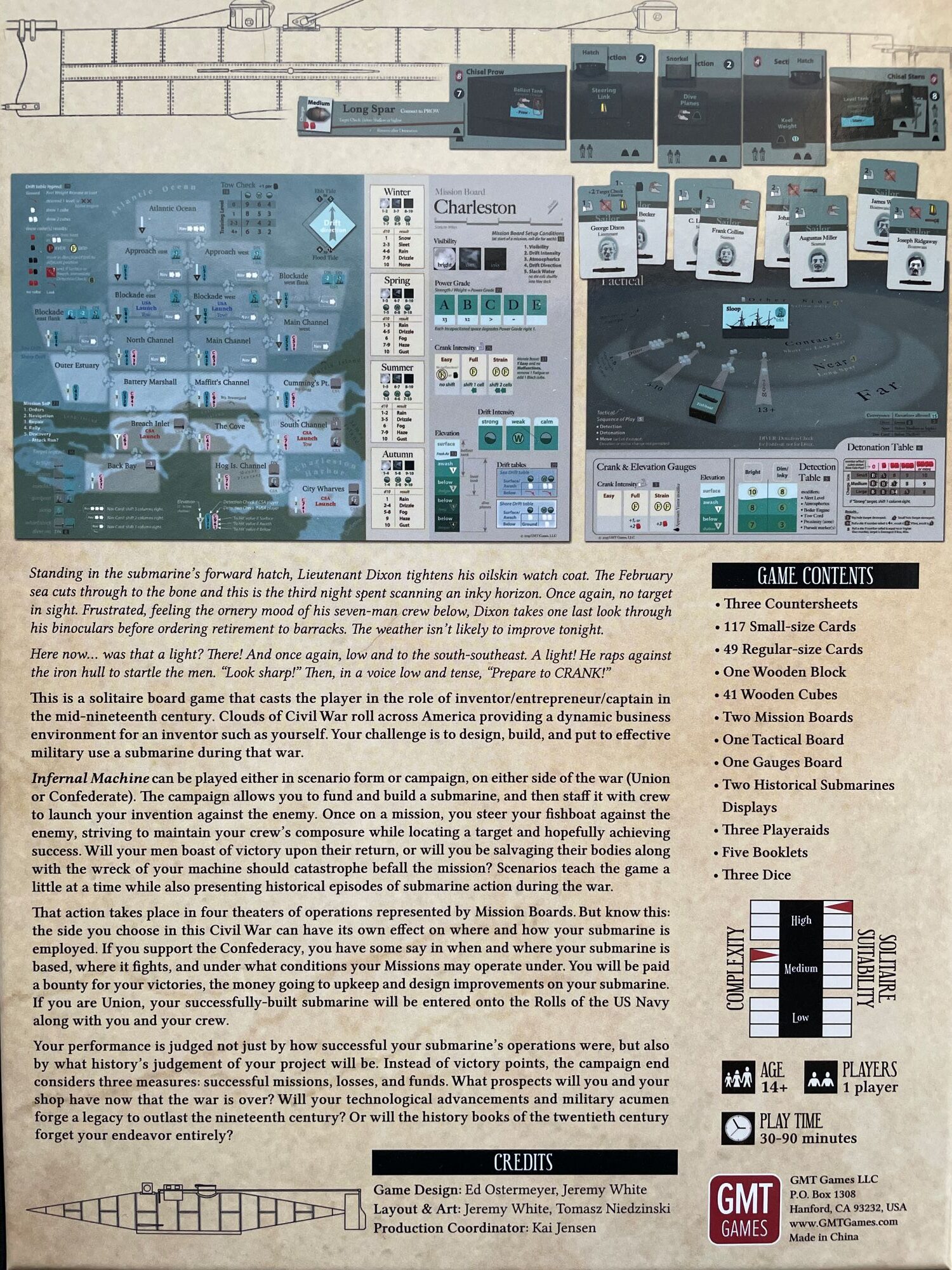
As the box describes, Infernal Machine covers the dawn of submarine warfare during the Civil War. Covering aspects of management and simulation, Infernal Machine lets you build a submarine (hereafter known as a fishboat) and launch it to take on missions. But the designers start you off slowly, doing what you probably want to do anyway: blow stuff up.

You learn to play Infernal Machine through a series of scenarios that teach you subsets of the game’s core mechanics. Backwards. First, you learn tactical play, where you engage a target, then missions where you navigate the boat to the target, and finally campaign play, where you start with no fishboat at all. For me, this gradual learning curve makes a pleasantly complex game very approachable.
Tactical Scenarios

Tactical scenarios are small and fast. Approach the target, avoid (or survive) detection, and attack the target. You’re assigned an Approach Vector by die roll with a more direct approach giving you the best chance. Crew training and how hard you make them (or the engine) power the fishboat can improve your vector, but a higher Crank Intensity means Fatigue and more red Fate Cubes. Fatigue has a limited effect in the intro scenarios, but more red cubes in your Fate Pool aren’t good. Here It mean less chance of destroying the target. Later, it could mean more Panic and losing control of the boat.
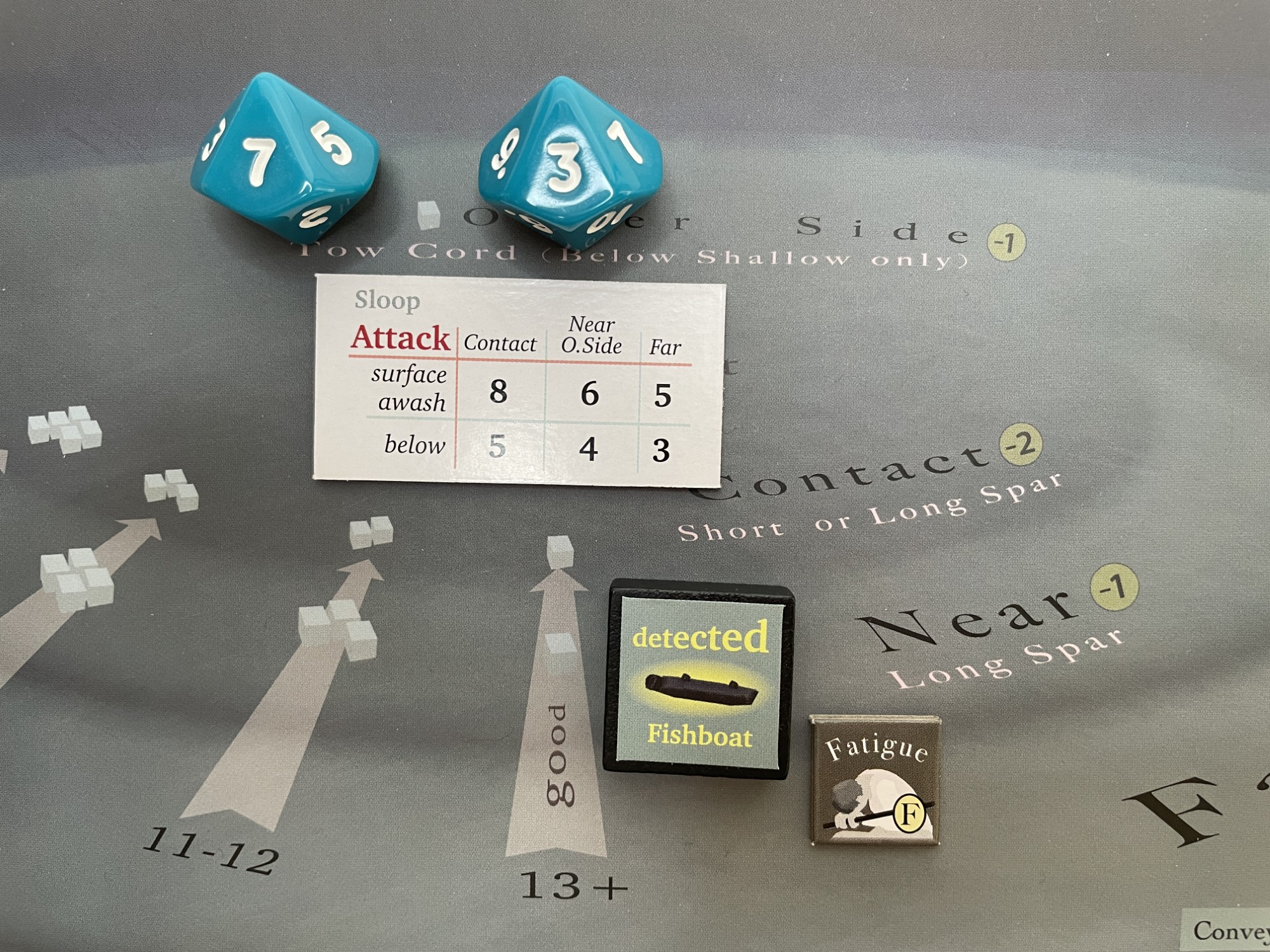
Detection by the enemy is affected by factors like their Alert Level and your proximity and depth, as well as lighting conditions. Once detected, the next detection means they attack. Here, enemy Alert Level might mean more attack dice and more chances for a hit.
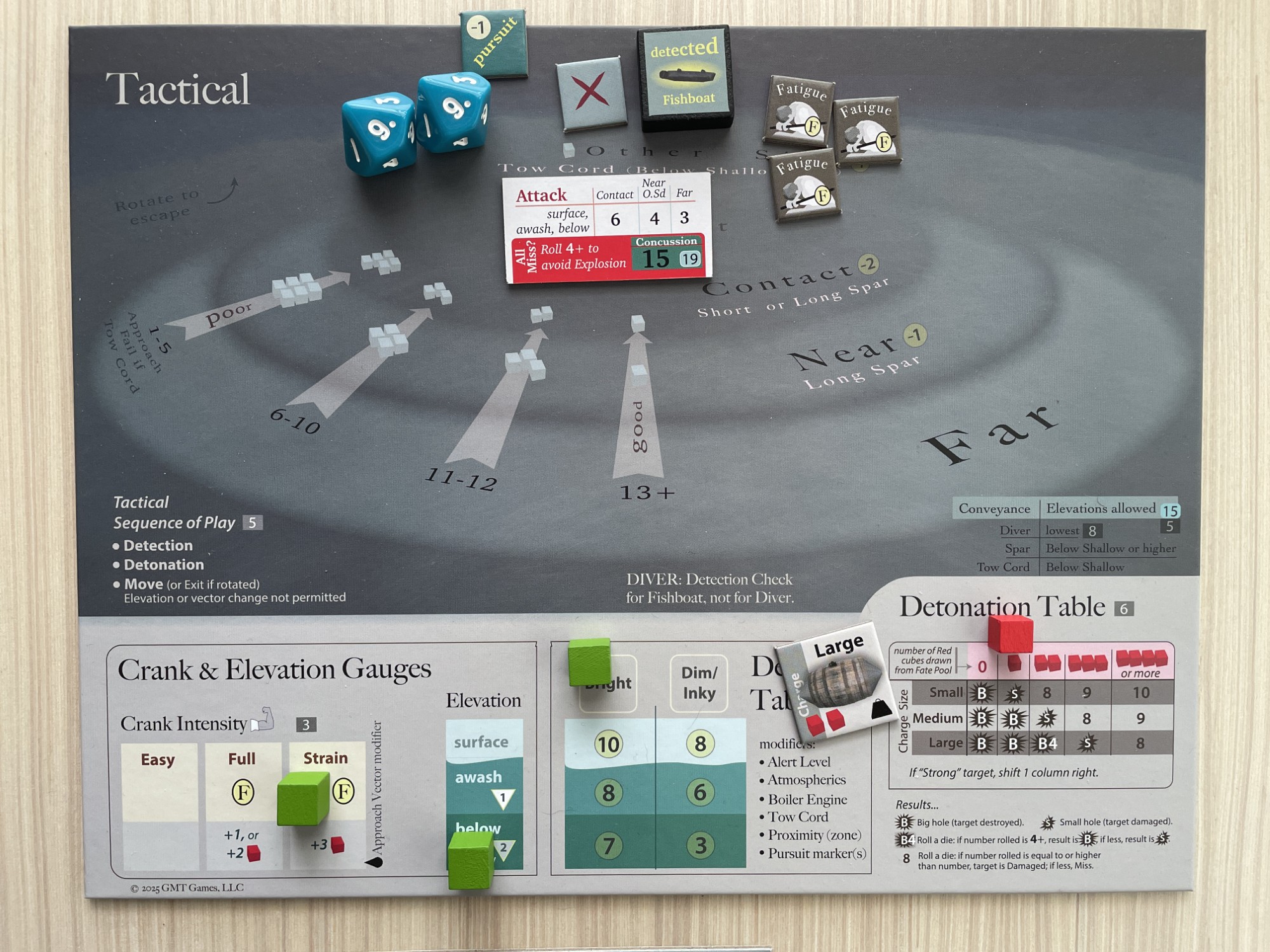
If you survive, you can attack at different ranges, depending on how you’re deploying the charge – on a spar or tow rope, or if you have a diver who walks along the bottom and manually places the charge. You get one attempt to destroy or damage the target. A better approach, fewer red cubes in your Fate Pool, and of course a bigger charge, give you a better chance of damage. Then the concussion from the charge might sink you.
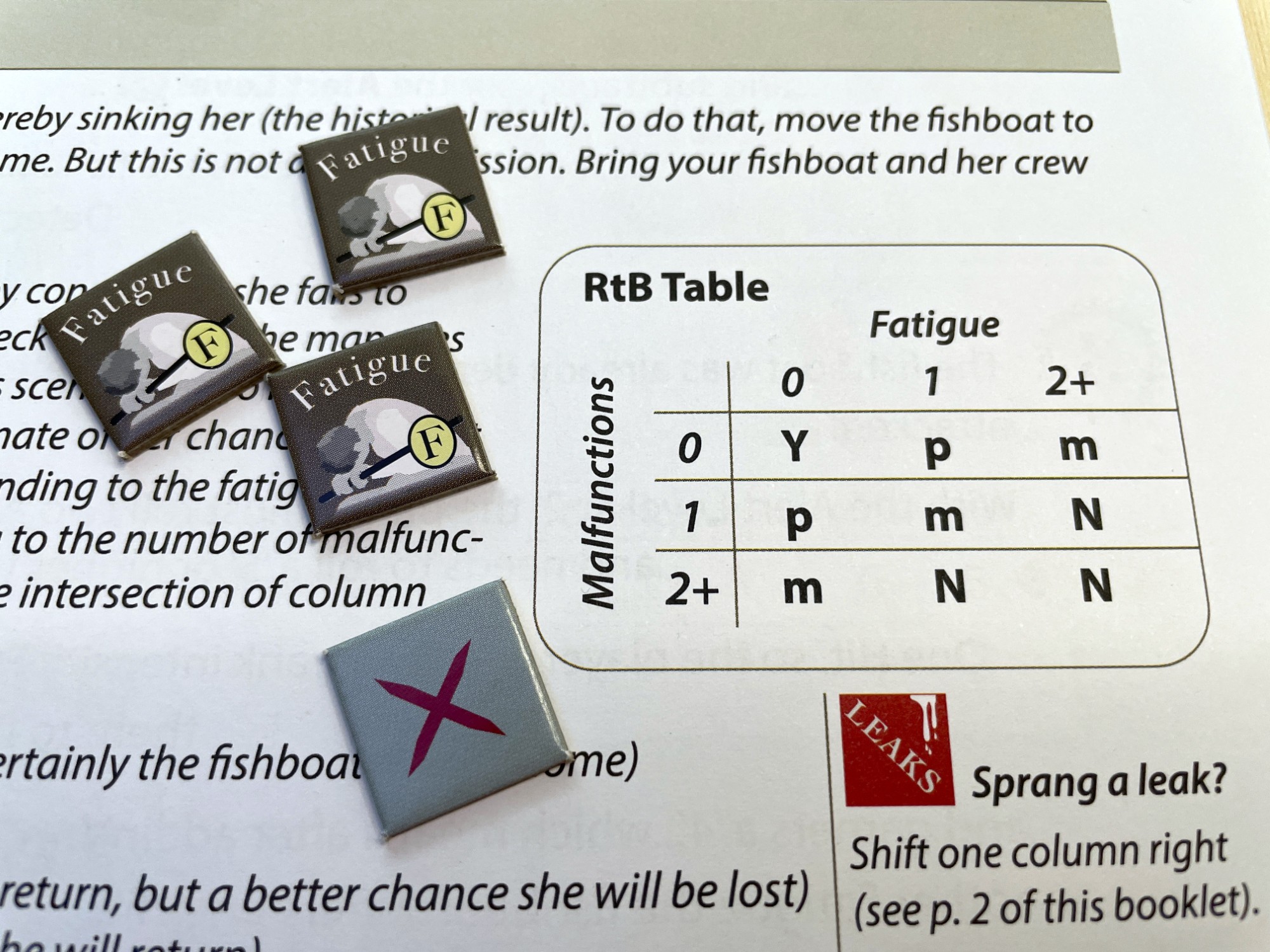
Once these tactical scenarios end, the Fatigue or damage you took determines if your crew made it back alive.
Mission Scenarios

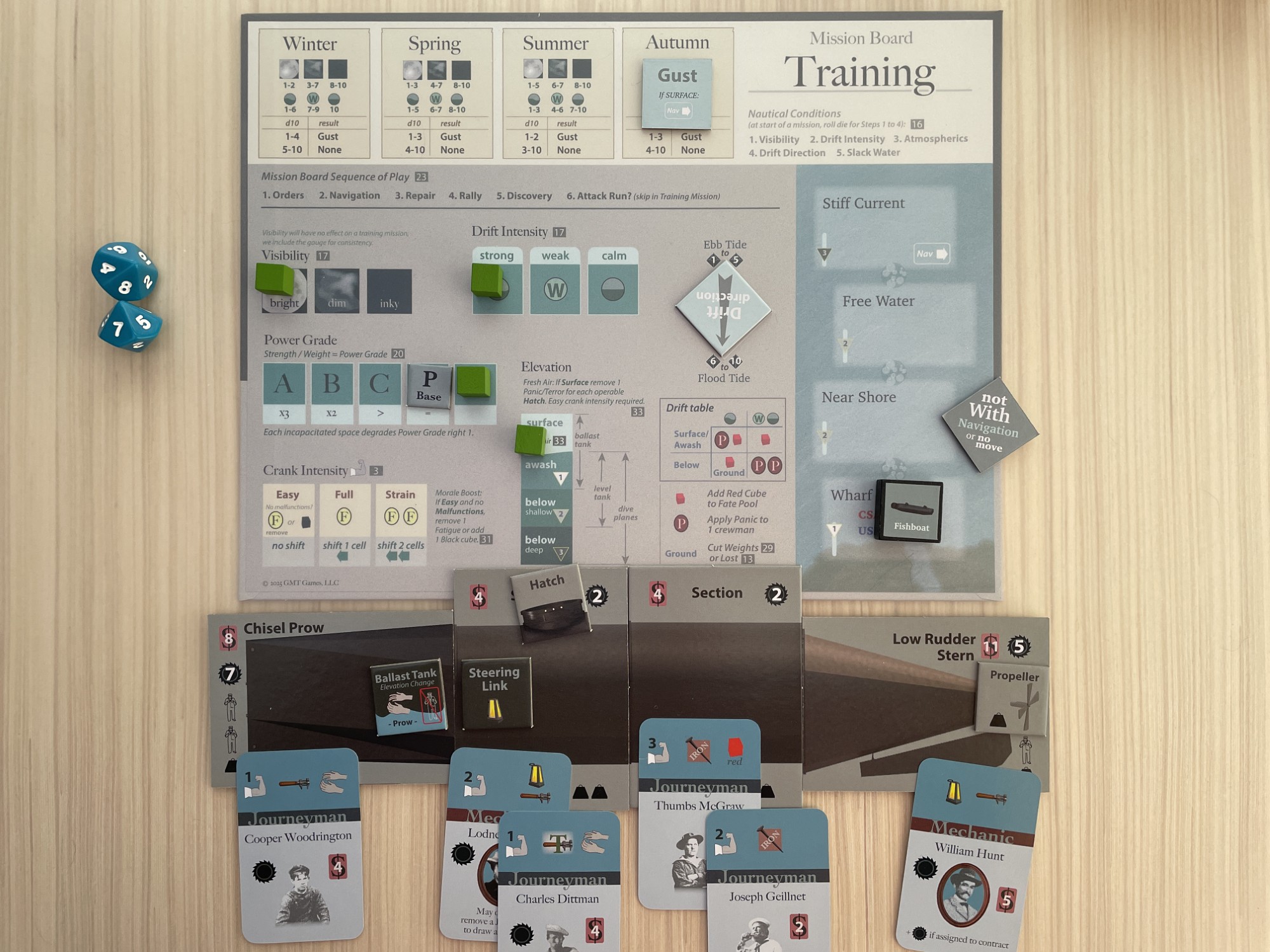
Missions add moving the boat, diving, surfacing, and managing your crew. And there are environmental conditions, like current, rain, and wind, to deal with. You start on a training map, but later scenarios move you to Charleston, Richmond, and New Orleans.
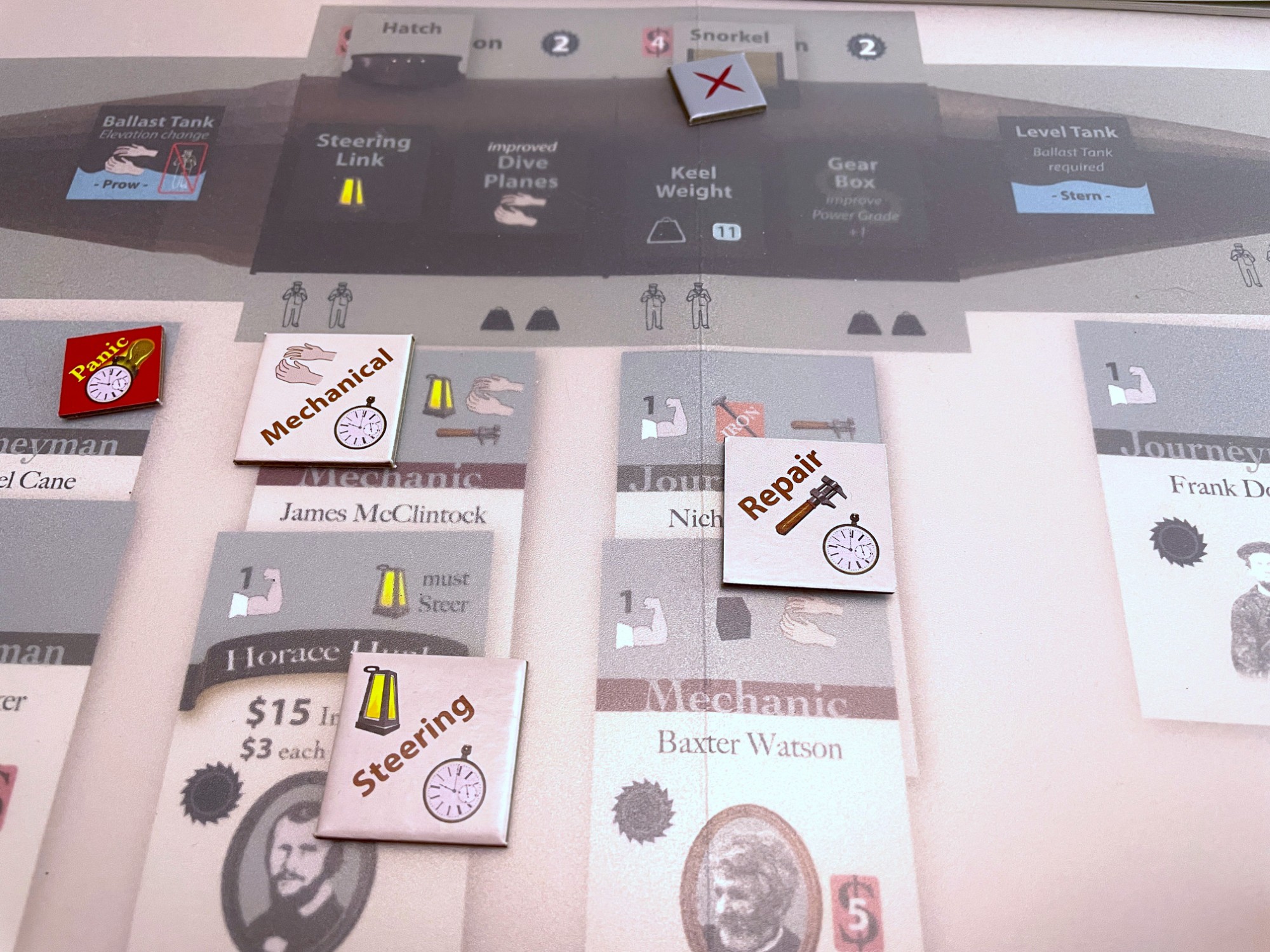
Start by giving orders to your crew to move the fishboat.
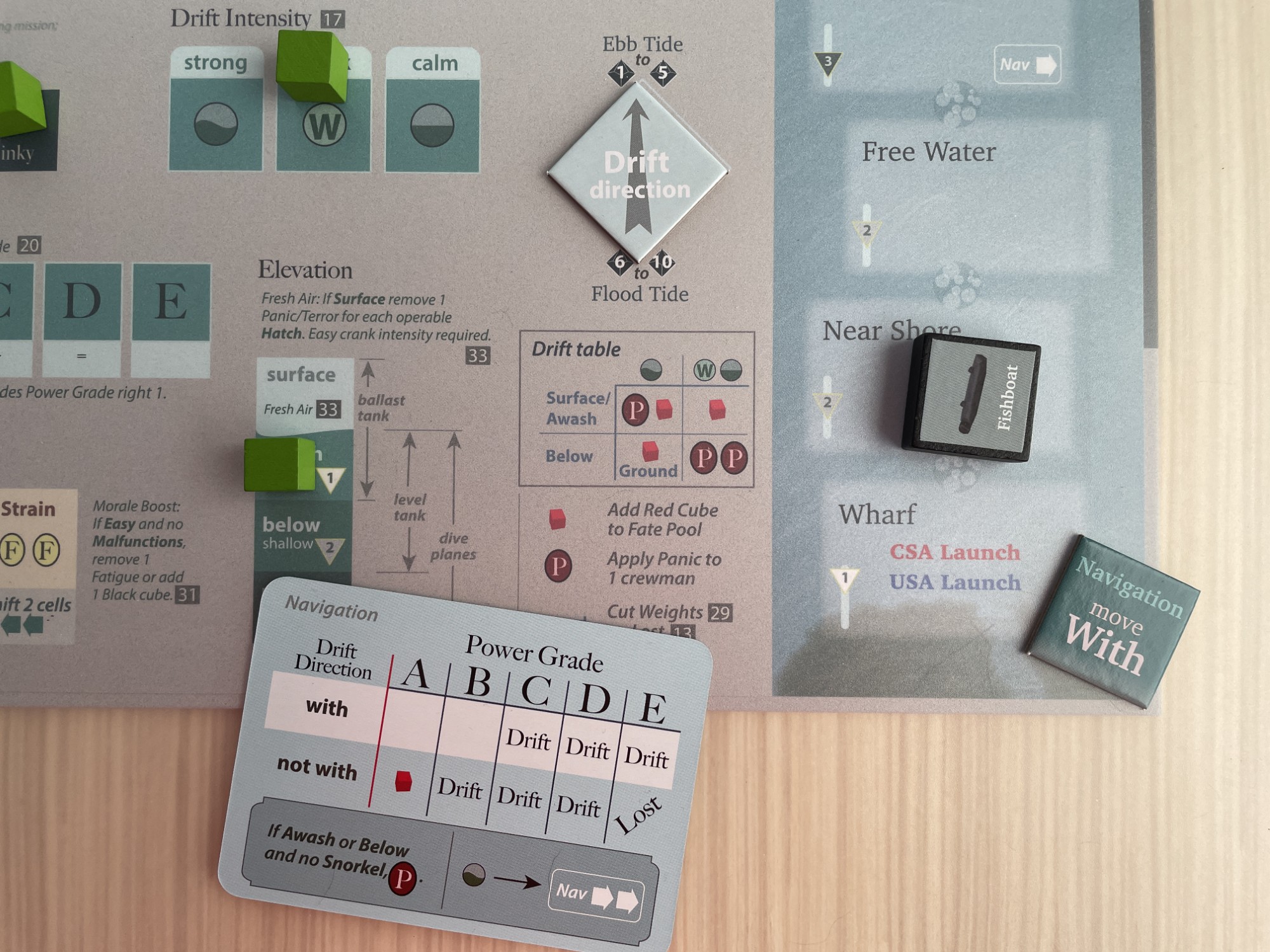
A Navigation Card might reduce your boat’s power, give you a red Fate cube, or create Panic that could make crewmen incapable of operating the boat. Or you might lose the boat entirely. You can improve results by increasing Crank Intensity, but you take on Fatigue that could eventually become Panic. Give repair orders for leaks and malfunctions. Rally your crew or surface to remove Panic.
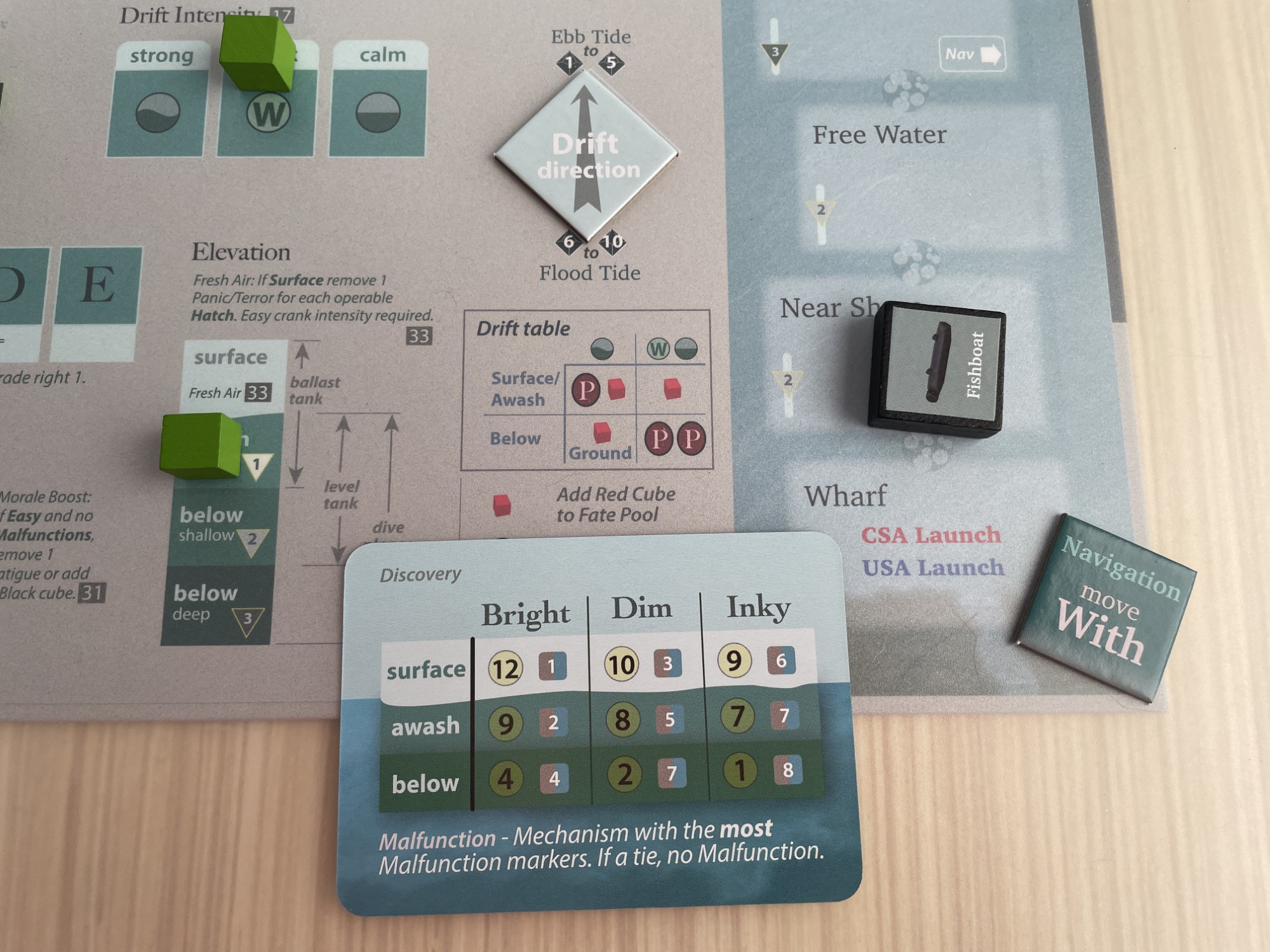
A Discovery Card tells you if you’ve been detected, if you take more Malfunctions, if conditions change and if your target is in sight. If it is, move to the Tactical Board and make use of your training. If not, go back to the Orders phase.
The Campaign Game
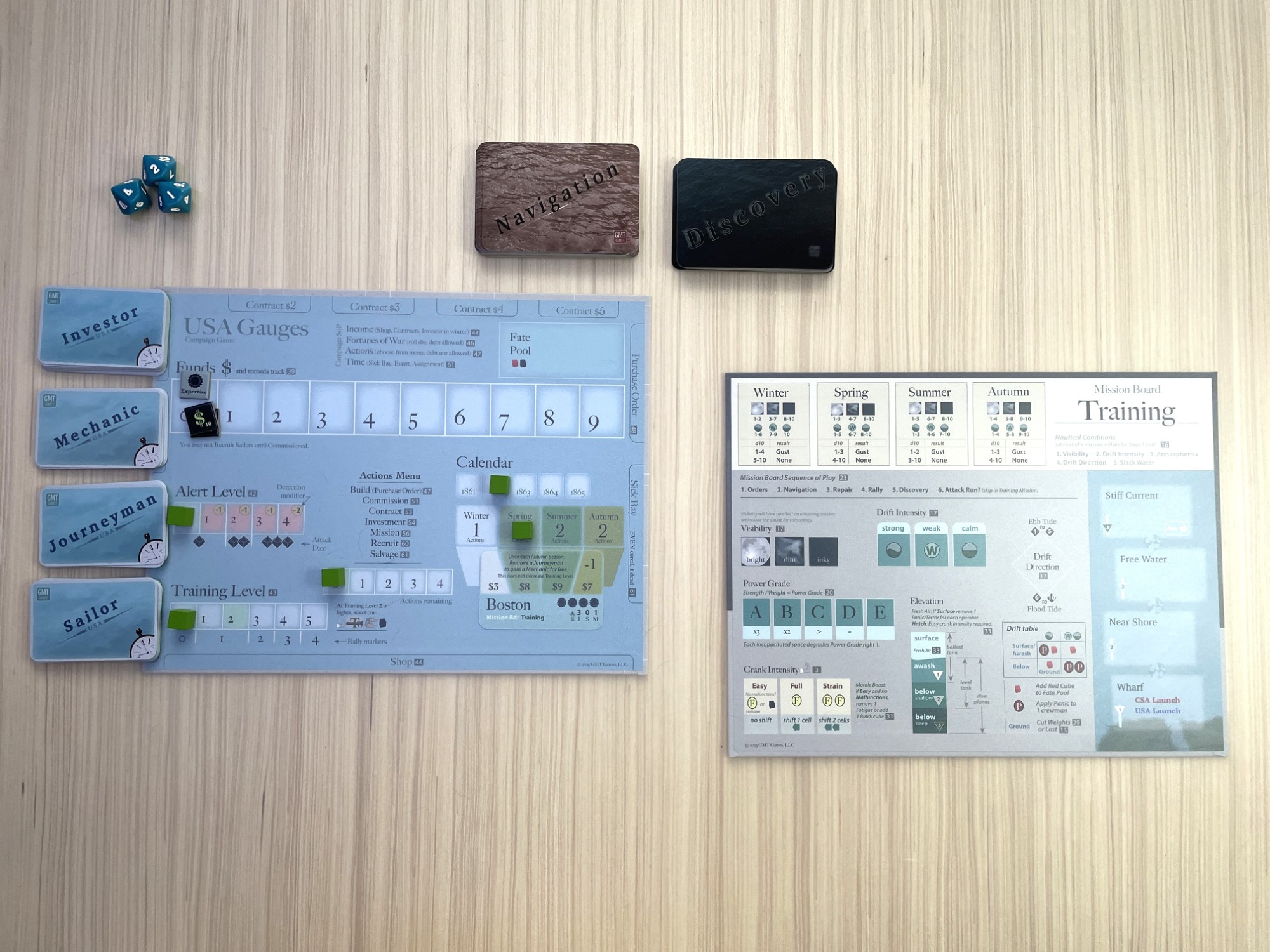
Starting with a mini campaign for training, you truly start playing Infernal Machine. Put together all you’ve learned and add more.

Pick an investor from three options out of the Investor Deck for startup cash and possibly Expertise that you need to build or a cube for your Fate Pool. Then start the turns, represented by seasons.

At the start of each turn, depending on the season and location, you might get Income from your shop. Later, you might have contracts that provide money.

Then the Fortunes of War might give you a boost. Or not.
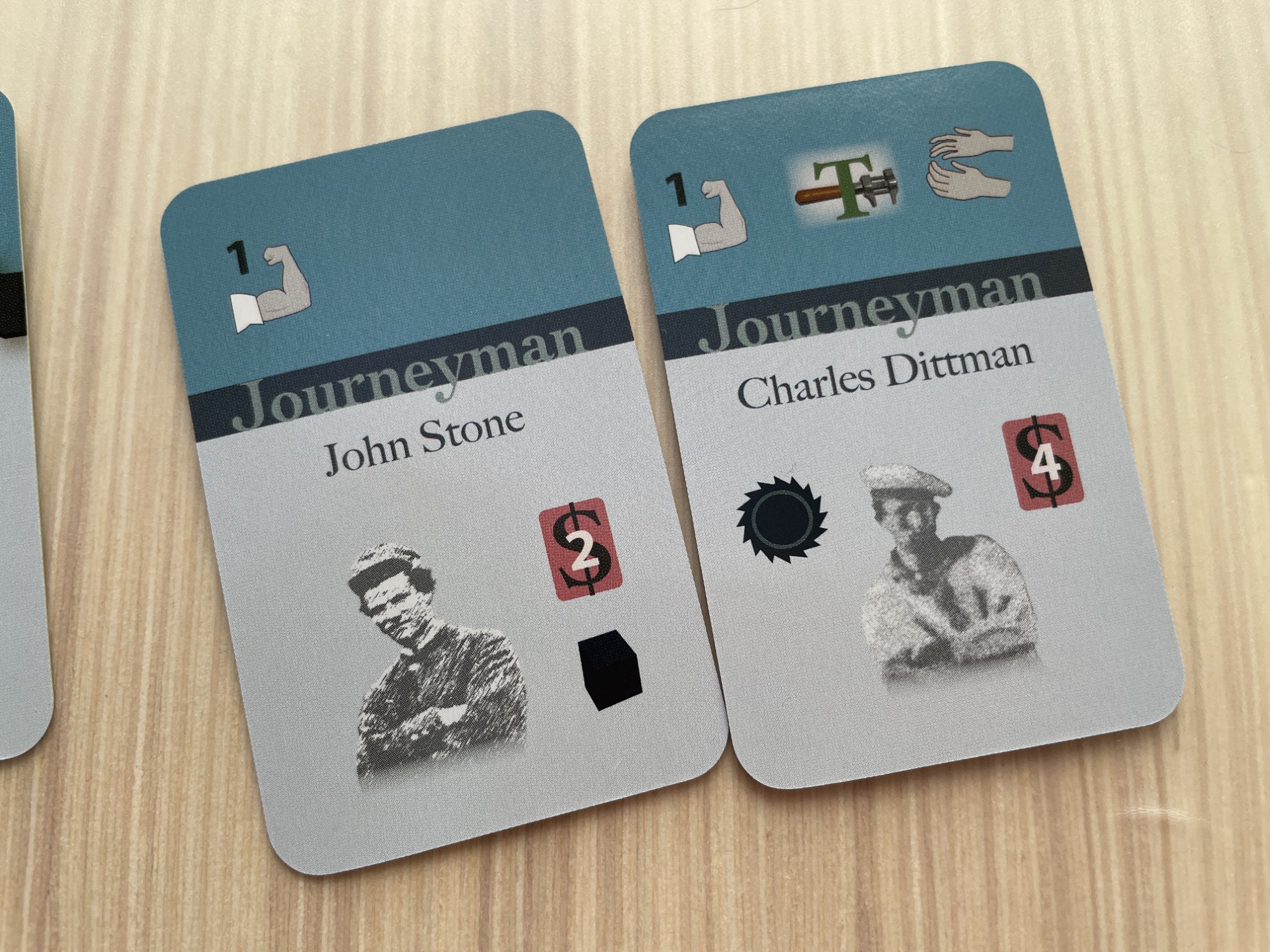
Based on your location, you can take one or two Actions, like recruiting crew.
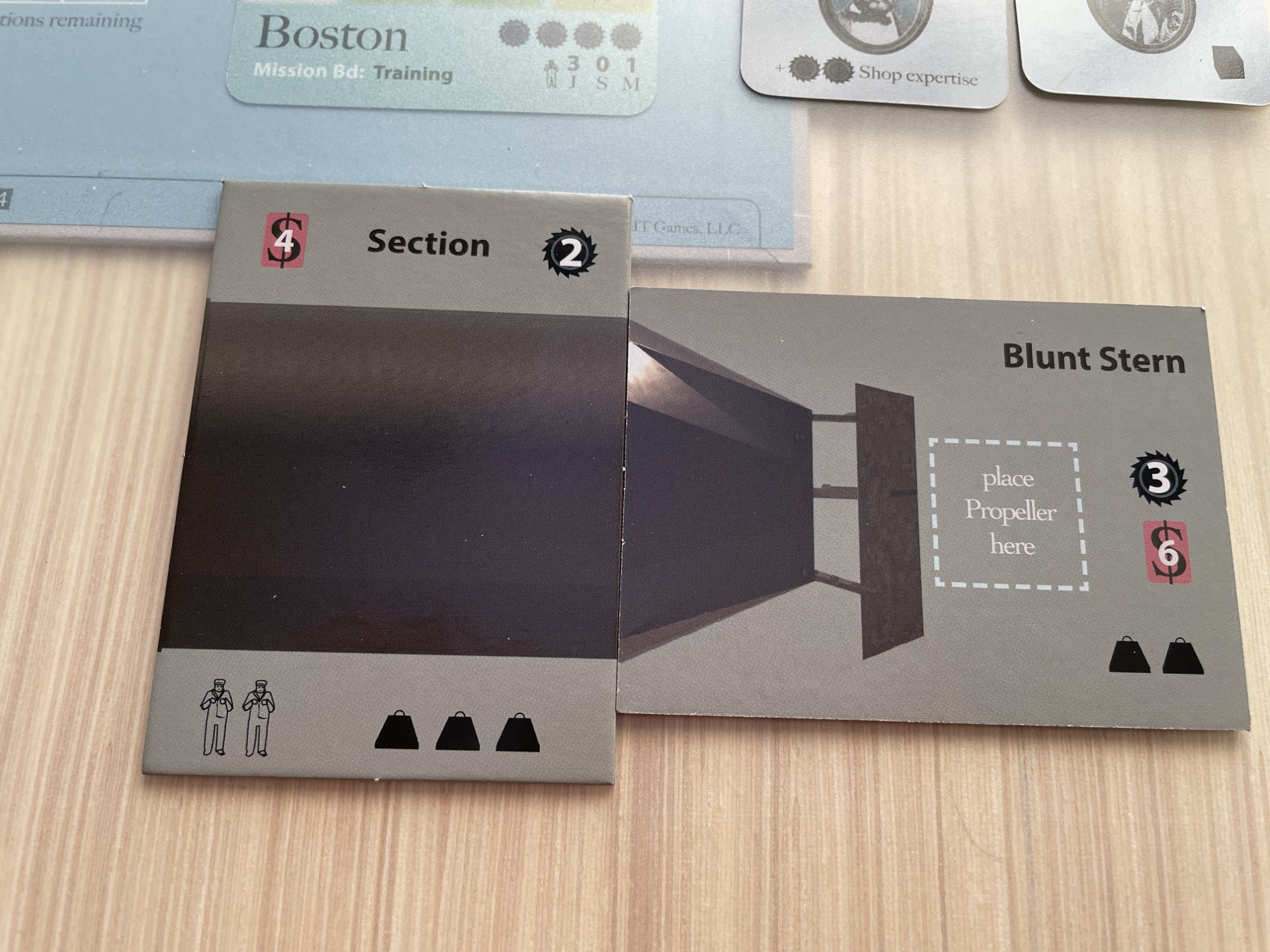
Or buying and assembling fishboat components or attempting to raise more money. You can pick up a contract to earn money, and eventually, accept missions, salvage a lost fishboat, and apply for a commission from the USA Navy or a letter of recruitment from the CSA. At the end of the turn, check on any people in Sick Bay as a result of a mission gone wrong or epidemic. Check for Events (a boost or setback), and possibly assignments from the Navy.

Once you collect enough money and expertise, build your fishboat. You’ve got options for prow and stern designs (weight and crew spaces matter), and you can add an engine or rely on people power. Crew it with your people, making sure they have the necessary skills, and, if you don’t have an engine, the strength to give it the best Power Grade possible. Now you can pull out a Location board and take on a mission and then a tactical action. See? Backwards. But clever.
Final Thoughts
Top of mind for me, Infernal Machine illustrates to me just how risky those first submarines were. How incredible it was that people had the courage to crew them. And step outside of them. The designer notes interspersed throughout the rules add more depth. For those revelations alone, I love it. Any time a game makes me stop and try to imagine what it was like to “be there” it’s time well spent.
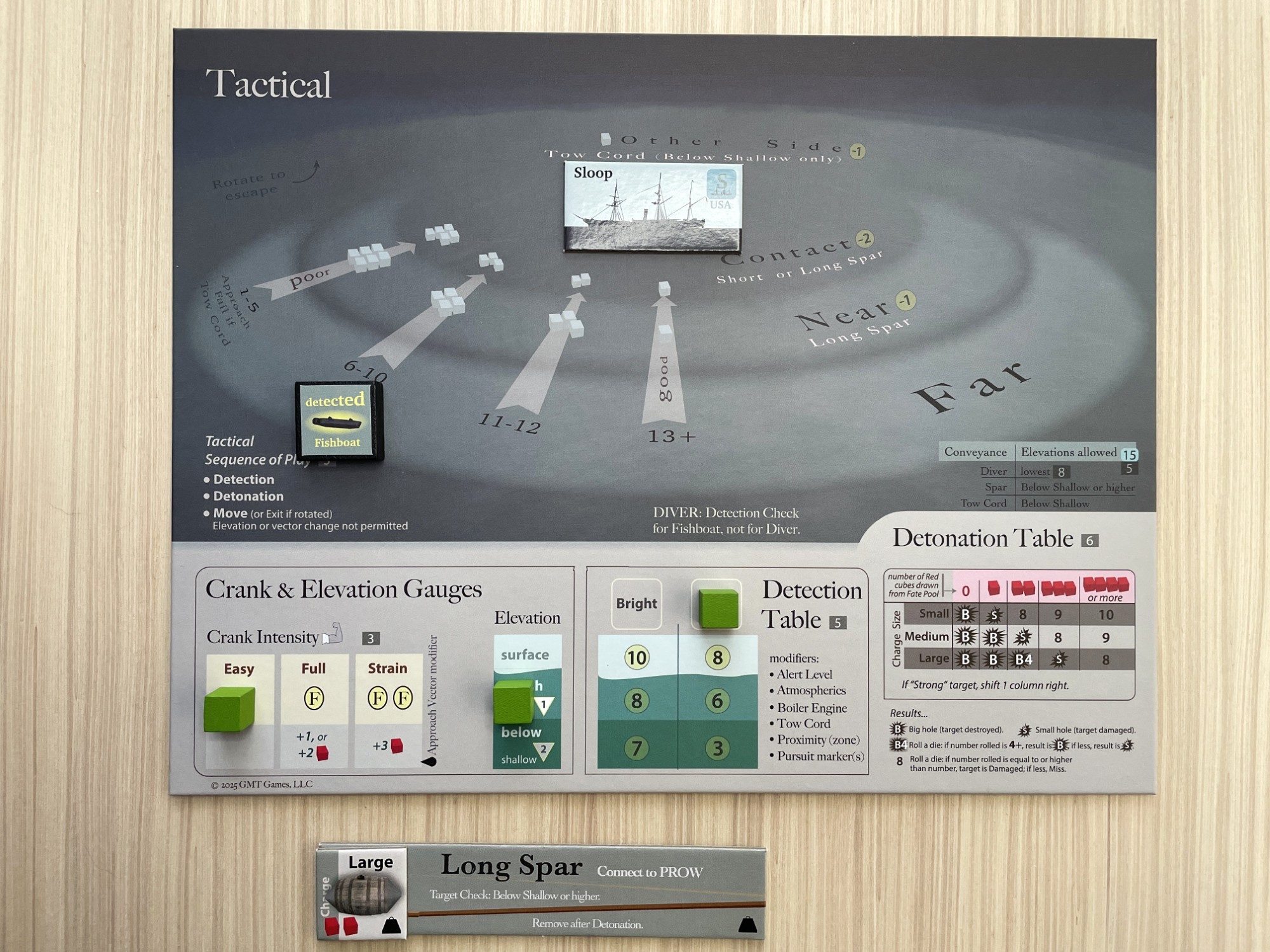
As far as gameplay, there’s a lot to take in by the time you get to the campaign game. But dividing the training into tactical, mission and campaign games got me invested quickly and the details made the game feel more realistic. Since you’re not playing against an opponent, I think they’re necessary to add variability. Plus, the players aides do a good job of referencing the rules. And I always appreciate an index. There are several booklets you need to use during the campaign game, but the cross references are done well. It all worked well for me and made the gameplay enjoyable
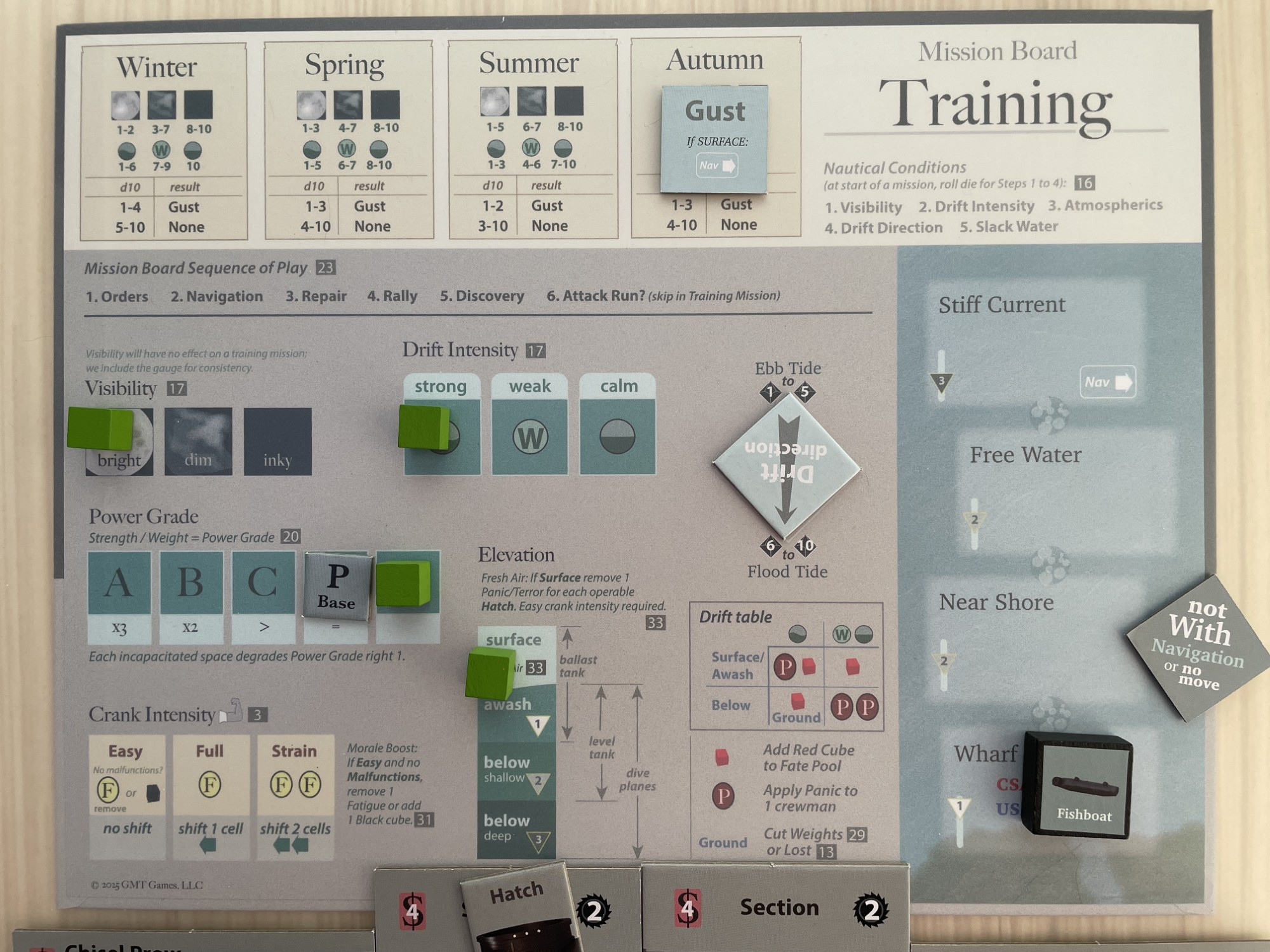
Those starter scenarios were rewarding. I lost my sub more times than not, through the concussion effects, grounding on the bottom of a channel and just by not making it back. And it was a neat exercise in “now what” when the crew was too busy to actually move the boat. Now roll all that forward into the campaign, where you’ve got limited funds and limited crew. Lost the boat? You also lost an experienced crew and have to start over

Once you get into the campaign, to a large degree you’re out of the water and in the shop. There’s definitely some management simulation going on. And it takes a fair amount of management to get to the point of launching even your first underpowered, overweight fishboat. If you’re just interested in missions and attacking targets, you can do that, but it’s going to be limiting and you’re missing at least half of the game. For me, it was a good balance. I like management sims to a point, and this one lets me manage to the point that I send a submarine out into the waters, hoping the current works for me, hoping my boat has enough power to deal with them, hoping I can submerge before enemy eyes spot me, and on and on…until I hope I make it back.
You can chat about this game in the Age of Gunpowder section of our discussion forums
Thank you for visiting the Regiment of Strategy Gaming and riding with The Armchair Dragoons.
Rather than list a bunch of social media links, the easiest thing to do is to check out our LinkTree, which connects you to all of our various locales around the web.
You can also support The Armchair Dragoons through our Patreon, and find us at a variety of conventions and other events.
Feel free to talk back to us either in our discussion forum, or in the comments below.


